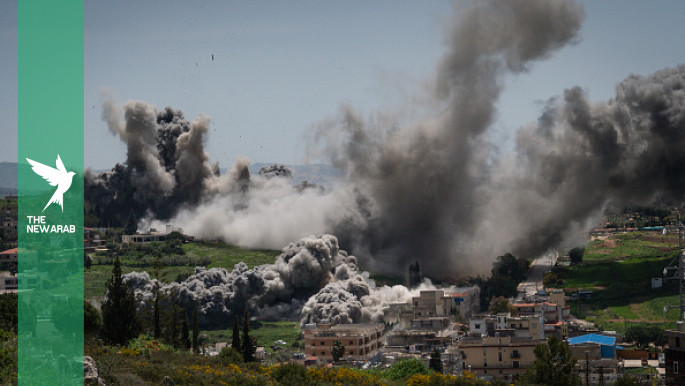
The Israeli army said on Monday, 20 April, it is maintaining positions in southern Lebanon during the ceasefire, claiming it is confronting Hezbollah activities. [Getty]
As the ceasefire in Lebanon enters its fifth day, the Israeli army is expanding into border villages in the southern parts of the country, using the agreement to extend control over areas it did not occupy before the supposed truce took effect at midnight last Thursday-Friday.
At the same time, the Israelis are increasing the scale of systematic destruction and forced displacement under a scorched-earth policy aimed at creating a buffer zone.
The Israeli army said on Monday, 20 April, it is maintaining positions in southern Lebanon during the ceasefire, claiming it is confronting Hezbollah activities.
It urged residents not to move south of the line of 21 villages and their surroundings: Mazraat Bayt al-Sayyad, Majdal Zoun, Zibqin, Yater, Srifa, Haddatha, Beit Yahoun, Shaqra, Majdal Selm, Qabrikha, Froun, Zawtar al-Gharbiya, Yohmor al-Shaqif, Arnoun, Deir Mimas, Marjayoun, Ibl al-Saqi, al-Mari, Kfarchouba, Ain Qinia and Ain Ata.
It also barred access to the Litani River area and the valleys of al-Salhani and al-Slouqi. Residents were urged not to cross into or return to around 55 villages, including al-Bayyada, Shama, Tayr Harfa, Abu Shash, al-Jibbayn, al-Naqoura, Matmoura, Yarin, Umm al-Touta, al-Zalloutiya, Bustan, Shihin, Marwahin, Ramieh, Beit Lif, Salhana, Aita al-Shaab, Hnin, al-Tiri, Rashaf, Yaroun, Maroun al-Ras, Bint Jbeil, Aitaroun, Blida, Mhaibib, Mais al-Jabal, Qalaat Dabba, Houla, Markaba, Tallousa, Bani Hayyan, Rabb Thalathin, Adaisseh–Marjayoun, Kfarkela, al-Taybeh, Deir Siryan, Qantara, Aalman, Adshit al-Qusayr, al-Qusayr, Maisat, Labouneh, Iskandarouna, Shamaa, Jijim, al-Dhahira, Kherbet al-Kseif, Khiam, Slaib, Mazraat Sarda and al-Majidiyeh.
Occupation over Lebanese border villages
Military sources told The New Arab that “Israeli forces have expanded their occupation of border villages since the ceasefire took effect at midnight on 16-17 April.”
The sources noted that “Israel had controlled around 40 border towns and villages, and that the number has now exceeded 50, which they have published on their maps. Daily demolition operations and ongoing incursions make it difficult to determine deployment and presence. Forces sometimes carry out explosions and withdraw and, at other times, remain in place.”
“Israeli control takes several forms. These include full occupation, as in Tallousa, Bani Hayyan, Rabb Thalathin, Houla, Mais al-Jabal and Markaba, meaning forces are stationed inside the villages,” the sources added.
Another form of control, according to the sources, is by “fire, preventing civilians from approaching certain areas, particularly on the outskirts of several villages. Many of these are predominantly Christian, such as Ain Ebel and Debel in the Bint Jbeil district, within what the sources described as an imposed siege.”
They added that “predominantly Christian villages along the border are not fully occupied but remain under Israeli control, including Debel, Ain Ebel, Aalma al-Shaab and Rmeish.”
This means “forces are positioned around them, complicating access and hindering the delivery of aid and essential supplies.”
“The same applies to predominantly Druze villages, such as Al-Majidiyeh in the Hasbaya district, where Israeli forces control the outskirts,” the sources concluded.
Israeli land and maritime ambitions in south Lebanon
Brigadier General Akram Srewi, an expert in military affairs and international law, told The New Arab that Israelis have circulated several maps, some of which contain significant inaccuracies.
One map includes villages such as Zawtar al-Sharqiya and Yohmor al-Shaqif, located on the northern bank of the Litani River, where Israeli forces have not reached and are not present.
He said this map was drawn long before the war ended and indicates a plan to control a belt stretching from Ras al-Bayyada on the Mediterranean coast in southern Lebanon to Mount Hermon and into southern Syria.
He said this reflects a project predating field control and aimed at creating a buffer zone in both southern Lebanon and southern Syria. It also includes control over Mount Hermon, a strategic point allowing oversight of both Syrian and Lebanese territory.
Srewi said that “amid anticipated negotiations with Lebanon and during preliminary talks and the ceasefire period, Israel deliberately published these maps, including plans for establishing 20 military positions in southern Lebanon, referred to as the yellow line, encompassing around 55 villages.”
“This appears to be an attempt to shape perception and establish a new political and media reality in which these areas are treated as accepted under Israeli presence. This would shift future negotiations to this basis rather than to the 2024 cessation-of-hostilities agreement or UN Security Council Resolution 1701,” he said.
“A broader project is linked to the area and has been planned for years. This involves placing the land under joint administration, not merely as an economic buffer zone between Lebanon and Israel or Syria and Israel, but as a jointly administered economic zone involving Lebanon, Israel and Syria,” Srewi added.
“This would also serve to overturn the maritime border agreement signed in October 2022,” he further said. “When Israel refers to al-Bayyada as a boundary, it implies rejecting previous borders, altering maritime boundaries and participating in gas production, particularly in Blocks 8 and 9 along the border.”
He said this indicates “an attempt to change realities at sea as well.”
Srewi also said that the map includes “Yohmor al-Shaqif in the Nabatieh district and Zawtar, highlighting the Litani project. The project includes a dam between Yohmor and Taybeh known as the Khardali Dam, which is highly significant for southern Lebanon.”
“Israel has long had ambitions regarding Litani waters and may seek to exploit them or divert water to the occupied Palestinian territory through future control or joint administration,” he added.
He said that “in its announcement on Monday, Israel, in the first part concerning the 21 villages along the border strip, aims to create an uninhabited buffer zone where it would establish around 20 military sites. The second directive concerns areas under fire control, where civilian presence is seen as potential cover for resistance elements. The third part is intended to pressure residents south of the Litani River and the Lebanese government to prevent returns to the listed villages”.
“The return of Lebanese residents under current tensions, alongside insecurity among settlers in northern settlements, could create internal pressure on Israel,” Srewi added. “Israel is therefore attempting to divide these areas based on its ability to control them, in line with imposed field realities and future expansion plans at Lebanon’s expense.”
Article translated from Arabic by Afrah Almatwari. To read the original, click here.