
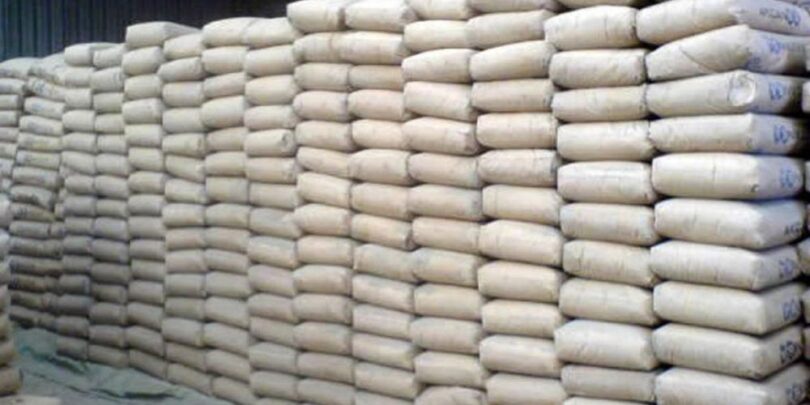
Rising costs of building materials, particularly cement, are rapidly eroding the dream of homeownership for millions of Nigerians, turning what was once a gradual aspiration into an increasingly unattainable goal, writes Chris UGWU.
For fifteen years, John Balogun has worked as administrative staff in one of public firms in Lagos, he has been punctual and diligent in the long corridors of offices where files gather dust faster than decisions are made.
His salary arrives in measured drops, never enough, always late. Yet he saved quietly, and consistently.
“I denied myself everything,” he told THE WHISTLER in a chat, his voice low but steady. “No new clothes unless it was necessary. No celebrations. Even family needs, I would say, let us wait.”
What he was waiting for was a modest dream: a three-bedroom bungalow on a small piece of land at Mowe town in Ogun State close to Lagos. Nothing extravagant. Just enough space for his wife, his children, and the dignity of ownership.
According to him, in 2012, he bought the land and in 2014, he began to gather materials, blocks first, then rods, then sand. He stacked them carefully, like hope made visible. At the time, a bag of cement was within reach, N2000.
Then the prices began to climb, at first, it was a slow rise, the kind people complain about but adjust to. Then it became something else, sharp and relentless. Cement, the very backbone of his dream, drifted further and further out of his grasp.
“Each time I saved enough to buy ten bags,” he recalls, “the price would increase, and I could only afford five”
“The foundation was laid eventually, after years of piecing resources together. It stands there now, solid but incomplete, a concrete outline of what could have been. No walls. No roof. Just a silent testimony to effort interrupted and grass has begun to grow within the foundation lines,” he said.
According to him, his children are growing. The eldest is already in the university. The family still lives in a rented apartment where the roof leaks during heavy rain. Every year, rent increases. Every year, the dream of leaving becomes more distant.
Balogun’s experience is not isolated.
A lecturer at one of the private universities in Ogun State, Adewale Johnson also told THE WHISTLER on further findings that he had spent years trimming his life down to essentials, saving small portions of his salary with a singular dream to build a modest home of his own.
“I have been saving for years,” he said quietly, his voice carrying the weight of repetition. “But every time I get closer, the cost of cement goes up again”
According to him, his unfinished foundation sits on a small plot of land at Ota in Ogun State, Sand has gathered in the corners. Weeds have begun to claim what was meant to be a living room due to his inability to continue the building following increasing cost of cement in the country.
A Widening National Crisis
Across Nigeria, Balogun and Johnson’s story is no longer unusual. What was once a distant economic concern, fluctuating construction costs, has become a deeply personal crisis.
According to findings by THE WHISTLER, the latest data presented by the National Housing Data Technical Committee and reported by the Federal Ministry of Housing and Urban Development in January 2026, Nigeria’s housing landscape is characterized by a high, yet redefined, deficit rather than a consolidated high homeownership rate.
The Technical Committee, led by Dr. Taofeek Olatinwo, officially pegged the national housing deficit at 14.925 million units for 2025.
Beyond the 14.9million unit gap, the committee noted that approximately 15.2 million housing units across Nigeria are structurally inadequate, often lacking basic services, safety, or durability, as reported in late 2025.
On homeownership, while the committee’s focus was on defining the deficit, previous studies have estimated Nigeria’s homeownership rate at approximately 25 per cent, with over 80 per cent of urban residents renting in some estimations.
The data was derived from a refined analysis of persons-per-room ratios and a National Housing Data Programme in collaboration with the World Bank.
The data showed that rapid urban growth and population increases are primary drivers of the deficit, alongside a slow pace of construction, limited long-term housing finance, and land title constraints.
Also, a recent study by NOI Polls found that 51 per cent of Nigerians live in rented accommodation, with many considering mortgage financing as an option for home ownership.
However, concerns about stable income and lack of data on housing prices are major barriers to homeownership. The Nigerian government was urged to develop low-cost housing across the country, rather than relying solely on private sector solutions.
Results from a study by NOI Polls show that 51 per cent of Nigerians currently live in rented accommodation, 40 per cent of which are paying between N20,000 and N100,000 yearly (across Nigeria). Only 31 per cent of Nigerians surveyed said they lived in their ‘personal house’ which they may have built, purchased or inherited.
Cement, and other essential building materials which are the backbone of Nigeria’s building industry, has surged in price over recent years, driven by inflation, currency instability, energy costs, and supply chain pressures. For developers, it squeezes margins. For ordinary citizens, it crushes dreams. Families delay building plans indefinitely, watching savings lose value in real time.
The duo is among millions of Nigerians whose hope of homeownership has dashed due to skyrocketing price of cement and other essential building materials across the country.
Their frustration reflects a growing national sentiment, the rising cost of construction is no longer just a business concern but a deeply personal crisis affecting everyday Nigerians.
Housing experts warn that Nigeria’s already severe housing deficit, estimated in the millions, is quietly widening. The implications stretch beyond shelter. Homeownership, long seen as a cornerstone of financial security, is slipping further out of reach for a generation already grappling with rising living costs and limited income growth.
Investigation by THE WHISTLER reveal a troubling pattern. Prices fluctuate wildly, often increasing without warning. Distributors blame manufacturers. Manufacturers point to production costs, energy prices, and logistics. Government statements come and go, promising intervention, stability, relief but no solution yet.
Available industry data and market observations show that the price of a 50kg bag of cement, which sold for about N8,000 in the first quarter of 2025, rose to between N10,000 and N11,000 at the beginning of 2026. The price has continued to climb and is now selling for between N11,500 and N15,000 in several parts of the country.
Similarly, within the last quarter, steel prices have gone up 20 per cent, sharp sand, 25 per cent, and wood/granite prices have also increased, but at a slower rate.
Also, 16 inches rods that were sold at N7,000 ten years ago has risen to N17,000 to N19,000 per rods depending on locations.
A sharp increase that is quietly but decisively closing the window of homeownership for low and middle-income earners. What was once a gradual climb onto the property ladder has now become for many an impossible leap.
Industry watchers warn that the current cement price surge could deepen the crisis, effectively locking a new generation out of property ownership.