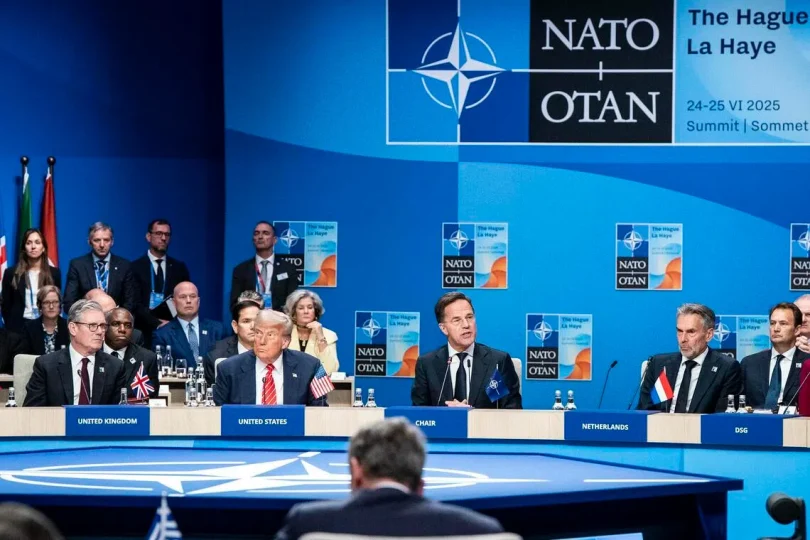
ANKARA, Turkey – European leaders arrive for the 2026 NATO summit meeting in Ankara, Turkey, with the alliance under threat.
They want to keep US President Donald Trump and the United States deeply engaged in NATO, but they have come to accept that the alliance is changing – and will have to rely far less on Washington for the conventional defence of Europe.
The Trump administration has made it clear that it is withdrawing troops and capabilities from Europe to shore up US military power in the Middle East and the Indo-Pacific, where China has become a rival to the United States.
The European governments want to ensure that the transition toward what many call NATO 3.0 is done as smoothly as possible. They want to feel confident that the gaps the Americans leave can be filled, even if imperfectly, to diminish their vulnerability to a more aggressive, militarised Russia.
The dangers of the current moment have been underscored by China’s test of a long-range ballistic missile Monday, the first such launch in nearly two years, and another huge Russian missile and drone attack on Kyiv.
NATO leaders are expected to endorse continued support for Ukraine, with the non-American members pledging US$80 billion (S$103 billion) in 2026 and 2027.
Ukrainian President Volodymyr Zelensky will attend, to press his urgent desire for more air defences against the Russian onslaught.
Mark Rutte, the secretary-general of NATO, is trying to walk a narrow line, prodding European member states to pay more for security while making sure Trump does not abandon the alliance in the process.
“We will breathe life into the concept of NATO 3.0: A stronger Europe in a stronger NATO,” he said last week.
But for several years at least, senior European officials say, the reality will be a gradually stronger Europe in a weaker NATO. There will be fewer US troops, fewer high-tech American capabilities and doubts that Trump would come to NATO’s aid in all circumstances, undermining deterrence.
Radoslaw Sikorski, Poland’s foreign minister and a former defence minister, outlined the transformation of NATO after it was founded in the aftermath of World War II.
“NATO 1.0 was a clear defence against Soviet aggression and expansionism, and NATO 2.0 was a post-Cold War search for purpose,” he said in an interview, with the alliance looking outside North America and Europe and after Sept 11, especially, to fight terrorism in Afghanistan and the Middle East.
Russia was seen as even a possible ally and certainly less of a threat, and some European NATO members effectively disarmed, he said.
But with Russia’s full-scale invasion of Ukraine in 2022, China’s rising ambitions and Washington wanting to shift resources to Asia away from Europe, Sikorski said: “NATO 3.0 will mean that Europe will take more of the burden for conventional defence and the US will be more of a cavalry-over-the-hill kind of ally.”
Time may be short to prepare. German and many NATO officials say a battle-hardened Russia would be ready for a war against NATO by 2029, so the pressure is on Europe to become more “war ready”, as the Germans say, and on the United States not to create unnecessary vulnerabilities in the meantime.
In Ankara, Trump and his officials are expected to keep the pressure on other NATO members to pay more for defence, and to stick to a commitment made in 2025 to increase spending to 5 per cent of gross national product by 2035.
Matthew Whitaker, the US ambassador to NATO, warned allies last week that there may be benefits for those who pay up and difficulties for those who lag the others.
For a time, the Europeans hoped that US threats to reduce its contributions to NATO would fade, as they did in Trump’s first term. They now accept that the Americans are serious, and that they must step up in their own interests.
“It’s very clear that the US role is changing,” said Claudia Major, an expert on trans-Atlantic security at the German Marshall Fund, a research group. She added that “the main hope is to do damage control and to get predictability”.
Europeans know they must do more, she said. The change “can be shaped but not avoided”.
The key questions, though, are how quickly will Washington withdraw support and how quickly can Europe act.
In 2022, at the Madrid summit of NATO leaders, the alliance began to demand for the first time since the Soviet Union collapsed that its members obtain specific quantities and kinds of equipment and personnel, and be able to move them to specific places in case of a war.
These requirements were drawn up by NATO’s then Supreme Allied Commander in Europe, General Christopher G. Cavoli, an American, and his staff.
But they must be redrawn after Washington announced some troop reductions and the withdrawal of critical equipment, like air refuelling and fighter planes.
Trump has been dismissive of NATO generally, calling it “a paper tiger” and saying allies were not there for him when he wanted their help in the war with Iran.
Defence Secretary Pete Hegseth has been even more biting than Trump about NATO and has announced a further review of the United States’ troop presence in Europe over the next six months.
Rutte will devote July 7, the first day of the summit, to a trans-Atlantic defence industry forum, to emphasise growing ties. The leaders’ dinner will take place on July 7. On July 8, there will be a morning session, followed by news conferences.
Much happy talk is expected in Ankara about European military spending and defence procurement. Beneath the surface, though, there are serious anxieties.
European armies do not have enough troops, US and NATO officials agree. For example, the British army is at its smallest since Waterloo in 1815, with fewer than 70,000 full-time, trained personnel.
European budgets are also stretched.
It is unclear when any large country other than Germany and Poland will be able in the next few years to reach NATO’s spending goal of 3.5 per cent of national income on core military needs and another 1.5 per cent on related military spending, like improving rail transport and emergency services in case of war.
Even at the 2025 summit, when these spending targets were agreed upon, allies refused Rutte’s request to reach those levels by 2029, insisting on 2035, suggesting that major increases will come only toward the end of that period.
Building up the so-called European pillar in NATO will inevitably take time, and it is not just a question of money, but of developing, buying and integrating sophisticated weaponry that the Americans will no longer provide.
Most crucially, these “strategic enablers” include long-range, ground-based missiles, air defence, satellites and intelligence coordination.
It is also vital, Rutte argues, that Washington provide the main nuclear deterrent for the alliance, the so-called “nuclear umbrella”, to counter threats from Russia or any other country.
Even as the alliance evolves into NATO 3.0, “you still need US leadership, high-end US capabilities, nuclear deterrence and enough American conventional power on the ground to show that the US has skin in the game”, said Matthew Kroenig, a former Pentagon official now at the Atlantic Council, a research group.
“There is a connection between troops on the ground and nuclear credibility.”
If few US soldiers are in Europe to fight and die, questions about the willingness of an American president to go nuclear become more acute.
There is also the fundamental question of command and control.
NATO has been built to be led by an American supreme commander, with simultaneous control over US troops in Europe.
The continent has competent generals, but no clear European command, since each ultimately reports to their own country’s political masters, said Camille Grand, a former senior NATO official and director of the main defence industry trade body in Europe.
Although European officials are normally either deputies to Americans or have an American deputy, overall command should remain with Washington, he argued.
“If there is only one American soldier left in Europe, it has to be” the American supreme commander, Grand said.
The Pentagon seems to accept that, with talk of a German or French supreme commander having faded.
If the United States withdraws or pulls back, “how do these countries work together on defence?” asked Max Bergmann of the Center for Strategic and International Studies, a research group.
“It is a really important political question, one that Europeans are currently reckoning with, because what we see in Europe is not a lot of European defence cooperation.”
And if there is a crisis, with Russian troops massing on a NATO border and the Americans missing, how does Europe organise a united response?
“NATO will evolve and reform and it’s healthy to be more honest about it,” Grand said. “But will it be a clear transition or a sudden pulling the plug on important capabilities? It must be something we do together.” NYTIMES
This article originally appeared in The New York Times.