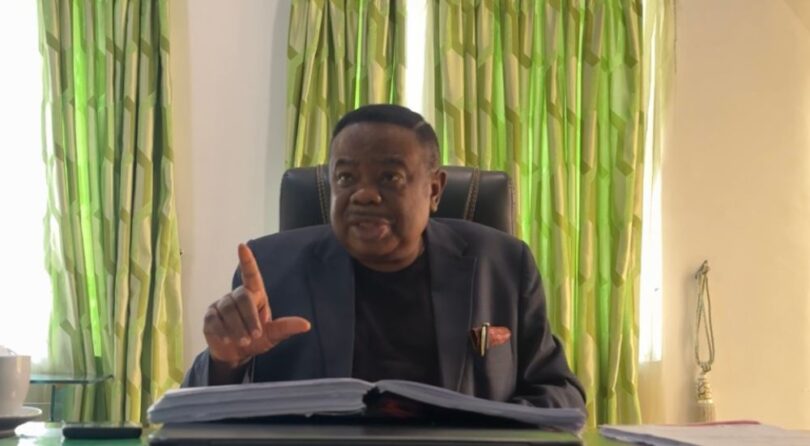
Chief Tony Okoroji has spent more than five decades at the intersection of music, copyright and the Nigerian creative industry. He began his career as a recording artiste in 1976, releasing Super Sure at 18, before becoming a music producer and repertoire manager with EMI. His 1978 album, Big-Big Sugar Daddy, on which he played all 16 musical instruments, remains one of the defining feats of his early career.
At 29, Okoroji was elected President of the Performing Musicians Association of Nigeria (PMAN), where he led campaigns for stronger copyright protection and reforms to Nigeria’s copyright laws. He later served on committees that drafted the Copyright Law and its first amendment and played a role in the establishment of the Nigerian Copyright Commission.
Today, Okoroji is Chairman of the Copyright Society of Nigeria (COSON), a prolific author and one of Nigeria’s most prominent voices on intellectual property and the rights of creative people. His career has taken him from the recording studio to the leadership of musicians, copyright battles and, more recently, traditional recognition, including acceptance by a monarch.
In this interview with Kasarahchi ANIAGOLU of THE WHISTLER, Okoroji speaks on the origins of MCSN, the formation of PMRS and COSON, his prolonged battles with the Nigerian Copyright Commission, royalty collection, the future of copyright in Nigeria and the lessons he believes the new generation of Nigerian musicians must learn.
Excerpts….
I amongst a few others, drafted the regulation, and these regulations were gazetted, you know, how they collect the money, pass it to the NCC, and how it’s supposed to be distributed equitably to everyone. Of course, when you get to government, they will twist everything for their own purposes. Usually they do this.
In fact, unknown to a lot of people, what we call MCSN, started as Giwa and Co. There was a Lagos lawyer, Fatai Oladele Giwa, who used to have his chambers at Breastfruit Street in Lagos. He was an agent in Nigeria for the London -based collective society, the Performing Rights Society of London, (PRS) of Great Britain.
What did he use to do? He used to collect money belonging to Nigerian artists from them, and distribute the money, and then try to collect money from Nigeria and send the money to London, to PRS. Around the 70s and early 80s, there was a lot of grumbling. We are an independent country.
Why should the PRS of London be the one that’s controlling copyright collections in Nigeria? And then, there was also some dispute as to the money that Giwa was giving to individual copyright owners, whether they were giving adequate resources. Are they getting their fair share? So there was a lot of squabbling. This was the period when the biggest broadcaster in Nigeria was FRCN, Radio Nigeria and Radio Nigeria refused to pay Giwa.
They were paying money to PRS at some point. They refused and said, we’re an independent nation. Why should we continue with this arrangement? And then, it became clear to Giwa that he couldn’t continue to operate the way he was operating.
So the idea of setting up an organisation outside of himself was advised to him. So he went to register the Musical Copyright Society of Nigeria, MCSN. It met a lot of bottlenecks.
First of all, a lot of people said Musical Copyright Society of Nigeria was inaccurate so they refused to register that and then registered Musical Copyright Society Nigeria, MCSN. There’s no off.
Now, who were the subscribers to MCSN? The subscribers to MCSN were both Alhaji Fatai Giwa and Adeolu Akinsanya. , An old musician who was Giwa’s friend. They were the two subscribers to MCSN.
Giwa was not a right owner, he had no copyright. He was a trader and a businessman. And that created problems. Because a collective or a CMO is supposed to be an organisation of right owners.
A CMO is not a profit-making body. It has never been. It’s right owners organising themselves and setting up an organisation to liaise between them and the users of music, or the rights of music. This can also be literary works. Recently, the audio-video industry has also joined. And it’s not a profit organisation. That is why in Nigeria, the law says you must be a company limited by guarantee. COSON does not make profits.
It is not allowed to make profits. That’s why as chairman, I don’t get a salary because I am a right owner. But from the general manager all the way down, they get paid because they’re not right owners.
Now, it was Giwa who appointed Mayo Ayilaran, who is now the Director General of MCSN. Giwa trained Ayilaran who later entered into a struggle with Giwa for control of MCSN. In the process, Giwa died and Ayilaran took complete control of MCSN over the period of 42 unbroken years, this same individual has controlled MCSN.
Now, if you check the MCSN memorandum and articles, check the quorum of their AGM meeting, they have just three persons.
Three people who formed a quorum to hold an AGM of an organisation that says it has hundreds of members. What was the craziest thing that they did? They brought in two organisations. The London Performing Right Society (PRS) and made it a member of MCSN. There’s another organisation in London, the Mechanical Copyright Protection Society (MCPS).
So, with this, they formed a quorum for the AGM and made a decision which they considered legal. The AGM is the highest decision-making body of any company in Nigeria. So, one guy forms the quorum, and you can’t go to court and challenge him, and says, look at the memorandum and articles.
The quorum is what? Three persons. And I represent all three persons so all this caused a lot of trouble.
In 1987, I was elected president of PMAN. PMAN had been formed because of the great amount of piracy and other forms of copyright infringement in Nigeria. That was the very basis on which we formed it.
Musicians in Nigeria and the music industry, got together and said, look, we have to fight this thing. I was not the first president of PMAN. I was elected president in 1987.
And I was overwhelmed. The leadership of PMAN at that time was overwhelmed by the complaints against MCSN by musicians stating that they don’t trust this organisation. They are supposed to be collecting money on their behalf, but they don’t see the money. And there is no transparency, no accountability.
And if you recall, MCSN came about out of Giwa’s agency. His agency was not a collective society. His agency was a private profit-making organisation, but evolved into a collective society because of the pressures it was going through.
But it was not prepared to lose control. His interest was profit. And when Ayilaran took over from him, it did not change. What pushed him was also the profit. He was not a right owner. None of them were right owners.
I was involved in months and months of meetings with Giwa. Giwa at first refused to even meet with me as president of PMAN. Then we threatened that we were going to form another collecting society, because Nigeria had none. Then eventually, they agreed. But he died and Ayilaran took over.
At some point, I joined MCSN and encouraged a lot of musicians to join MCSN. I said, look, if we cannot reform this organisation from outside, let’s get inside and see if we can reform it and make it an actual collecting society representing copyright holders. But we failed.
We were not given a chance to make any changes. It was clear to us that MCSN was going to be run the way it was being run. We are like interlopers in somebody’s business.
And I had to resign from MCSN. And I got backlash out of that because some of the people who joined resigned. Some refused and said Why are we being pushed this way and that way? So some of the people, they claimed they were their members. But actually, people who joined because we asked them to join, so when they list Charley Boy and the likes, I know how those people became members of MCSN.
We needed a collecting management Organisation (CMO) to licence the use of music because a lot of music was reproduced in Nigeria.
And then there was another problem that we had to deal with. I used to be an artist with the recording company EMI, which became Ivory Music in Nigeria. Initially, this was not the age of the Internet and AI when anybody could record his own music in a small cubicle or on a laptop. Recording music then was a big deal.
You had to have a big recording studio. It was not cheap. When you record music then you have to spend a lot of money.
In Nigeria, people used to come from all over the country to Lagos, because there was no other recording studio in Nigeria. Apart from Lagos. People came from Ghana to record music in Nigeria.
To get a recording contract was a big deal, we would throw a party when we get signed to any. The contract were given out by a few recording companies. In Nigeria, we had EMI, Polygram, Tamasha, Sony Music amongst others.