
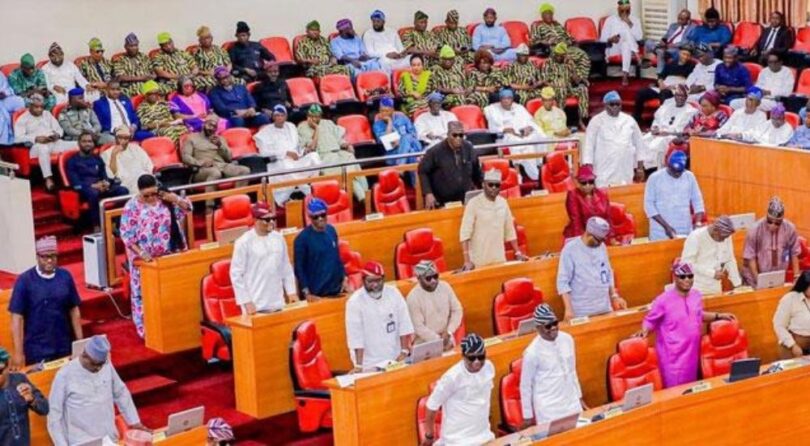
For more than three years, residents of Bani in the Kaiama Local Government Area of Kwara State have endured the consequences of illegal lithium mining. According to community members, these operations have destroyed farmland, disrupted livelihoods, and heightened fears of violence.
As the crisis deepened, residents faced another obstacle: they struggled to reach their elected representatives in the State House of Assembly to raise their concerns and seek urgent government intervention.
Community members told DUBAWA that they repeatedly sought intervention from Ahmed Saidu Baba, who represents their constituency in the Kwara State House of Assembly, but could not reach him.
Official portrait of Hon. Ahmed Saidu Baba — Source: Kwara State House of Assembly
They said they submitted petitions to his constituency office and made several other attempts to draw his attention to the worsening situation. Their efforts to contact him through an official digital channel provided by the Kwara State House of Assembly also failed.
The official email address listed for Baba on the Assembly’s portal, [email protected], was non-functional when residents attempted to use it.
Describing the impact of illegal lithium mining and what he said was the government’s failure to intervene, one resident, Jamal Olamilekan, said the activities had devastated farmlands and heightened insecurity in the community.
“Illegal lithium mining has destroyed our farmlands, brought armed violence into our town and nearby villages, and left us living in constant fear,” Olamilekan said.
He added that residents had repeatedly tried to draw the government’s attention to the problem, but their efforts had yielded little response.
“We have tried to speak to the government about this problem, but they seem not to be bothered about it, and this is making this illegal business continue to grow,” he said.
“Our honourable (Ahmed Saidu Baba) is the only person who can take this issue up for us and present it as a motion in the House of Assembly, but he cannot be reached. Only his political loyalists can reach him,” he added.
DUBAWA’s experience attempting to contact Saidu Baba corroborated his constituents’ claims that his listed email address was not functional. The only contact information provided on the State House of Assembly’s website was an email address that returned an error saying it could not be found or could not receive messages.
Screenshot showing Hon. Ahmed’s official email address not working
‘A Community Struggles To Reach Its Lawmaker’
What happened in Bani is far from isolated.
In Gidan Yaro, a community in Wamakko Local Government Area of Sokoto State, residents are struggling with poor school facilities and say they have been unable to reach their elected representative for help.
Machido Abubakar, a local youth leader, described the condition of the community’s only primary school. “Our education situation is very bad,” he told DUBAWA. “The school has just one block of two classrooms, with no desks or chairs for the pupils.”
He said the poor conditions had affected school enrolment, while repeated appeals for government intervention had yielded little response.
Gidan Yaro Community — Credit: Abdulwasiu Olokooba
Gidan Yaro Primary School — Credit: Abdulwasiu Olokooba
The community’s hopes for intervention grew in 2025, when residents heard that the Sokoto State Government was identifying underserved communities for educational support.
“After Eid-il-Fitr in 2025, word was going around town that the governor wanted a comprehensive list of communities in serious need of educational investment,” Abubakar said.
Residents wanted to contact their representative at the State House of Assembly, Lamido Abubakar, to ensure their community was considered, but they could not find a phone number or email address through which to reach him, according to Abubakar.
Machido said the community consequently missed out on a state government N8.3billion intervention announced in August 2025.
Fallen ceiling at Gidan Yaro Primary — Credit: Abdulwasiu Olokooba
When DUBAWA visited Gidan Yaro on Wednesday, Oct. 7, 2026, to examine the school’s condition, the facilities remained in disrepair. During the visit, between 9 a.m. and 10 a.m., the two-classroom block had no desks or chairs, and no students or teachers were present. The classrooms had cracked walls and collapsed ceilings.
Cracked Wall at Gidan Yaro Primary — Credit: Abdulwasiu Olokooba
For residents of the G/Bubu/G/Yaro electoral ward, the situation reflected more than inadequate school facilities. It also raised questions about whether communities could reach the lawmakers elected to represent their interests and help them seek government intervention.
“We just want a school where our kids can sit and learn,” Abubakar said. “When a community suffers, its people need a direct line to their representative. Without that, our problems never reach those who can truly fix them.”
Gidan Yaro’s experience echoes concerns raised in Bani, where residents also said they struggled to reach their elected representative while seeking help with community problems.
A nationwide investigation by DUBAWA between May and September 2026 revealed widespread failures in digital accessibility and public responsiveness across Nigeria’s 36 State Houses of Assembly. To test how easy it is for citizens to access lawmakers, DUBAWA emailed every state assembly requesting official contact channels and guidelines for constituent reporting. Beyond the digital realm, DUBAWA submitted physical Freedom of Information (FOI) petitions to seven state legislatures to benchmark offline responsiveness and adherence to legal disclosure mandates.
17 State Assemblies Have No Official Emails
For four months, DUBAWA examined the official digital presence of all 36 State Houses of Assembly to determine whether citizens could find publicly accessible institutional email addresses to contact their lawmakers and the assemblies.
The investigation reviewed the state legislatures’ official websites and their social media presence, particularly on Facebook, to assess how the institutions use digital channels to communicate with citizens and provide avenues for public engagement.
The findings show a significant gap in digital accessibility. Of the 36 State Houses of Assembly examined, 17 (47.2%) had no publicly identifiable official email address through which citizens could directly contact the institution on the platforms reviewed.