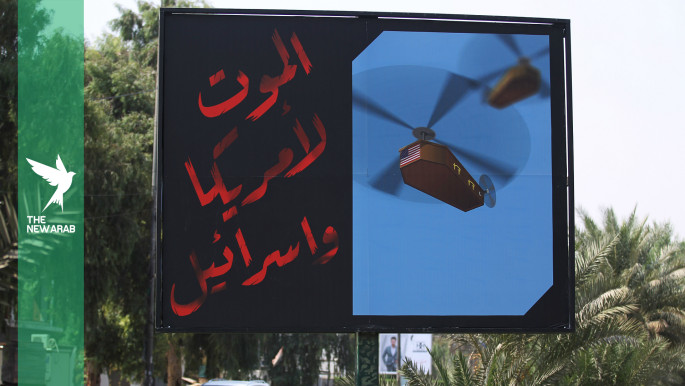
On Monday, 4 May, informed political sources in Baghdad told The New Arab that three factions so far have expressed readiness to hand over their weapons to the PMF. [Getty]
Informed Iraqi sources in the capital, Baghdad, told The New Arab that several armed factions have agreed to hand over their weapons to the Popular Mobilisation Forces (PMF) in the coming phase.
They said the move forms part of a political manoeuvre by which the factions seek to reposition themselves in the political landscape and bypass US conditions requiring non-engagement with any Iraqi government that includes representation from armed factions.
This comes in preparation for participation in the anticipated government headed by Ali al-Zaidi.
This move comes amid increasing international pressure, led by the United States, which has directly stressed to leaders of Iraqi political blocs, as well as to the prime minister-designate, the need to prevent the inclusion of armed factions allied with Tehran in the next government formation.
It warned of repercussions for bilateral relations and potential political, economic, and possibly security measures, according to the sources.
However, the main obstacle remains that Washington does not see any distinction between the PMF—the umbrella grouping of Iraqi factions—and the factions that present themselves as part of the “axis of resistance” that quickly engaged in the recent war alongside Iran.
On Monday, 4 May, informed political sources in Baghdad told The New Arab that three factions so far have expressed readiness to hand over their weapons to the PMF, which they describe as a government institution under the law, with the step to be carried out through an official announcement.
This is part of an effort to send positive signals to the US administration.
Sources confirmed that the groups Ansar Allah al-Awfiya, led by Haidar al-Gharawi; Sayyid al-Shuhada, led by Abu Alaa al-Walai; and Asaib Ahl al-Haq, led by Qais al-Khazali, have spoken of their readiness to place their weapons under the custody and control of the PMF.
The step, according to the same sources, comes as part of an effort to enable the political wings of these factions to participate in the next government.
It also aims to circumvent what Baghdad fears could be a US ban, which could have economic and financial repercussions.
The move is also seen as seeking to provide US President Donald Trump with an announcement of an achievement in Iraq in line with his known approach.
Earlier on Sunday, Member of Parliament Hassan Al-Khafaji spoke about ongoing talks with the armed factions. He said, “We spoke with the factions as statesmen and told them that we do not have either al-Qaeda or ISIS, and today you have become politicians, and most of you have engaged in political work, so lay down your weapons”.
He predicted that “they will respond to this call”.
“When I met some leaders, they said they want to build the country and leave problems behind,” he added.
However, as political analyst Hussein al-Asaad describes, this political manoeuvre raises fundamental questions about these armed factions’ ability to convince Washington and the international community of the seriousness of this shift.
This is particularly the case given that some of these factions have been listed on US terrorism lists for years.
This makes the separation between military and political wings subject to ongoing doubt.
Al-Asaad told The New Arab that “the intention of some armed factions to announce handing over their weapons represents a step with more political than security dimensions. They are attempting to reposition themselves in preparation for participation in the next government.”
“This step reflects a growing awareness among these factions of the scale of international pressure, particularly from the United States, which has drawn clear red lines regarding the inclusion of any faction with an armed wing in the government formation”, he said.
Al-Asaad explained that “the declared shift towards exclusively political work may be an attempt to avoid potential repercussions, including sanctions or political and economic restrictions”.
“In theory, handing over weapons could enhance the chances of integrating these factions within the official framework of the state,” he noted.
However, he further pointed out that “the real challenge lies in their actual commitment to separating political work from any military or security activity outside state institutions”.
“The inclusion of some of these factions on US terrorism lists for years complicates the ability to market this shift easily. Washington may view this step as a formal measure unless it is accompanied by long-term practical steps, including genuine and transparent restructuring,” al-Asaad added.
The expert concluded that “the next government will face a precise test in achieving a balance between accommodating influential political forces on the ground and maintaining Iraq’s international commitments. This makes the issue of factional weapons one of the most prominent challenges shaping the coming phase.”
Between domestic calculations and external pressures, the step of handing over weapons appears to be the beginning of a long negotiation process rather than a unilateral measure.
It reflects the continued complexity of Iraq’s transitional phase, in which considerations of sovereignty, legitimacy, and regional and international balances intersect, according to observers.
Article translated from Arabic by Afrah Almatwari. To read the original, click here.