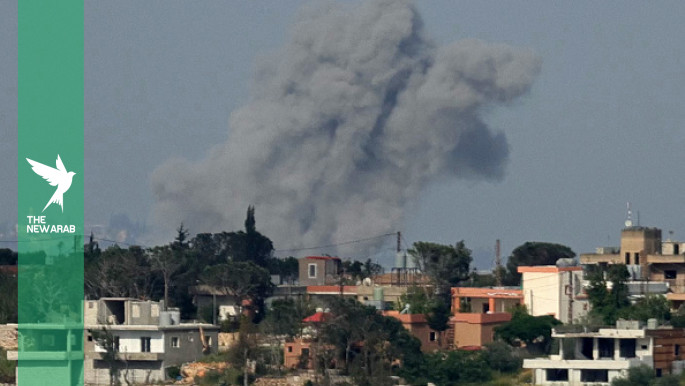
Smoke rises from the site of Israeli airstrikes that targeted the village of Zawtar al-Sharqiyah in the Nabatiyeh district [Getty]
The Israeli military issued new evacuation orders for 11 villages in south Lebanon on Sunday and continued its airstrikes across the war-battered region, despite a truce.
Warnings were issued for towns and villages in the Nabatiyeh district, outside the security zone Israel currently occupies along the border.
The military ordered residents of Doueir, Arabsalim, Sharqiyeh, Jibchit, Baraachit, Srifa, Dounine, Braiqaa, Qaaqaaiyat al-Jisr, Qsaibeh and Kfarsir to distance themselves a thousand meters away from these areas before striking them.
Some of the villages were included in evacuation orders on Saturday.
Lebanon’s state-run National News Agency later reported a series of Israeli strikes across southern Lebanon, including on towns not mentioned in the evacuation warning.
No deaths were immediately reported from the latest strikes on Sunday.
Since fighting resumed between the Hezbollah militant group and Israel on 2 March, the Israeli military has issued evacuation orders for most of south Lebanon, including both south and north of the Litani River.
Israeli troops now occupy the entire border region in the south, establishing a buffer zone that spans more than 500 square kilometres, several kilometres deep. Only a small number of civilians remain within this security zone, while the rest have been forced to flee.
Hezbollah has recently begun using cheap drones controlled by fibre-optic cable, making them largely immune to electronic jamming, to conduct daily attacks.
Scorched earth
Since its invasion, entire towns and villages along the border have been flattened as part of Israel’s continued scorched-earth policy.
Videos often shared by the Israeli army show entire neighbourhoods being detonated at once. At least 24 villages have been flattened or largely devastated by the demolitions, according to initial figures.
Asharq al-Awsat newspaper said Israeli forces have so far destroyed more than 25,000 homes in the border region in the latest round of fighting since March.
Citing ‘preliminary data and cross-referenced sources,’ the report said 56 schools have been completely destroyed so far and another 120 damaged, while 15 hospitals have also been damaged, including eight that are no longer operational.
Ten bridges in south Lebanon have also been hit, including primary bridges that cross the Litani River. Israel had said it intended to isolate south of the Litani region from the rest of the country.
Israel’s scorched-earth policy in the south is turning the area into a de facto buffer zone, without publicly declaring it as such, Asharq al-Awsat said.
Despite the violence, the US-brokered ceasefire reached in mid-April and extended until 17 May has largely de-escalated Israel’s attacks.
Lebanon and Israel are set to begin direct negotiations soon, aimed at reaching a peace deal and ending the decades-long conflict. While a time and location are yet to be confirmed, US President Donald Trump had said the talks will commence within two weeks, before the ceasefire deadline.
Lebanon has stressed that Israel must fully abide by the truce before negotiations begin, but Tel Aviv says it will not pull its troops out before Hezbollah is fully disarmed.
The Iran-backed militant group has lambasted the planned negotiations, saying it is “not concerned” with their outcome.
Lebanon’s President Joseph Aoun has defended the diplomatic track as the only way to end the war and guarantee that Lebanese southerners can return home.