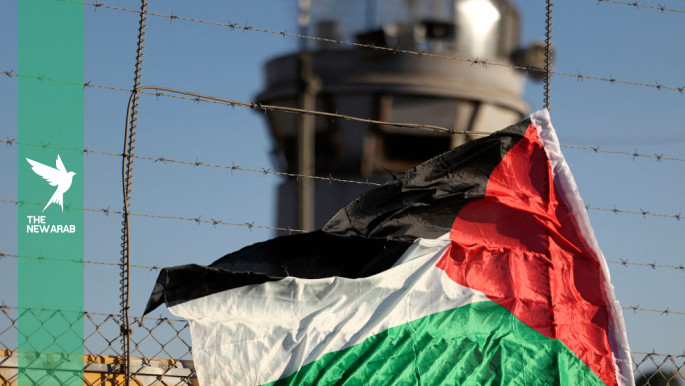
Close to 10,000 Palestinian prisoners are held across Israeli prisons, where they are subject to dire conditions [Getty/file photo]
Israeli prison officials are deliberately depriving Palestinian detainees from accessing some vital health care equipment and services, leaving prisoners in agony or deprived of basic human rights, such as functioning hearing aids.
The prison policy is in line with far-right minister Itamar Ben-Gvir’s block on the families of detainees depositing funds to their loved ones, needed to access vital medical equipment.
Among those affected is Adam Oweneih, who is deaf and unable to replace the batteries for his cochlear implant, as a result of Ben-Gvir’s policy, Haaretz reported.
The 24-year-old has also not been sent to a rehabilitation centre or provided follow-up examinations.
Due to his inability to hear and follow the instructions of the prison officials, he has received beatings from guards.
Oweineh, from Battir in the Occupied West Bank, has been held in administrative detention since January 2025 on suspicion of being involved in manufacturing explosive devices, and continues to be held without trial or charge.
The 24-year-old underwent a cochlear implant operation two months before his detention, which requires specialised batteries and a six-month to one-year rehabilitation process post-operation.
Batteries for his implant were also confiscated by the Israeli Prison Service at the time of his arrest.
His father, Ghassan Oweineh, told Haaretz: “He can’t hear at all. I was very afraid someone would hit him, because that could damage his brain. He needed six months to a year of rehabilitation for his hearing to become semi-normal.”
Oweineh’s family has tried to transfer batteries to him several times, succeeding only twice. Attempts to provide him with batteries via a lawyer have also proved challenging amid the IPS’s complete lack of cooperation, his family said.
Oweineh’s plight caught the attention of Physicians for Human Rights – Israel, who filed at least four petitions with Israel’s High Court of Justice, demanding that he be provided with batteries for the device and the necessary medical examinations.
The group said Oweineh was seen by a professional in October last year following the numerous appeals, and was finally given access to batteries in February.
The organisation said it has communicated with the IPS on at least 50 cases concerning Palestinian detainees who needed items such as glasses and hearing aid batteries, as well as other forms of medical assistance.
National Security Minister Ben-Gvir, one of Israel’s most high-profile, vehemently anti-Palestinian politicians, enacted the policy following the Hamas 7 October 2023 attacks, which triggered Israel’s military onslaught in the Gaza Strip – still ongoing today and has killed over 72,500 Palestinians in acts labelled as genocidal.
Since then, conditions for Palestinian detainees have deteriorated rapidly. Prisoners have been subject to an uptick in abuse, torture, medical neglect, and reduced portions of food by Israeli prison officers.
Between October 2023 and November 2025, almost 100 Palestinians died in Israeli prisons amid such conditions, while the number of Palestinians held in solitary confinement has risen from 3.5 percent in 2022 – when Ben-Gvir was appointed national security minister – to 35 percent in 2024.
Direct contact with families has also been cut off, and communication can only be conducted via lawyers. Palestinian detainees’ access to lawyers and visits from them have also been dramatically reduced.
As of December 2025, at least 9,128 Palestinians are currently held in Israeli prisons, according to the B’Tselem NGO, with hundreds in administrative detention.