The Israeli Broadcasting Authority reported on Thursday that Israel and the United States are pressuring Lebanon to repeal the law criminalising contact or negotiations with Israel in an effort to advance talks between the two sides. [Getty]
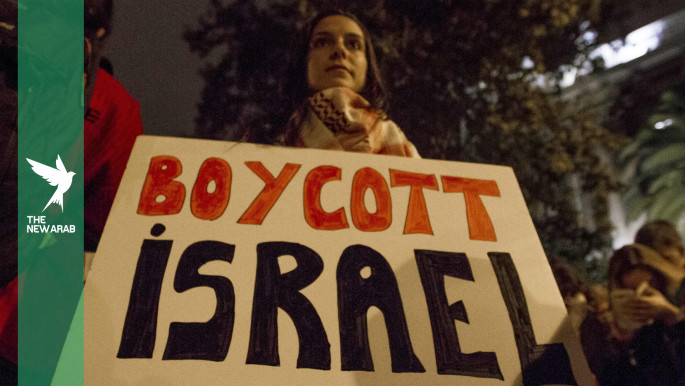
The “Boycott of Israel” law in Lebanon has moved to the centre of political debate amid the launch of Lebanese-Israeli negotiations at the US State Department in Washington on 14 April and their continuation on Thursday, 23 April, at the White House. The talks come as media reports persist about pressure from Israel and the United States to repeal the legislation.
The issue was highlighted when a Lebanese journalist asked US President Donald Trump on Thursday about the law during a press conference following the second round of talks between Lebanon and Israel.
“If we talk to Israelis, this is considered a crime under Lebanese law for us as Lebanese, punishable by imprisonment. What will we do about that?” the journalist asked.
Trump said he was not aware of the law.
“I think that should end. I have never heard of the law at all, and this is a good start. If talking to Israel is a crime, I am sure the matter will end quickly, and I will make sure of that. I know Lebanon does not want that law. This is madness,” he said, urging those present to resolve the matter.
The Israeli Broadcasting Authority reported on Thursday that Israel and the United States are pressuring Lebanon to repeal the law criminalising contact or negotiations with Israel in an effort to advance talks between the two sides.
The authority said the request coincides with a stated willingness in Beirut to resume negotiations.
In this context, official Lebanese sources told The New Arab that “many issues are being raised in the media, but Lebanon’s priorities remain a ceasefire, an end to Israeli attacks, Israel’s withdrawal from occupied territories, the release of prisoners, and the launch of reconstruction.”
“All other issues are secondary and will be addressed later. They are not a priority at this stage,” the sources said.
“President Joseph Aoun’s initiative clearly defines priority areas, including direct talks, with discussions underway on timing and venue,” the sources added. “Current meetings remain consultative and preparatory, held at the ambassador level. The priority now is consolidating the ceasefire and moving toward a phase of direct negotiations.”
Law professor Jad Taameh of the Lebanese University told The New Arab that Lebanon remains, under law, in a state of ongoing hostility. The 1949 armistice agreement, signed on 23 March 1949, did not end the state of war but only suspended military operations, as reflected in its legal nature.
He added that United Nations Security Council Resolution 1701, adopted on 11 August 2006, reaffirmed this framework not as a peace agreement but as a mechanism for managing the conflict.
“Normalisation in the legal sense requires a transition to normal relations between states, which is not currently the case and will not be in the foreseeable future,” he said.
Taameh noted Lebanon’s legal framework opposing normalisation is “based on multiple interconnected laws forming a coherent system.”
“First, the Boycott of Israel law, issued on 23 June 1955, which stipulates in its first article a prohibition on dealing with Israel or with any entities or individuals residing in or affiliated with it, whether such dealings are commercial, financial, or of any other nature,” Taameh said.
The second is about the “provisions in the Lebanese Penal Code, particularly Article 273 and subsequent articles, which criminalise contact with the enemy. Lebanese courts have consistently interpreted these provisions broadly, considering any contact that may benefit the enemy, even indirectly, as criminal.”
He added that “rulings by the Permanent Military Court have reinforced this interpretation, establishing that contact in certain circumstances is sufficient to establish criminal liability, reflecting a clear judicial trend toward broadening the concept of contact with the enemy.”
Third, according to Taameh, is “Law No. 194 of 2011 on Lebanese nationals who sought refuge in Israel, whose explanatory memorandum reaffirmed a continued state of hostility and non-recognition. Thus, this reinforces the legislative characterisation of the relationship.”
He argued that “normalisation cannot be a political decision or administrative measure but would require dismantling the existing legal framework through legislative amendment.”
Accordingly, he said, “Any negotiations conducted outside the framework of public order would lack legal legitimacy even if carried out by official authorities.”
Taameh said Trump’s comments on the issue exceeded diplomatic norms, stressing that the law’s repeal falls within the authority of the Lebanese parliament.
He added that pressure to repeal it is linked to its effect of exposing anyone engaging in contact with Israel to legal prosecution.
Article translated from Arabic by Afrah Almatwari. To read the original, click here.