
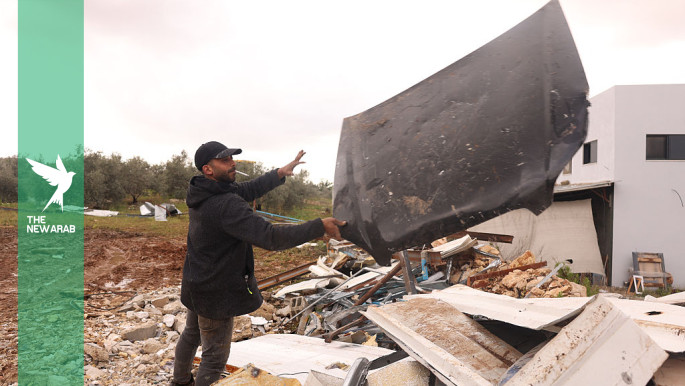
Rights groups describe the situation in the West Bank as “unliveable” due to continued Israeli settler attacks and restrictions by authorities [Getty]
Israeli forces and settlers deploy sexual violence as part of a sustained campaign of pressure driving Palestinian communities from their homes across Area C of the occupied West Bank, according to a report by the Norwegian Refugee Council (NRC).
The study says these abuses are not isolated incidents but part of “a coercive environment that contributes to the forcible transfer of Palestinian communities”.
The report documents at least 16 cases of conflict‑related sexual violence and draws on 83 in‑depth interviews across 10 communities in the Jordan Valley, South Hebron Hills and central West Bank – all of which have experienced partial or full displacement, or face an immediate risk of being forced out.
In the first three months of 2026 alone, UN figures show 1,697 Palestinians were displaced in Area C due to settler and military violence and related measures, already surpassing the 1,658 displaced for the same reasons in all of 2025.
“Sexualised violence is a tool in this larger realm of violence”, Allegra Pacheco, Chief of Party for the West Bank Protection Consortium and one of the report’s lead authors, told The New Arab. “It’s not a pattern of a one‑off type of case. It’s continuous. This violence goes on and on until the community – basically, until most of them – end up leaving”.
The report details cases in which soldiers and settlers invaded Palestinian homes, subjecting women and men to degrading sexualised abuse.
In one incident, soldiers and settlers entered a woman’s house, ordered her to undress for an invasive “search”, and then subjected her to internal examinations and groping while making humiliating comments.
Other testimonies describe forced public nudity and the sexualised humiliation of men and boys, including being ordered to strip, photographed while partially naked, and threatened with further abuse.
Palestinians in multiple communities report settlers and soldiers exposing their genitals, including in front of minors, urinating on detainees, or taking degrading photographs of partially naked Palestinians.
Women and girls described being stalked when they went to toilets or water points, facing explicit threats of rape and sexual assault that made daily life – grazing animals, collecting water, travelling to school – feel impossible.
Pacheco said the research grew out of repeated testimonies from women’s groups about this “invasion into the domestic spaces” that families had previously seen as their last refuge.
According to the NRC, such violence “functions as a coercive tool that penetrates domestic space, fractures family life and renders continued civilian residence untenable”.
More than 70 percent of displaced households interviewed identified threats against women and children – particularly sexualised threats – as the decisive reason for leaving their homes and land.
In Area C, the report finds these abuses have intensified and are now central to decisions about whether families can stay. They have also produced severe economic and social consequences for women, and widespread psychological harm.
For children, displacement and persistent fear translate into disrupted schooling; roughly 40 percent of children interviewed said their education had been interrupted after they were forced to move.
To cope, many families have adopted what the report calls “gendered coping strategies”. These include restricting women’s movement outside the home, relocating women and children away from frontline areas, and arranging early marriages in the belief that this might offer protection.
At least six families reported marrying off girls aged 15–17 after repeated incidents of sexualised threat and harassment.
Sexual violence part of broader regime of discrimination
The sexualised abuse, the report stresses, comes on top of a broader regime of systematic discrimination and violence.
Restrictions by Israeli authorities, demolitions, confiscations and attacks on homes by both soldiers and settlers have created an environment many communities describe as unlivable.
Families interviewed cited a pervasive sense of insecurity, movement restrictions, loss of access to grazing land, water and electricity, and the constant threat of attack as key reasons they finally decided to leave.
Impunity, the report argues, is a central part of this coercive environment. Incidents of settler violence and sexualised abuse repeatedly occur in the presence of Israeli forces “without intervention or effective investigation”, further reducing communities’ practical ability to remain in place.
Human rights organisations say that around 93 percent of investigations into settler attacks are closed without charges, with only a tiny fraction resulting in indictments – and even fewer in jail time.
The NRC warns that the pattern of unchecked sexualised and gender‑based violence, combined with entrenched discrimination and ongoing incitement, meets several “early warning” indicators used by UN bodies and atrocity‑prevention experts.
For the communities already pushed off their land, Pacheco said, the result is “total devastation”: 92 percent of displaced families in the survey lost access to grazing land, 84 percent lost their property and furniture, and large majorities of women and children reported intense stress, anxiety and fear.