
It is difficult to see through the dust inside the cramped, low-roofed tent on the eastern edge of Khan Younis. Ibrahim al-Aloul works alongside four others, with a piece of fabric tied over his mouth and nose as his only shield against the toxic grey powder as he sifts and grinds.
Outside, a skinny donkey waits with a cart to carry the finished product to the next tent along, where it will be mixed with gypsum, calcium and binding agents before being bagged in flour sacks and sold.
This is Gaza’s cement industry, improvised out of desperation and for now the only construction operating in the besieged Palestinian coastal strip. The health risks of these compounds are severe, but in Gaza, where the death toll of the past two years of Israeli bombardments has reached more than 71,000 and a steady toll of killings continues despite the eight-month ceasefire, options are limited.
“We work long hours and the dust is suffocating,” Aloul says, stepping outside into the street of tents to breathe – endless rows that have become the only homes Palestinians can find. “But there is no other work, and no other cement. We have no choice.”
Israel has barred cement and all building materials from entering Gaza since October 2023, deepening a blockade on construction imports in place since 2007. By October 2025, Unosat satellite imagery found approximately 81% of all structures in the Gaza Strip had been damaged, with more than 123,000 destroyed outright. The UN estimates the destruction generated 61m tonnes of rubble, and a joint EU, UN, and World Bank assessment puts the cost of recovery at $71.4bn (£52bn) over the next decade.
Against that backdrop, a small, scattered network of entrepreneurs, labourers and engineers has begun turning the ruins into raw material.
The idea came to Saadi al-Sha’er – Aloul’s employer – when he noticed clay fused with cement dust accumulating around Gaza’s bombed factories and warehouses. Before the war, he had made fibreglass products. When that work disappeared, he began experimenting.
“At the ruins of a brick and marble factory in al-Qarara, north of Khan Younis, I found large amounts of the material,” he says, cement dust coating his clothes, eyelashes and hair. Workers break the hardened deposits down by hand with heavy concrete blocks, then sieve the result through progressively finer meshes until only powder remains – sourced from bombed-out factories, marble-cutting plants and crushed concrete debris.
The final mixture is roughly 60% cement dust, 15% lime, 10% gypsum, 10% calcium and a bonding agent. When the bonding agent runs out, wood glue is substituted. Sha’er also processes a second product: prewar cement that hardened in storage, broken down and reformulated with gypsum and bonding agents to perform slightly better.
“When ingredients run short, I improvise,” he says. His operation produces between half a tonne and two tonnes a day, employing about 30 people.
He sells for 12 to 18 shekels (£3-£4.60) a kilogram at source. By the time it passes through traders, the price has multiplied. A single bag now costs 2,000 shekels (£506). Before the war, a standard bag of conventional cement cost 40.
For a population largely destitute, these sums are mostly beyond reach. But for those who can find the money, the substitute is the only path to something sturdier than a tent.
Mahmoud al-Astal, 38, a farmer in al-Mawasi, has been in a shelter with his extended family for more than two years. He looked into buying poles and nylon sheeting to build a greenhouse-like structure, but the cost and short lifespan put him off.
“I found it more logical to construct something more solid to shield us from the elements and last longer, since there is no end in sight to this displacement situation,” he says. “And since we’re not after a high-rise, this cement should do fine.”
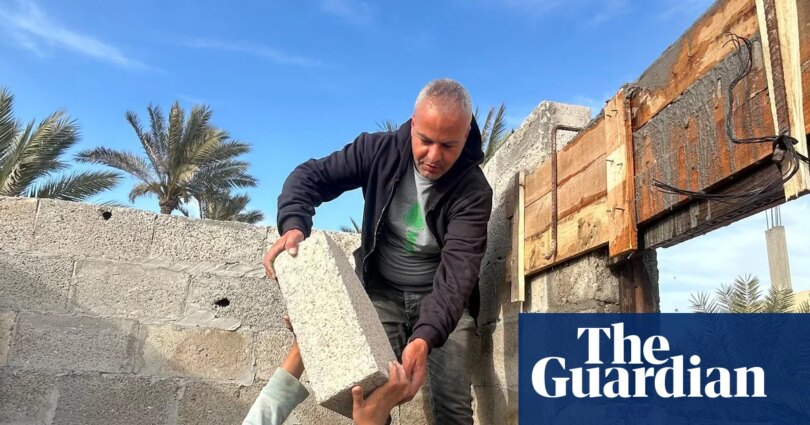
Othman al-Awda, a builder who is constructing Astal’s small two-room house using the substitute cement, adjusts his mix ratios to compensate for its reduced strength and keeps his ambitions strictly within the material’s limits. “It is clearly limited in strength,” he says. “But it works for brickwork. I would never use it for columns.”
The October 2025 ceasefire agreement explicitly required the immediate resumption of humanitarian aid and the entry of reconstruction materials. But OCHA, the UN’s humanitarian arm, reports that reconstruction efforts are being severely delayed by continued bans or tight controls on “dual-use” items such as steel, cement and heavy equipment, which, according to Israel, could also serve a military purpose.
Mahmoud Ubeid, a civil engineer specialising in construction management, oversees renovation works at several sites, including, most recently, al-Wafa hospital. Confirming that the substitute cement is now the primary material available for finishing work such as plastering, tiling and basic wall repair, he says his firm offers a 12-month warranty on work done with it, but no more.
“It performs its purpose during the current phase, but it cannot be relied upon long-term,” Ubeid says. “It fails under testing and cannot be permitted for structural use. But for temporary finishing – to preserve lives and property – it is what we have.”
He knows the quantities are nowhere near sufficient. Ubeid estimates that what is now being produced amounts to less than 1,000th of Gaza’s temporary finishing needs alone. Priority goes to hospitals and public infrastructure.
Sha’er, who has worked in construction since 2008, does not describe what he is doing as a solution. Living in a building that once served as Asda’a prison and displaced from Rafah along with dozens of other families, he crosses the rubble to his tent every morning, ties the cloth across his face and starts sifting.
“What we are doing to build is unimaginable, against all odds,” he says. “But I won’t give up.”