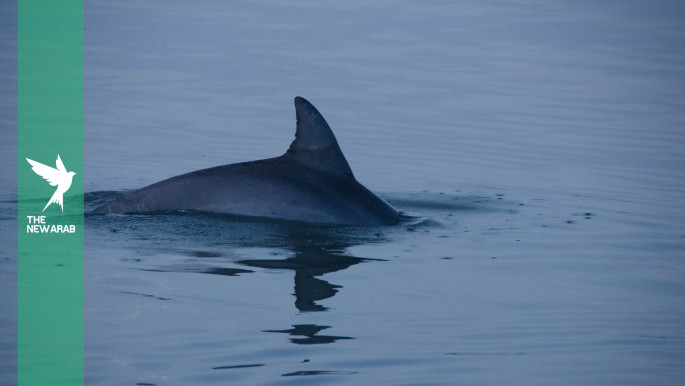
The US Navy has is known to have trained dolphins for military purposes since 1959 [Getty]
As the US and Iran battle for dominance in the Strait of Hormuz, recent remarks by Secretary of Defence Pete Hegseth have taken a bizarre turn.
At a Tuesday press conference at the Pentagon, a journalist asked Hegseth and Joint Chiefs of Staff Chair General Dan Caine about reports of ‘kamikaze dolphins’ possibly being deployed by Iran.
Caine said he hadn’t heard of the reports, asking the journalist whether he meant “like sharks with laser beams?”, referencing the 90s James Bond parody film Austin Powers.
Hegseth, however, gave a response that raised more questions than answers.
“I can’t confirm or deny whether we have kamikaze dolphins, but I can confirm they [Iran] don’t,” Hegseth said.
Amid the latest unexpected twist in a war that has been full of them, The New Arab takes a quick dive into what ‘kamikaze dolphins’ are, and what we know about the US Navy’s Marine Mammal Programme.
What are ‘kamikaze dolphins’?
The question posed to Hegseth came after Iran’s repeated threat of deploying weapons previously unseen in battle, as well as a recent Wall Street Journal report in which an Iranian official was quoted as saying that Iran could use submarines or suicide dolphins in the Strait of Hormuz.
In 2000, the BBC reported that Tehran purchased Russian-trained dolphins who were taught to “kill for the Soviet navy”. The report added that the cetaceans could “undertake kamikaze strikes against enemy shipping carrying mines that would explode a ship on contact with its hull”.
Apart from the decades-old report, little more is known about whether Iran has actually deployed dolphins into combat zones, though we do know that the US has.
What is the US Navy’s Marine Mammal Program?
The US Navy began training dolphins back in 1959, basing the operation in San Diego in California.
At the training centre, bottlenose dolphins have been trained by the navy to detect, locate, and recover objects in the open sea, coastal waters, and harbours.
Dolphins, known for their high level of intelligence, weren’t the first choice, however.
Before settling on dolphins, the US Navy also conducted experiments with sharks, rays, and sea turtles. The programme also trains sea lions in similar tasks.
Do the dolphins have their own divisions?
As with other parts of the US Army and Navy, the dolphins and sea lions have their own units, some solely of dolphins and some mixed.
There are five known units – MK 4, MK 5, MK 6, MK 7, and MK 8 – each with its own respective duties.
The MK 4 unit detects floating sea mines, while the MK 7 unit detects mines placed on the seabed. The MK 8 unit identifies safe passages before military landings on beaches, while the MK 6 dolphin and sea lion unit protects ports and ships from unauthorised swimmers.
Lastly, the MK 5 sea lion unit recovers equipment launched during military tests.
The units mostly appear to be trained in detection and monitoring activities, with no suggestion of offensive combat capabilities – and no ‘kamikaze dolphins’.
Have the dolphins been deployed to combat zones?
The MK 6 dolphin unit was deployed during the Vietnam War to detect unauthorised swimmers around ports, ships, and military installations.
The same division was deployed in Bahrain during the Iran-Iraq war to protect US military assets.
A dolphin unit was also sent to the Gulf during the 2003 US-led invasion of Iraq for mine-clearing operations.
There are, however, no known deployments of ‘kamikaze dophins’ yet.