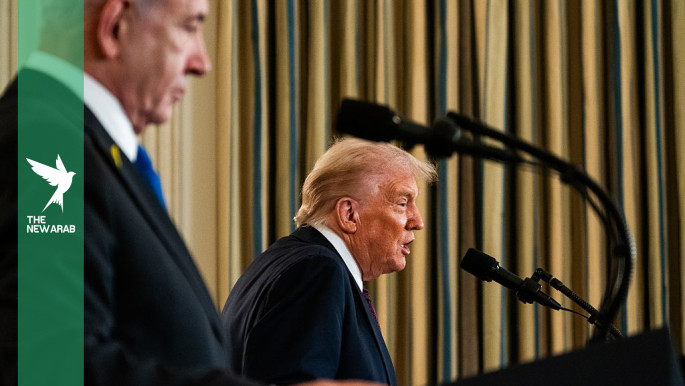
Trump’s remarks on “very good” talks with Iran have fuelled growing concern in Israeli media that a potential agreement could strengthen Tehran and fall short of Israel’s stated war goals. [Getty]
Concerns are growing in Israel over a possible agreement being shaped between the United States and Iran, driven mainly by three issues linked to Iran’s missile programme, Tehran’s regional allies, particularly Hezbollah, and the failure to achieve the war’s stated objectives.
Military assessments circulating in Israel suggest that any potential agreement may not impose meaningful restrictions on Iran’s ballistic missile programme and could negatively affect the Israeli army’s freedom of action in Lebanon.
According to Israeli newspaper Yedioth Ahronoth, political and security circles in Israel fear the deal could limit the military’s operations in Lebanon and potentially lead to pressure for withdrawal, while failing to meet several objectives set at the start of the war, foremost among them the overthrow of the Iranian regime.
The newspaper added that one of Israel’s main concerns is the possibility of billions of dollars in frozen Iranian funds being released, which could give Tehran greater ability to strengthen its military arsenal and expand support for its allies across the region.
Yedioth Ahronoth quoted Israeli officials as saying that most of the security establishment favours maintaining pressure and sanctions on Iran, based on assessments that the Iranian regime is facing increasing internal pressure and that any agreement could give it a chance to recover.
One Israeli official familiar with the matter described the agreement as “very bad for Israel”, arguing that it would “entrench the Iranian regime and throw it a lifeline at a time when it is nearing collapse”.
According to the report, Israeli officials are also disappointed that the proposed deal would reportedly only restrict uranium enrichment for 15 years, despite US President Donald Trump’s pledges not to allow Iran to obtain a nuclear weapon.
Israeli officials have compared the potential agreement to the previous nuclear deal, arguing that the so-called “sunset clause” would eventually allow Tehran to resume its nuclear path.
The report said the war’s goals included preventing Iran from obtaining a nuclear weapon, destroying its ballistic missile system, reducing its regional influence, and ultimately toppling the regime. However, developments over recent months suggest a clear gap between those aims and the actual outcome.
Regarding Iran’s nuclear programme, estimates cited by Yedioth Ahronoth from Western sources indicate that Tehran has accumulated a large stockpile of enriched uranium since 2018, while part of that stockpile remains unaccounted for following military strikes.
Intelligence assessments also reportedly suggest that the time needed for Iran to produce a nuclear weapon has not significantly changed, raising doubts over the effectiveness of the deal’s time-limited restrictions.
On Iran’s ballistic missile capabilities, the report said Tehran still possesses thousands of missiles, some stored in underground facilities alongside ready-to-launch platforms, despite strikes targeting those systems.
The newspaper cited American reports suggesting Iran could use any period of calm to rebuild its arsenal rapidly.
Regarding Iran’s allies, the report concluded that Hezbollah remains capable, despite the strikes it has endured, of threatening Israel’s northern front, including through advanced weapons such as fibre-optic-guided drones that have confused Israeli forces.
The report also said the Houthis’ continued offensive capabilities reflect the limited impact military operations have had on Iran’s “network of influence”.
The broader goal of weakening or toppling the Iranian regime also appears not to have been achieved, according to the report. Despite economic crises and previous protests, Iran has not witnessed a large-scale internal uprising during the war.
Reports also point to continued regime cohesion despite domestic challenges and the fallout from the assassination of Supreme Leader Ali Khamenei.
The newspaper said there was deep concern in Israel that the anticipated agreement could become a strategic gain for Tehran, ensuring the survival of the regime and giving it time to reorganise rather than achieving the goals declared at the beginning of the war.
The Israeli concerns come after President Donald Trump announced that the United States had held “very good” talks with Iran over the past 24 hours and that both sides agreed Tehran would not obtain a nuclear weapon.
Speaking to reporters in the Oval Office on Wednesday, Trump said a deal was likely, adding: “They very much want to make a deal, and we’ll see if we can make that happen. They cannot have nuclear weapons. It’s pretty simple.”
Iranian Foreign Ministry spokesman Esmaeil Baghaei also confirmed on Wednesday that Tehran was reviewing a US proposal to end the war in the region.
Quoted by Iranian news agency ISNA, Baghaei said “the American plan and proposal are still under review by Iran”, adding that Tehran would relay its response to Pakistan, which was leading mediation efforts between the two sides, once it had “completed the formulation of its position”.