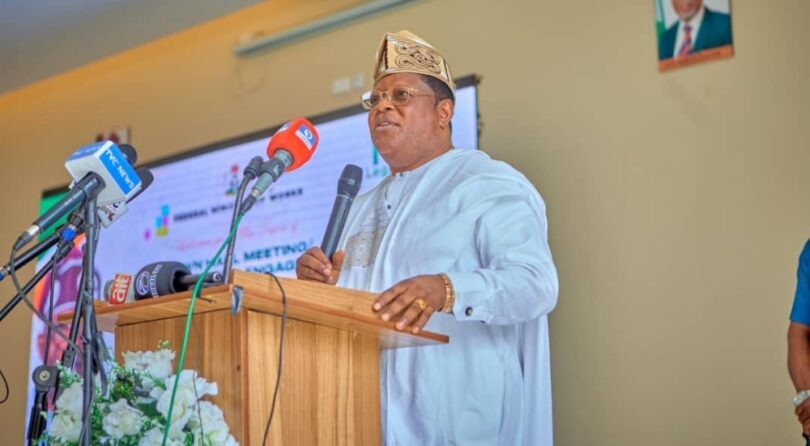
The Minister of Works, Senator Dave Umahi, has disclosed that Section Two of the Lagos-Calabar Coastal Highway is expected to be completed by November, while Section One is substantially completed and ready for inauguration.
Umahi disclosed this while speaking with journalists during an inspection tour of the highway project on Wednesday evening in Lagos.
He said that some ongoing works, including flyovers, underpasses and interchanges being observed on the corridor, belonged to section two of the project.
“Some of the works you are seeing, such as underpass, overpass and the interchange, belong to section two.
“Section one does not have any flyover. You may be asking why we say it is ready while flyover construction is still ongoing. Those works belong to section two,” he said.
The minister also said that about 200m of pavement had been intentionally left unfinished due to soil settlement concerns.
“We have been checking the settlement there, and it is settling very fast. We do not want to take chances.
“If after two weeks we are not satisfied with the settlement, we will put flexible pavement there temporarily for one year before replacing it with rigid concrete pavement,” he said.
According to him, rigid concrete pavement does not tolerate settlement because it can crack.
Umahi said that only minor works such as shoulders and landscaping remained on section one.
He expressed satisfaction at the quality of work by the contractor, Hitech Construction Company, and praised President Bola Tinubu for initiating legacy infrastructure projects across the country.
“We are doing the same in Sokoto, Kebbi, Badagry, Oyo, Cross River, Akwa Ibom, Ebonyi, Benue, Kogi, Jos, Gombe and Biu.
“These legacy projects are spread across the six geopolitical zones, and it shows that the president is fair,” he said.
Umahi added that by November, the coastal highway construction would have reached the Ogun/Lagos border.
He noted that the highway construction was also progressing on the Ogun/Ondo axis.
“Before this time next year, motorists will be able to drive all the way to Ondo, while work on the Edo section will commence,” he said.
He assured Nigerians that roads constructed under the current administration were designed to last for between 50 years and 100 years.
The Federal Controller of Works in Lagos, Engineer Olufemi Dare, said that 47km Section One of the coastal highway was 98 per cent completed.
“The remaining works within the next two weeks are mainly tree planting and walkways.
“I can confidently say that this project is completed and ready for commissioning,” he said.
The Director of Bridges and Design in the Federal Ministry of Works, Engr. Musa Saidu, said that the construction met all engineering standards of the ministry.
“As you can see, from Victoria Island to Chainage 47, engineering-wise, the project is complete.
“What remains are aesthetics such as tree planting, solar installations and about 100 metres of continuously reinforced concrete pavement awaiting settlement,” he said.
The Senior Special Assistant to the President on Community Engagement (South-West), Mrs Moremi Ojudu, described the highway as a major economic corridor for the South-West and Nigeria at large.
Similarly, the Senior Special Assistant to the President on Community Engagement (South-East), Mrs Chioma Nweze, commended the Federal Government for extending legacy infrastructure projects to the South-East.
She cited ongoing work on the Trans-Saharan Road as evidence that no geopolitical zone was left out.
The Chairman of the House of Representatives Committee on Works, Hon. Akin Alabi, described the project as a dream come true.
He recalled that the coastal highway was envisioned by Tinubu when he was the Governor of Lagos State.
He commended the president, Umahi and the National Assembly for supporting the project through funding and oversight.
Also, Senator Osita Ngwu, a member of the Senate Committee on Works, said that initial doubts about the project had disappeared following visible progress on it.
“It is difficult for anybody to come here and not be impressed.
“This is what we call a legacy project, and I encourage Nigerians to visit and see what the government is doing,” he said.