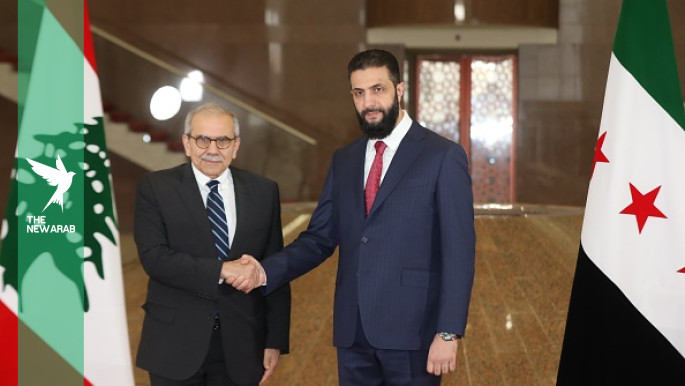
Lebanon’s Salam (L) meets with Syria’s Sharaa during an official visit in Damascus in April 2025. [Getty]
Lebanese Prime Minister Nawaf Salam is set to meet with Syrian President Ahmed al-Sharaa in Damascus on Saturday, where they will discuss pressing issues between the neighbouring countries.
Salam will be accompanied by Deputy Prime Minister Tarek Mitri and several other cabinet ministers, Lebanese sources told The New Arab. The prime minister last met with Sharaa in Damascus in April last year.
Saturday’s visit will explore ways to boost cooperation across security, economic and trade sectors and bolster bilateral relations. Each minister is expected to meet their Syrian counterpart to address outstanding issues, the sources said.
Talks between the governments in Beirut and Damascus have largely focused on border control and demarcation, and the return of more than a million Syrian refugees still in Lebanon.
The 375-kilometre border between Lebanon and Syria has long been notorious for smuggling—notably cross-border human trafficking and the smuggling of drugs, fuel and other goods—with authorities in both countries finding it difficult to control.
But reports over the past year have indicated that joint efforts have successfully clamped down on many traffickers.
The porous border has yet to be fully demarcated, with Saudi Arabia playing a mediating role in talks over its delineation.
The Lebanese ministerial sources told The New Arab that discussions on Saturday in Damascus would address the conflict in the region, including Israel’s offensive on Lebanon, and talks between Beirut and Tel Aviv.
Syria has managed to distance itself from the Middle East war triggered by US-Israeli strikes on Iran, but Israeli forces still occupy parts of southwestern Syria and have conducted strikes across the country.
A main topic of discussion will be unresolved judicial matters and the issue of Syrian refugees who fled to Lebanon to escape the Syrian civil war, especially attacks by the Assad regime. Many have returned to Syria since Israel resumed its wide-scale attacks on Lebanon in March.
In February, Lebanon and Syria also signed a deal to begin transferring Syrian prisoners back to their country, which had been a key demand by Damascus to improve ties. Many detainees are in prison for suspected ties to extremist armed groups.
Lebanon and Syria share a turbulent history. The former Assad regime occupied its smaller neighbour and dominated it politically between 1990 and 2005, when it was forced to leave after the assassination of then Lebanese prime minister Rafik Hariri.
Since President Bashar al-Assad’s ouster in December 2024 and a new Lebanese government took hold, both countries have reiterated the need to rebuild ties based on mutual respect, without interfering in each other’s affairs.
Salam’s government has said it would prioritise the return of Syrian refugees through a clear plan and open a serious dialogue with Syrian authorities to review bilateral agreements in a way that serves the interests of both countries.
Many agreements signed under the deposed Assad regime were seen in Lebanon as disproportionately serving Syrian interests.
The new Islamist-led government in Damascus resents the Lebanese militant group Hezbollah, which fought alongside Assad’s forces during Syria’s civil war, and has accused the group of planning and conducting attacks in Syria. Hezbollah has denied the allegations.