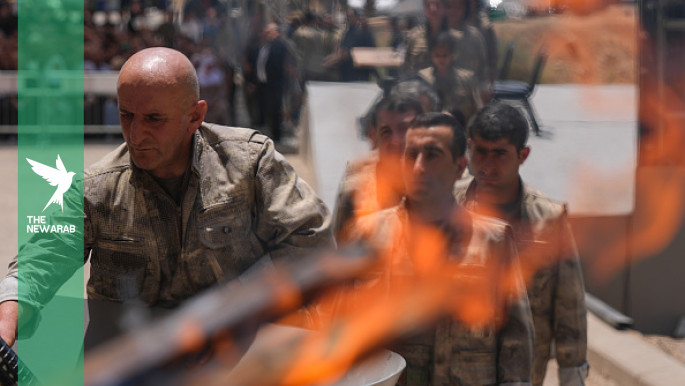
The PKK says its symbolic destruction of weapons in Iraq showed commitment to peace [Getty]
Turkey’s peace process with the Kurdistan Workers’ Party has entered a period of stagnation, amid growing disagreements over disarmament, legal reforms, and the future role of jailed leader Abdullah Ocalan.
The slowdown comes despite months of talks under Ankara’s “Turkey free of terrorism” initiative, launched in late 2024 to end the decades-long conflict between the Turkish state and the PKK.
Although the PKK formally announced its dissolution and the end of armed conflict on 12 May 2025, progress has stalled over competing demands from both sides.
The group carried out a symbolic handover of weapons in the Iraqi Kurdish city of Sulaymaniyah in July 2025, but Kurdish parties and PKK figures say Ankara has failed to follow through with promised political and legal measures.
PKK Executive Committee member Murat Karayilan accused Turkish authorities of “effectively stopping the process” by refusing to take what he described as concrete steps toward peace.
In comments to the PKK-linked Firat News Agency, Karayilan said the continued isolation of Ocalan was undermining negotiations, adding that the jailed leader had not met representatives from the pro-Kurdish Peoples’ Equality and Democracy Party for a month.
“One of the main conditions for continuing the agreement is the release of Abdullah Ocalan,” Karayilan said, describing it as essential for the success of the process.
Other senior PKK figures, including Mustafa Karasu and Sozdar Avista, also called on Ankara to remove what they described as obstacles to the talks and introduce legal guarantees for Kurdish political participation.
The PKK has argued that legislative reforms must accompany disarmament, including changes related to prosecutions, political participation, and the status of Kurdish politicians removed from office over alleged PKK links.
Turkish authorities, however, insist the group must fully disarm before any legal changes are introduced.
Turkish President Recep Tayyip Erdogan said last week that the process remained on track despite criticism from Kurdish groups.
“Despite all covert and overt attempts at sabotage, we have passed the 18th month of the process and succeeded in overcoming many critical obstacles calmly,” Erdogan said during a parliamentary group meeting.
He added that the atmosphere surrounding the talks remained positive and that the next stage would require “careful management”.
Erdogan later met coalition partner Devlet Bahceli, whose nationalist party has unexpectedly backed the peace initiative.
Bahceli recently proposed granting Ocalan a formal role in the process through an “Office of Coordination for the Peace and Politicisation Process”, arguing that the PKK founder should work within a defined legal framework.
The talks were initially launched after meetings with Ocalan in prison and appeals from him for the group to dissolve and lay down arms, culminating in the PKK’s announcement last year.
However, key Kurdish demands remain unresolved, including possible legal reforms linked to Ocalan’s life sentence and the fate of imprisoned Kurdish politician Selahattin Demirtas.
DEM Party foreign relations spokesperson Ebru Gunay said contact with Ocalan had been cut since 27 March, calling the interruption “a serious problem given the sensitivity of the process”.
She said the government had yet to implement recommendations prepared by a parliamentary committee tasked with advancing the initiative.
“Legal arrangements and guarantees are among the most important confidence-building measures, but there is no initiative from the government,” Gunay said.
Security sources in the Kurdistan Region of Iraq told The New Arab that PKK fighters remain active in areas near the Turkish border, including the Qandil Mountains, Zakho, Amadiya and Soran.
A commander from the Kurdish Peshmerga forces said Turkish drone surveillance and military monitoring continued along border regions, although direct clashes and airstrikes had decreased significantly compared with previous years.