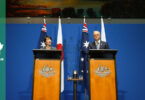

As the United States piles pressure on Lebanon to hold a direct meeting between President Joseph Aoun and Israeli Prime Minister Benjamin Netanyahu, a growing chorus of Lebanese and Arab figures have warned against the costs of such a move.
On Monday, prominent Arab intellectual Azmi Bishara cautioned Lebanon against what he described as the political and strategic risks of such a move.
His comments, posted to social media, come amid reports that Lebanese President Joseph Aoun is considering a meeting with Israeli Prime Minister Benjamin Netanyahu at the White House, a prospect that has stirred debate in Lebanon and across the region.
Being forced to restate this is uncomfortable, but necessary,” he wrote in Arabic, warning that any meeting with Netanyahu would carry serious implications. He noted that the Israeli leader is “a wanted war criminal by the International Criminal Court,” adding that “any Arab meeting with him amounts to rehabilitating him while his crimes continue”.
Bishara, who heads the Doha-based Arab Center for Research and Policy Studies, also questioned the premise of negotiations under current conditions, arguing that Netanyahu “is not concerned with a ceasefire” and instead sees Lebanon as the party that “must pay a price” for it.
On the substance of any potential agreement, Bishara warned that Israeli withdrawal to internationally recognised borders would not come without far-reaching conditions. “From Israel’s perspective, withdrawal… would come only in exchange for a peace agreement,” he wrote, adding that this would go beyond normalisation to include alignment against Hezbollah—“effectively turning the conflict into an internal war”.
Bishara cautioned that entering talks without clear guarantees could weaken Lebanon’s negotiating position. A meeting that does not produce concrete outcomes, he suggested, may instead serve to bolster Israel diplomatically, particularly in the eyes of the United States.
He also cautioned it could serve as a continuation of the “discredited Abraham Accords” after the war.
The reports of a possible White House meeting come as tensions remain high along the Lebanese-Israeli border, with continued Israeli strikes and detonations in southern Lebanon. Israel has killed over 2500 Lebanese since the current round of fighting began on 2 March. The ceasefire announced on 26 April expires on 17 May, and Israel has violated it thousands of times.
On Monday, the US envoy to Lebanon Michel Issa downplayed the significance of a meeting at a press conference near Beirut, saying “Netanyahu is not a monster”.
Netanyahu’s campaign in Gaza after 7 October 2023 likely amounts to genocide in which over 80,000 Palestinians have been massacred.
Lebanese former prime minister Fouad Siniora, who is considered pro-peace with Israel, said in late April that a Lebanese meeting with Netanyahu would be a ‘sin’.
Hundreds have protested in Beirut against direct talks or a peace treaty with Israel while the latter’s occupation and violations continue.
Reports suggest Saudi Arabia and Egypt have also advised the Lebanese government not to offer such a major conession to Israel without securing a full withdrawal and ceasefire first.