
Apple’s steep price hikes in Macs and iPads are spotlighting the chip crunch, raising fears that Android phones and Windows PCs could be next. While various tech companies have been highlighting this issue for a long time, how real is the supply shortage on ground?
How Chip Shortage Affects Consumers
Memory chips go unnoticed until your laptop lags, phone gets pricier, or cloud bill spikes. Memory is essentially a computer’s working space. It temporarily holds everything the system is actively using, from web pages and videos to spreadsheets and AI tasks.
DRAM is the high-speed memory that powers servers, PCs and smartphones, while NAND is used for long-term storage in solid-state drives. Then there’s HBM, or high-bandwidth memory, a more advanced form placed close to AI chips to handle massive data flows at much higher speeds. HBM matters most right now because AI workloads are extremely memory-intensive, pushing demand for faster, high-capacity memory to new limits.
“Memory prices have risen more than six-fold over the last year, a sharp break from decades when the cost of DRAM generally kept falling,” according to Shawn Kim, Head of Morgan Stanley’s Europe and Asia Technology Team. The pressure is coming from AI infrastructure buildouts, he added.
How Profound Is The Shortage?
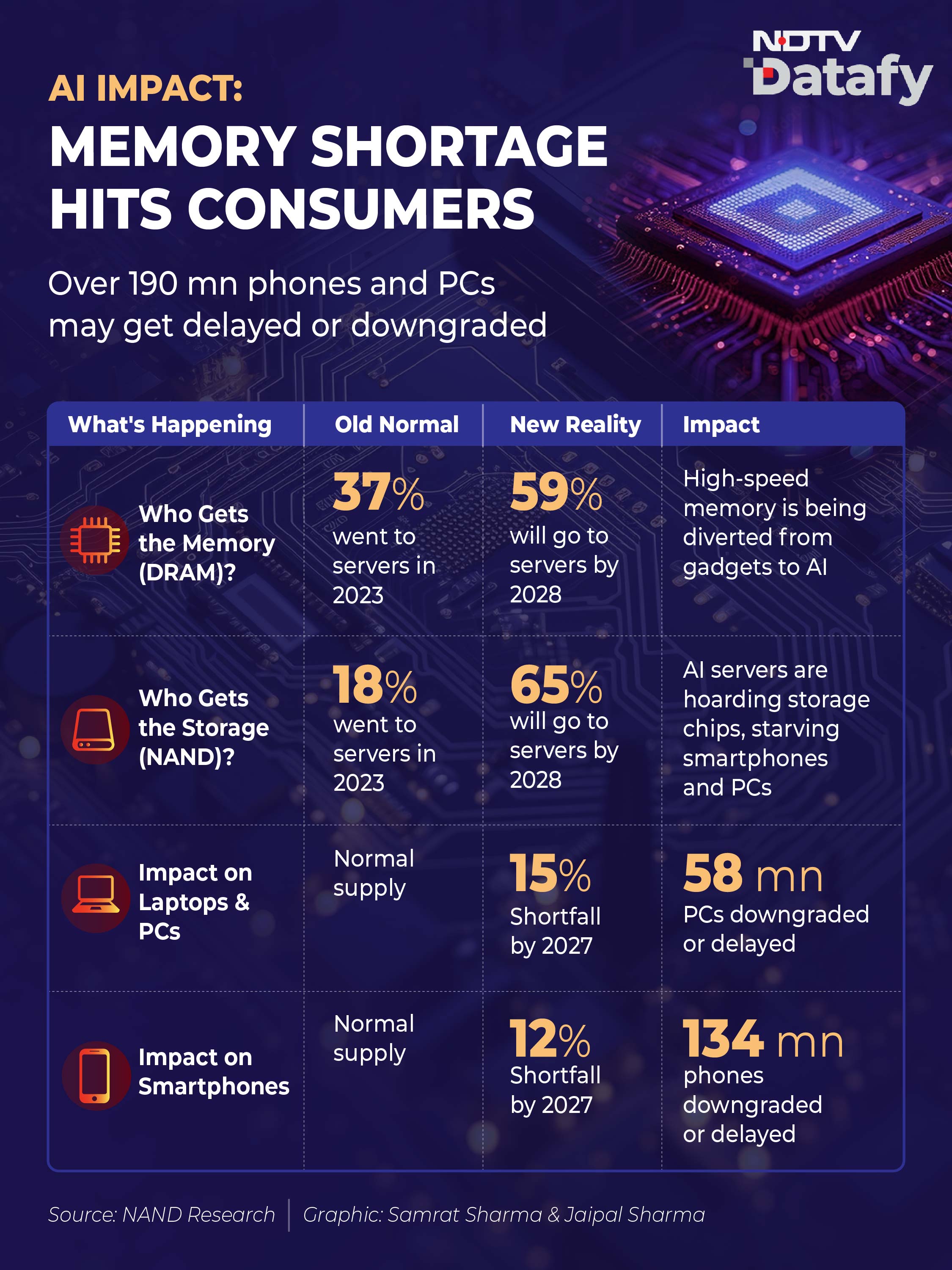
An unprecedented AI data centre boom is triggering a massive $670 billion surge in the global memory market, expanding it to $890 billion by 2026, according to Morgan Stanley. To feed hungry AI servers, manufacturers are aggressively hoarding components, poised to pull 59 per cent of high-speed memory and 65 per cent of storage chips by 2028.
This reallocation is directly starving consumer electronics. It is estimated that laptop and smartphone manufacturers may face severe double-digit supply shortfalls by 2027. Consequently, over 190 million PCs and smartphones may be hit with inevitable delivery delays or shipped with slower, downgraded parts to keep retail prices stable.
Samsung Electronics while announcing the first quarter 2026 results said, “The Memory Business surpassed its quarterly sales record by addressing high-value-added AI demand despite limited supply availability, with industry-wide memory price increases also a contributing factor.”
Steep Rise In Chip Prices
A historic supply crunch has sent chip costs skyrocketing. The hardest-hit component is PC memory, which has doubled in cost . It is closely followed by a massive up to 95 per cent price spike in memory chips powering smartwatches, automotive systems, and AI supercomputers, according to NAND Research.
Smartphone memory is experiencing its own crisis: raw phone storage has jumped by up to 60 per cent, corporate data storage is up by nearly 58 per cent, and consumer SSDs for laptops and gaming consoles are 40 per cent more expensive. This unprecedented quarterly inflation in Q1 2026 is expected to trigger higher retail prices and downgraded device specifications.
The cost structure of a smartphone is heavily dependent on the memory used. For a mid-range device, memory can represent 15-20 per cent of the total bill of materials while for a high-end flagship device, it is around 10-15 per cent, according to a Market Intelligence Agency IDC.
AI Hits Non-AI Supplies
Amid a clear focus on AI, the sufferings will be more with non-AI electronics. “Memflation will destroy, or at least delay, non-AI demand into 2028, to varying degrees depending on the application,” Rajeev Rajput, Senior Principal Analyst at Gartner.
Meanwhile, AI has turned memory from the cheapest part of the digital economy into one of its most contested resources. These tiny chips most people never think of may now decide what gets built or delayed, and how much we all end up paying.