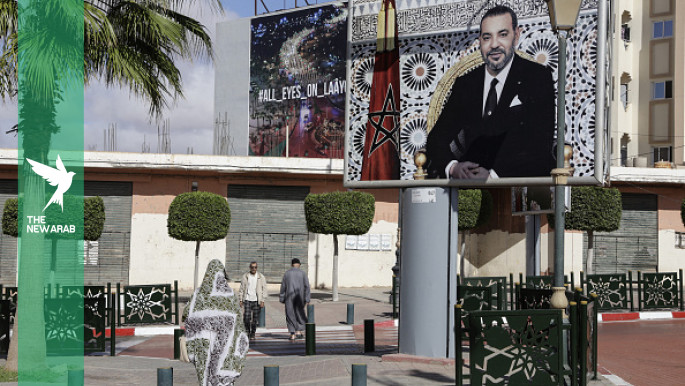
Questions remain over the extent to which the alliance can advance, given the long history of internal divisions and splits within the Moroccan left since its formation. [Getty]
The Democratic Left Federation and the Unified Socialist Party are moving toward finalising details of an electoral alliance ahead of Morocco’s parliamentary elections scheduled for 23 September.
The step marks a notable shift after five years of estrangement between the two parties. It signals a renewed effort to prioritise unity over fragmentation, which has long characterised the Moroccan left.
The upcoming national council meetings of the Democratic Left Federation, which brings together the Democratic Way, the Socialist Democratic Vanguard Party, the Unified Socialist Left—a breakaway from the Unified Socialist Party—and the Unified Socialist Party itself, are expected to be decisive.
The meetings are due to take place on Sunday, 3 May, to approve an electoral alliance framework by creating a party alliance, as outlined in Article 55.1 of the Organic Law on Political Parties.
The law states that “two or more political parties may ally on the occasion of elections for municipal councils, regional councils, and members of the House of Representatives. The alliance applies at the national level. A political party may not belong to more than one alliance for the same elections.”
It also provides that “a political party alliance may, under its endorsement, present lists including candidates who must belong to the parties forming it, in whole or in part, where applicable” and that “the political affiliation of each candidate shall be indicated in the lists.”
The law also stresses that “the alliance may also, under its endorsement, present candidates belonging to one of its constituent parties in constituencies where elections are held by single-member ballot.”
The two parties had pre-empted the national council meetings in a joint statement issued on Saturday, 3 May, following a meeting of their political bureaux.
They said they had discussed ways to strengthen joint action and unify efforts to develop programmes capable of addressing current challenges.
They also emphasised the need to bring political positions within the left closer together, opening the door to new possibilities for convergence.
The parties highlighted the importance of the upcoming political phase and its implications for restructuring the party landscape.
Both parties stressed that this potential rapprochement is part of a broader process of joint reflection aimed at building a more coherent political platform capable of driving democratic change.
They added that the coordination process remains open and is expected to deepen in the coming period, particularly as legislative elections approach.
As the 2026 House of Representatives elections draw nearer, political debate has resurfaced over the possibility of parties, particularly those on the left, forming alliances that could strengthen their parliamentary presence in Morocco.
At one point, discussions had pointed to the possible formation of an electoral bloc bringing together the Party of Progress and Socialism, the Unified Socialist Party, and the Democratic Left Federation in an attempt to present a joint political platform and a more influential left parliamentary bloc.
The talks did not lead to an agreement.
However, the Democratic Left Federation and the Unified Socialist Party have since moved closer to announcing an electoral alliance for the upcoming vote.
The two parties’ national councils, scheduled for 10 May, are expected to be a decisive moment in determining the direction of this process.
Questions remain over the extent to which the alliance can advance, given the long history of internal divisions and splits within the Moroccan left since its formation.
Both parties share broadly similar political positions, particularly support for a parliamentary monarchy as a minimum framework for political reform.
They previously helped establish the Democratic Left Federation on 30 January 2014, alongside the Socialist Vanguard Party and the National Ittihadi Congress, to unify the Moroccan left.
Since then, they have contested elections on joint lists under the alliance.
That unity unravelled ahead of the 2021 elections when the Unified Socialist Party unexpectedly withdrew its signatures from joint lists submitted by the “Democratic Left Federation” to Morocco’s Interior Ministry and ran independently.
The decision triggered a deep split among the left and disrupted the alliance many had viewed as a potential unified left-wing force.
In recent months, as the 23 September elections approach, coordination between the two parties has resumed.
This has led to the creation of a joint technical mechanism to develop a practical framework for electoral coordination, particularly regarding candidate selection and constituency allocation.
This work uses the 2021 election results as a reference to determine which party leads in each district.
Abdelhafid Younsi, a political science professor at Hassan I University in Settat, said efforts are underway to revive the alliance on a new political basis ahead of the legislative elections.
“The joint statement issued by the two parties last Saturday was vague regarding the form of this cooperation, whether it is an alliance like before or an opening to field candidates jointly in all or some constituencies,” he told The New Arab. “But beyond this technical political analysis, the question remains whether this coordination or alliance can disrupt the political scene, build new balances of power, or influence voting intentions.”
Younsi added that “the reality shows we are dealing with politically modest electoral parties, even if they are politically present.”
“Electoral presence is linked to objective factors such as geographical reach and organisational capacity to manage elections, financial resources and the ability to fund a strong campaign,” he said.
He added that “political presence is also shaped by positions on complex societal issues linked to the economy and identity.”
Mohamed Allal Fajri, a Moroccan political science researcher, said rapprochement between left-wing opposition forces in parliament is expected and could lead to an electoral alliance aimed at improving their position in the parliamentary map following the September elections.
This could take the form of joint lists or a shared electoral programme.
He said it would be a miscalculation for parties with ideological convergence to contest elections separately, even with near ideological alignment between the two parties.
Fajri said one of the key indicators of the Moroccan left’s crisis is its failure to reach political maturity.
He attributed this to conflicting interests and psychological and subjective factors that limit its ability to assess its real capabilities in a fragmented political landscape.
He also pointed to constraints linked to the electoral system.
He added that ideologically and politically aligned parties, as well as those sharing a similar assessment of the current situation and the stakes after the 23 September elections, should form alliances and develop a unified electoral discourse to confront the forces dominating the government.
This would allow voters to compare government performance with opposition programmes better.
It would also strengthen accountability within the limits of Morocco’s constitutional framework, particularly regarding executive authority.
In the 2021 parliamentary elections held on 7 September, both the Democratic Left Federation and the Unified Socialist Party each won one seat in the House of Representatives, held by Fatima Tamtni and Nabila Mounib, respectively.
Article translated from Arabic by Afrah Almatwari. To read the original, click here.