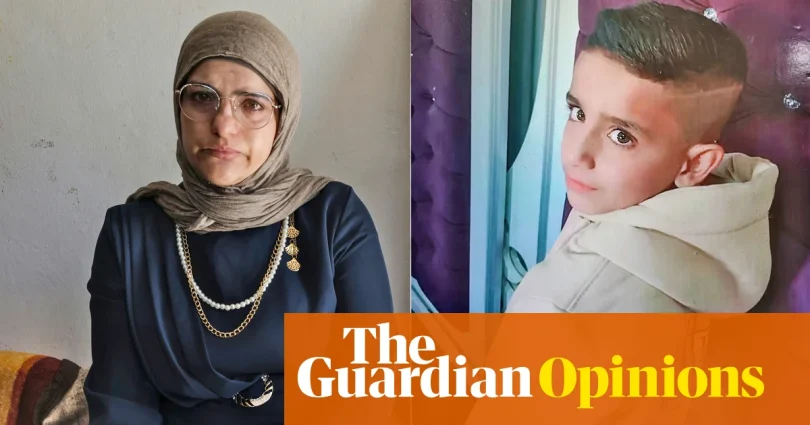
My name is Aliyah Abdel Majid al-Halaq. I am 33 years old, from the village of ar-Rihiya, south of Hebron, and the mother of five children. My eldest daughter, Mais, is 14. My youngest son, Elias, is five. Between them was my beloved nine-year-old son, Mohammad.
I always knew that life under occupation was built on violence, humiliation and fear. No Palestinian mother needs to be taught that. Still, I tried to protect my children from the full weight of that truth. I told myself that the poverty we lived in was the greatest hardship we had to endure; that patience would carry us through; that despite everything, our children could still grow up happy. On 16 October 2025, the day the Israeli army killed Mohammad, even that fragile belief was taken from me. I understood then that occupation does not only take land, freedom or dignity. It takes away something even more fundamental: a parent’s certainty that her child will come home. It turns every Palestinian mother into someone who lives in constant anticipation of loss.
Before Mohammad was killed, most of our life revolved around trying to protect our family and earn enough to feed our children. My husband, Bahjat, worked far from home at a supermarket, earning just a few dozen shekels a day. Only on weekends he returned, bringing whatever was left after paying for his food and accommodation. To support our family, I sold homemade sweets. This helped ease the hunger of our children. Despite these hardships, they were still too young to understand injustice or the cruelty of life.
Mohammad came home from school once overjoyed by the brand-new backpack he received from Unicef. His happiness filled our home. His siblings celebrated with him. I remember realising that day how even something as simple as a new school bag could fill a child’s heart with joy. Mohammad loved football. He asked if he could go and play with his friends on the school playground nearby. I said yes. It was the last time I saw him alive.
Later, I went to the supermarket with my father and my other children. My father’s phone rang. Without thinking, I grabbed it. My mother’s instinct was telling me the call was for me. The man on the line asked about Mohammad. The moment he realised I was his mother, he hung up. I knew something had happened. A few minutes later, I saw a WhatsApp video of young men carrying Mohammad as blood poured from his body. His blue school uniform had turned red. I collapsed.
When I regained consciousness, I was in the hospital. At first, I was told Mohammad’s injuries were minor. Then they said he had been taken into surgery. Moments after the surgeon came out, I heard cries of Allahu Akbar and people weeping. The next thing I remember is waking up at home, hearing my husband’s heartbreaking cries as young men brought Mohammad’s body back. He looked peaceful, almost as though he was asleep.
Eyewitnesses later told me what had happened. Israeli soldiers had entered the village. When they neared the school’s playground, they began firing teargas. Mohammad and his friends escaped. He stopped about 100 metres away and stood with his arms folded. Then one of the soldiers fired, striking him in the pelvis.
He had done nothing. I still cannot understand why that soldier opened fire, or whether there was any reason at all – or whether, in his eyes, being a Palestinian child was reason enough. According to eyewitnesses, even after Mohammad was wounded and bleeding heavily, soldiers continued firing, preventing the assistance of those trying to reach him and carry him to safety.
For months, I searched for an explanation. I no longer believe one exists. What remains is a question I cannot escape: how is it possible that a mother should ever have to ask why a soldier shot her nine-year-old child?
At first, you believe your tragedy is unlike any other. Then you discover that your family has become part of an ever-growing list. More mothers, each carrying the memory of the moment after which life was never the same. In my case, that list has grown to include 54 Palestinian families in the occupied West Bank whose children were killed by Israel in 2025 alone.
When it happens once, it can be called a tragedy. When it happens constantly, we must ask what allows it to continue. How is it possible that so many Palestinian children are killed, yet no one is held accountable? Not a single soldier has been indicted over the killing of my son after he went to play soccer.
Today, I understand occupation differently. There was a soldier who pulled the trigger and killed Mohammad. But there is also a system that protects those responsible, conceals reality and almost never holds anyone accountable.
And there is a world that remains silent.
Since October 2023, the world has not done anything to stop Israel from killing more than 21,500 Palestinian children and teenagers in Gaza. It has also stood by as Israel killed 248 Palestinian minors in the occupied West Bank during the same period. It did not stop Israel from killing my son. Nor has it ensured that Israel is held accountable for its actions.
after newsletter promotion
Since Mohammad’s killing, our lives have changed entirely. Every day has become a struggle to survive. My husband lost his job and struggles with trauma. I live between my son’s grave, his photograph and his brand-new backpack that still hangs on the wall of his room. Poverty and hunger have become intertwined with grief and pain that are almost impossible to bear. Every day, I try to hide my tears from my children. I try to hide the fear that now lives inside me, the loss of any sense of safety, and the endless questions with no answers.
I am writing these words because I refuse to let Mohammad become just another number.
I want people to remember that he was a boy in the fourth grade. That he loved football. That he loved catching birds only to set them free. That he dreamed of becoming a doctor, so that one day people would call him “Dr Mohammad”. That he came home overflowing with joy because of a new school bag, went to play soccer, and never returned.
With Mohammad’s immense loss, I also lost my belief that childhood, in itself, offers protection. One bullet ended his dreams and left behind a mother who asks herself every day: how many more children must die before the world recognises that Palestinian children deserve to live like every other child?
Aliyah and Mohammad’s story was gathered as part of B’Tselem’s report Unshielded Childhood, documenting the killing of Palestinian children and teenagers by Israel in 2025