
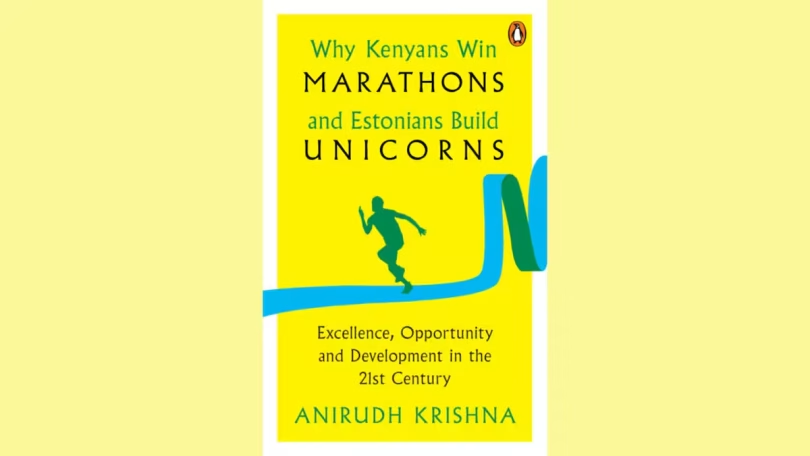
In “Why Kenyans Win Marathons and Estonians Build Unicorns”, scheduled to release on July 26, development scholar and author Anirudh Krishna, examines what he describes as “flows of excellence” — sustained, world-leading performance by people from a particular country or region in specific fields.
Drawing on more than a decade of research, the book challenges popular assumptions that exceptional achievement is predetermined by inherited traits, climate or culture.
Instead, it argues that excellence emerges where governments, institutions and communities invest in long-term pathways that identify, nurture and support talent.
“Anyone can build the infrastructure of opportunity. Projects of world-class excellence have come up amid a variety of conditions — in post-Soviet Estonia, totalitarian North Korea, democratic South Korea, low-income Kenya, lower-middle-income Jamaica, modern-day Finland, oil-poor Nigeria, etc.
“None of these flows emerged spontaneously. Each is the product of deliberate investments, following a common set of core design principles,” the author writes in the book.
His research spans a diverse range of examples, including marathon runners from Kenya and Ethiopia, sprinters from Jamaica, technology entrepreneurs from Estonia, writers from Nigeria, schoolteachers from Finland, female golfers from South Korea, wrestlers from Haryana and even hackers from North Korea.
Based on field visits, interviews with athletes, coaches, administrators and experts, as well as secondary research in inaccessible locations such as North Korea, the study concludes that successful ecosystems of excellence have emerged in countries of varying sizes, incomes, climates and political systems.
The book disputes commonly held explanations linking sporting or intellectual success primarily to genetics or geography.
It notes that Jamaica’s dominance in sprinting and Kenya’s supremacy in long-distance running are relatively recent phenomena, despite both countries having possessed the same genetic and geographical characteristics for generations.
For instance, the book argues that Jamaica did not become a sprinting powerhouse immediately after independence in 1962. The country’s Olympic medal tally remained modest for decades before rising sharply around the turn of the millennium.
Similarly, Kenya’s marathon dominance accelerated only in the mid-2000s after decades of more limited success.
”Many attribute the Kenyan runners’ successes to their elevated training grounds that rise to 8000 feet above sea level in Kenya’s Rift Valley — as living and running at such a high altitude develops greater aerobic capacity and hones other physiological advantages.
”But if altitude were the most important factor involved, then surely there would be many more world-class long-distance runners hailing from other high-altitude places, such as Lhasa, Tibet (11,900 feet), La Paz, Bolivia (11,000 feet) and Mammoth Lakes in California (7,880 feet),” the book questions.
The central argument the book makes is that excellence depends on the existence of a visible, accessible and continuous ”ladder of opportunity” that allows talented individuals to progress from grassroots participation to world-class performance.
“Why Kenyans Win Marathons and Estonians Build Unicorns”, published under Penguin Random House India’s ’Viking’ imprint, is currently available for pre-order online. It is priced at ₹699.