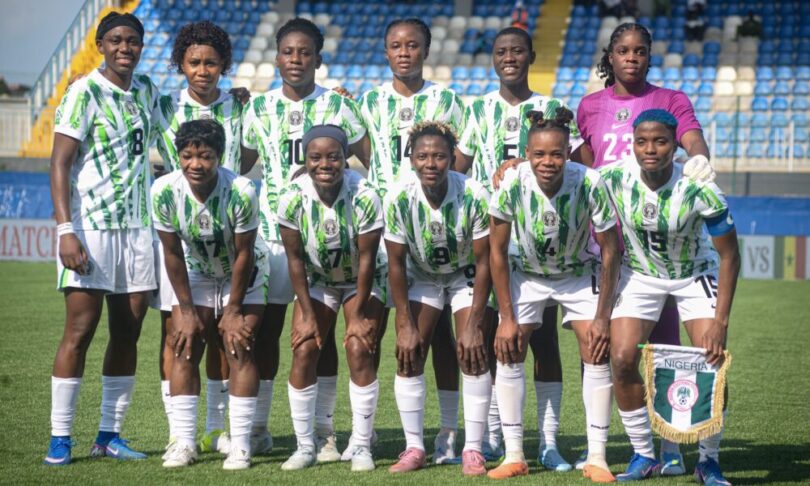
Beyond the scoreline, the performance offered interim coach Augustine Eguavoen encouraging signs of a team beginning to rediscover its defensive solidity while exploring fresh possibilities in attack
Nigeria’s Super Falcons took another confident step towards the 2028 Los Angeles Olympic Games after dismantling Comoros 5-0 on Tuesday to complete a 7-0 aggregate victory and advance to the third round of the qualifying campaign.
The Super Falcons were expected to overcome Comoros, particularly after establishing a two-goal advantage in the first leg. However, the manner in which they completed the job was important, especially for a side seeking to rebuild confidence and consistency following a disappointing 2026 Women’s Africa Cup of Nations campaign.
Comoros had thrashed Sudan 30-0 on aggregate in the opening round of the qualifiers, but Nigeria exposed the considerable gulf in quality between the two sides, keeping clean sheets in both meetings and scoring seven unanswered goals.
The next assignment against Morocco will demand significantly more from the nine-time African champions. Before that potentially defining encounter, Premium Times examines five major takeaways from Nigeria’s victory, ranked by their importance to Eguavoen’s rebuilding project.
For a team with ambitions of returning to the Olympic Games, defensive organisation will be just as important as attacking firepower. Nigeria’s two-legged victory over Comoros provided an encouraging indication that the Super Falcons may be finding greater stability at the back.
The Nigerians conceded no goals across both matches, recording consecutive clean sheets for the first time since the group stage of the 2024 Women’s Africa Cup of Nations.
Although Comoros offered limited attacking threat, their impressive 30-0 aggregate demolition of Sudan in the previous round meant they could not be dismissed entirely. Nigeria, however, restricted their opponents and completed the tie without allowing them a route back into the contest.
Perhaps the most encouraging aspect was Eguavoen’s decision to trust a new centre-back partnership involving Shukurat Oladipo and Christy Ucheibe. The pair looked composed, mobile and complementary, showing a promising understanding of their defensive responsibilities.
Ucheibe’s contribution was particularly notable because she combined her defensive duties with a goal from the penalty spot, underlining her value at both ends of the pitch. Shukurat Oladipo put up a performance that reminded all why she was named the best defender in Italy last season.
The partnership still needs to be tested against opponents with greater technical quality and more sophisticated attacking movements. Nevertheless, Nigeria’s defensive display provides a useful foundation for the next round.
Morocco possess considerably more attacking quality than Comoros and are likely to ask harder questions of the Nigerian backline. If the Super Falcons can carry this organisation and concentration into that contest, they will give themselves a stronger chance of progressing.
The Super Falcons have completed the immediate task, but the real examination of Eguavoen’s side is approaching.
Nigeria will face Morocco in the third round after the Atlas Lionesses advanced following the withdrawal of the Republic of Congo from their second-round tie. The meeting promises to be a much more demanding contest, with progression in the Olympic qualifying campaign at stake.
Morocco have developed into one of Africa’s leading women’s football sides in recent years, making the fixture a significant test of Nigeria’s defensive discipline, midfield control and ability to convert attacking opportunities against stronger opposition.
There is, however, a source of confidence for the Super Falcons. Nigeria defeated Morocco 3-2 in the final of the 2024 Women’s Africa Cup of Nations, a result that demonstrated their capacity to withstand pressure and deliver when the stakes are high.
That victory will offer encouragement, but it should not be mistaken for a guarantee of success. The upcoming tie is a fresh contest, and Nigeria must show that they can reproduce their best football over two legs against an opponent capable of punishing defensive lapses.
The victory over Comoros has given Eguavoen room to assess his options and build momentum. The Morocco games will reveal whether the encouraging signs in the latest performance can translate into a result against elite continental opposition.
For Nigeria, the objective is no longer simply to score freely against a less experienced opponent. It is to demonstrate that the team can remain compact under pressure, compete in the decisive areas and produce the quality required to keep their Olympic dream alive.
Nigeria have never lacked outstanding goalscorers. From Mercy Akide and Perpetua Nkwocha to Asisat Oshoala, the Super Falcons have enjoyed generations of forwards capable of defining matches and carrying the weight of expectation.
But as Oshoala moves into the later stages of her career, Nigeria must continue identifying players who can shoulder the responsibility of leading the attack. Kanu’s performance against Comoros offered another reason to believe she can play a major role in that transition.
The forward scored twice in Tuesday’s encounter and finished the two-legged tie with three goals, strengthening her growing case as a dependable attacking option.
Kanu brings more than an eye for goal. Her strength allows her to compete physically with defenders, while her mobility gives Nigeria the flexibility to use her centrally or from wider attacking positions. She also showed an ability to remain involved in dangerous situations rather than relying solely on chances presented to her.
That variety could prove valuable against Morocco, where Nigeria may have fewer opportunities and will need their forwards to make the most of openings.
However, the next step is sustaining that effectiveness against higher-quality opposition. Goals against Comoros will provide confidence, but performances against Morocco would offer a more convincing indication of Kanu’s readiness to become one of Nigeria’s leading attacking figures.
With the Super Falcons searching for consistency and a reliable source of goals, Kanu has given Eguavoen another positive selection dilemma.
Michelle Alozie was arguably one of Nigeria’s standout performers across the two legs, delivering the kind of energetic and balanced display that could prove crucial in the more demanding rounds of the qualifiers.
Operating at right-back, Alozie covered the flank tirelessly, combining defensive responsibility with forward runs that gave Nigeria another route into attacking areas. Her work rate and willingness to contribute in both phases helped the Super Falcons maintain their threat while remaining organised.
Her performances were particularly encouraging after a difficult showing at the 2026 Women’s Africa Cup of Nations. The Comoros tie provided an opportunity to rebuild confidence, and Alozie took it by demonstrating the qualities that have made her a valuable member of the national team.
Modern full-backs are often required to do much more than defend their own penalty area. They must provide width, support attacks, recover quickly and make sound decisions when possession changes hands. Alozie showed encouraging signs in those areas over the two matches.