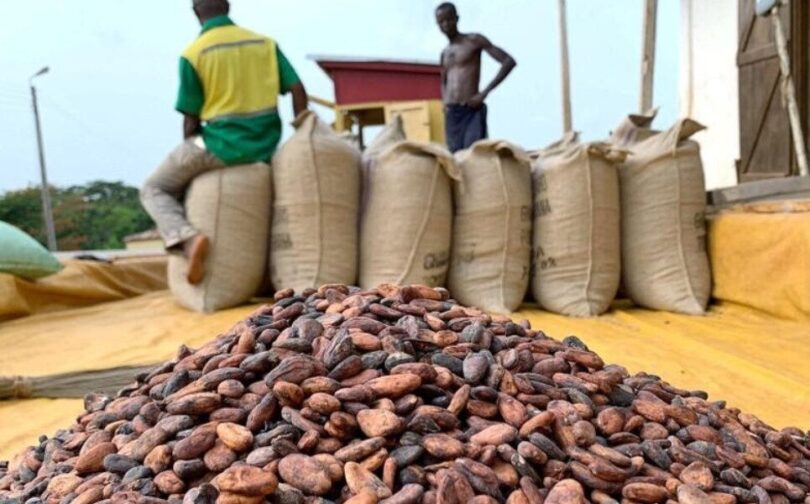
Nigeria’s cocoa bean exports to the United States rose from $21.7 million in 2024 to $142 million in 2025, according to the US mission in Nigeria.
Nigeria’s cocoa bean exports to the United States increased more than sixfold in 2025, rising from $21.7 million in 2024 to $142 million, the US mission in Nigeria has said.
“U.S. demand for Nigerian cocoa is booming. Cocoa bean exports to the United States jumped from $21.7 million in 2024 to $142 million in 2025,” the US mission said in a post on its official Facebook page on Tuesday.
The mission said the trade relationship also benefits Nigeria through US agricultural exports, noting that wheat accounts for 67 per cent of US agricultural exports to the country.
The trade, it said, represents “fair, two-way trade that works for farmers, businesses, and families on both sides of the Atlantic.”
The increase comes amid efforts to revive Nigeria’s cocoa industry, improve productivity and expand local processing to capture more value from the commodity.
Nigeria’s cocoa industry has struggled with declining productivity, ageing plantations and growing pressure from urbanisation and population growth, which continue to reduce available farmland in major producing states.
Many cocoa trees are between 20 and 40 years old, while the average cocoa farmer is about 60 years old. The ageing plantations and farming population have contributed to declining yields and limited youth participation in the sector.
Smallholder farmers also face high borrowing costs, inadequate access to fertilisers and pesticides, poor-quality or counterfeit seedlings, and limited access to affordable financing.
Meanwhile, international regulations, including the European Union Deforestation Regulation (EUDR), are increasing pressure on producers and exporters to demonstrate traceability and ensure that their supply chains are not linked to deforestation.
Nigeria’s limited domestic processing capacity is another major challenge. Historically, more than 80 per cent of the country’s cocoa has been exported in raw form, limiting opportunities for local value addition, industrial development, and job creation.
However, indigenous companies, including Johnvents, which operates in Ondo State, are seeking to expand domestic processing and the production of chocolate and other cocoa-derived products.
In a related development, EIB Global, the international development arm of the European Investment Bank Group, and First City Monument Bank (FCMB) announced €85 million in financing to support private-sector businesses across Nigeria’s agricultural value chains.
At least 70 per cent of the financing is expected to target the cocoa and dairy value chains.
Stakeholders and policymakers are also advocating the establishment of a National Cocoa Management Board to restore quality control, standardisation, and input distribution functions lost after the former board’s dissolution in 1986.
These proposals form part of broader efforts to improve the sector’s performance under Nigeria’s National Agricultural Technology and Innovation Policy (NATIP) 2022–2027, which seeks to increase agricultural output and strengthen the sector’s productivity and competitiveness.
According to the National Bureau of Statistics (NBS), Nigeria’s agricultural exports have grown significantly, with cocoa beans accounting for a substantial share of export earnings.
In the first quarter of 2026, Nigeria exported agricultural products worth ₦1.17 trillion. Cocoa beans accounted for ₦596.90 billion, alongside other major export commodities, including sesame seeds and cashew nuts.
Cocoa and its derivatives also accounted for 41.11 per cent of Nigeria’s non-oil export value in the first half of 2025.
Despite the recent increase in export value to the US, the country remains a relatively modest destination for Nigerian cocoa. In the first quarter of 2025, the US was the fourth-largest destination for Nigeria’s cocoa exports, accounting for about 6.1 per cent, behind countries including the Netherlands.
The increase in cocoa exports also comes against the backdrop of changing trade conditions between Nigeria and the US.
Nigeria’s overall exports to the US declined by 20.5 per cent in the first nine months of 2025, while the US tariff rate applicable to Nigerian goods increased from 14 to 15 per cent in August.
The US subsequently exempted certain commodities that it does not produce domestically, including cocoa, from its 10 per cent reciprocal tariff.
Global cocoa prices also declined sharply during 2025. Prices began the year at about $10,950 per tonne before falling to approximately $5,400 by November.
Nigeria’s cocoa production was also projected to decline by 11 per cent in the 2025/2026 season, raising concerns about the sustainability of export growth.
Although rising export values could strengthen Nigeria’s foreign exchange earnings and non-oil revenue, the benefits do not automatically translate into higher incomes for farmers.
Export earnings are influenced by international prices, demand and trading arrangements, while farmers’ incomes depend on farm-gate prices, bean quality and productivity.
Consequently, falling global prices and lower projected output could reduce farmers’ earnings even when export values rise.
Speaking to PREMIUM TIMES on Wednesday, Agbo Bassey, the National Secretary of the Cocoa Farmers Association of Nigeria, urged the government to organise farmers into cooperatives so they can sell in bulk and negotiate better prices with buyers.
He also called for investments in fermentation and drying centres to improve bean quality and ensure that farmers receive better prices for higher-quality produce.