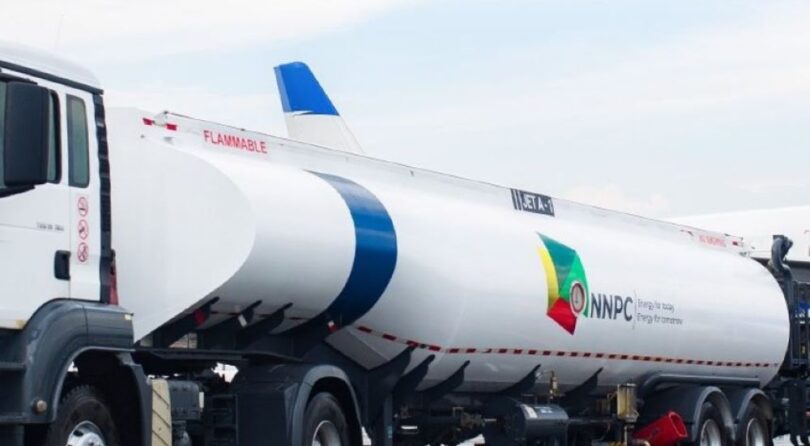
The presidency has announced a 30-day petrol price relief measure under which NNPC Retail will forgo its retail profit margin and sell petrol at cost amid former Vice President Atiku Abubakar’s promise to reduce pump prices by restoring petrol subsidy.
The measure was announced on Thursday by the Finance Minister and Coordinating Minister of the Economy, Taiwo Oyedele, as part of interventions introduced by the government in response to the rise in global crude oil and petrol prices.
Under the arrangement, NNPC Retail, which the government said already sells petrol at the lowest price in the market, will sell the product at its landing cost for 30 days.
This means where the company’s landing cost is N1,300 per litre, it will sell at N1,300.
The presidency said the decision was backed by President Bola Tinubu to cushion the effect of global crude oil price shocks and volatility on vulnerable households.
Oyedele urged other fuel marketers to follow NNPC’s example, arguing that the current surge in crude oil and petrol prices was unlikely to persist.
He, however, stressed that the temporary price relief should not be interpreted as a return to the petrol subsidy regime abolished by the Tinubu administration on May 29, 2023.
“This is neither a subsidy nor a price control: it is designed to smooth prices over time rather than suppressing them. The reasoning is simple. 1,400 naira a litre today and 1,400 tomorrow is better than 1,500 today and 1,300 tomorrow, because volatility itself adds to uncertainty and cost. And when fares rise sharply, they rarely fall as fast. The ceiling will be reviewed monthly, reset as costs require, and the figures published for transparency,” Oyedele said.
The government is also negotiating an N1,350 per litre ceiling on the ex-gantry or landing cost of petrol.
Under the proposed arrangement, refiners and importers would absorb costs above the ceiling and recover the difference later when crude prices or exchange rates become more favourable.
Oyedele said the government would also begin forward sales of crude to domestic refineries as production increases and previously committed crude becomes available.
The measure is expected to reduce the exposure of domestic petrol prices to movements in the international market.
The government said it was also working with states and security agencies to restrict the collection of road taxes and levies that add to transport and logistics costs under the 2025 tax reform laws.
The government is increasing funding for cash transfers to vulnerable households and subsidised credit for small businesses and consumers.
The government further announced an accelerated rollout of compressed natural gas, or CNG, in partnership with state governments.
The CNG, according to the government, is 60 to 70 per cent cheaper than petrol, with transporters expected to pass the savings on to passengers through lower fares.
The government also said it would consider an excess profit tax for operators found to be taking undue advantage of consumers anywhere along the energy value chain.
Revenue from such taxes, it said, would be used exclusively for measures such as transport support or vouchers for urban minimum-wage earners affected by higher fuel costs.
The Federal Government also plans to work with the National Assembly on enhanced tax relief for low-income earners under the 2027 Finance Bill.
Other measures include cutting regulatory costs that add to the cost of doing business and, indirectly, to the prices of goods and services.
The government plans to also establish a National Strategic Fuel Reserve, which it said would allow refined products to be released into the market under published rules during global supply disruptions or periods of hoarding.
The reserve, according to the government, would be used to protect supply and reduce price volatility rather than fix petrol prices.
Traffic management agencies are also expected to improve traffic flow in major urban centres to reduce fuel consumption, while the government’s newly launched NIPOST address codes are expected to reduce logistics costs.
The intervention comes weeks after Atiku promised to restore petrol subsidy as part of his 2027 Atiku Economic Recovery Plan if elected president.
Atiku framed it as a targeted production subsidy for petrol refined in Nigeria rather than a subsidy for imported fuel.
Under the proposal, qualifying public and private refineries would receive crude at preferential prices, subject to independently verified refining capacity, efficiency, regulatory compliance and domestic-supply obligations.
The refineries would be required to process the crude domestically and supply an agreed quantity of petrol to the Nigerian market under a transparent pricing formula that reflects the benefit of the cheaper crude.
Atiku’s camp has also proposed an annual fiscal ceiling and a sunset clause to reduce the intervention as domestic refining capacity and efficiency improve.
The proposed model includes electronic tracking of crude allocations, refinery output and domestic deliveries, as well as independent audits and penalties for diversion, falsification or failure to pass savings to consumers.
“We will move subsidy from importation to production, from middlemen to Nigerian refineries, and from unverifiable claims to verifiable barrels,” he had said.
The former vice president defended the proposal as a temporary and controlled intervention rather than a return to the previous subsidy regime.
Reacting, the presidency rejected the proposal, arguing that a return to subsidy would reverse the gains of the government’s market reforms and create renewed pressure on public finances.
The government maintained that the removal of the petrol subsidy regime was necessary after years of fuel scarcity, smuggling, currency pressures and fiscal strain.
“Removing the fuel subsidy came at a price. But the alternative has been tried. Nigeria has already lived through that cycle: scarcity, smuggling, a collapsing currency and a fiscal crisis. We cannot afford to live through it again, least of all in response to a temporary disruption, and at the very moment the results of reform are gathering pace,” it said.
The presidency said the new measures were intended to cushion households without reversing the subsidy removal.