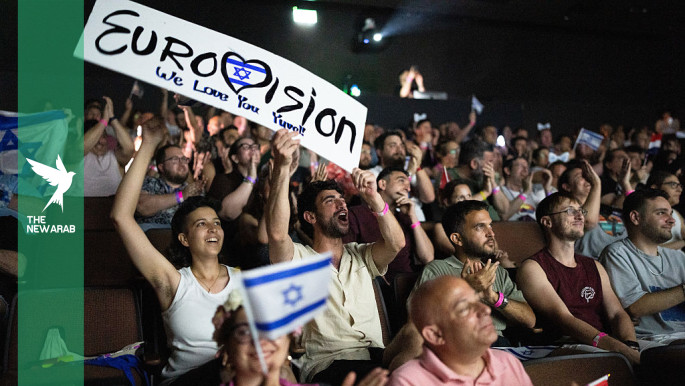
Israel ran a coordinated, state-backed Eurovision campaign spending more than $1 million to boost its contestants [Getty]
A New York Times investigation has found that Israel ran a coordinated, government-backed campaign to transform Eurovision into a soft-power tool, spending more than $1 million promoting its contestants while lobbying to remain in the contest amid growing backlash over the war on Gaza.
The investigation, published on Sunday, found that Israel spent more than $800,000 on advertising around the 2024 Eurovision contest in Malmö, Sweden, with funding linked to Prime Minister Benjamin Netanyahu’s public diplomacy office.
According to the report, Israeli officials, embassies and pro-Israel groups coordinated multilingual campaigns encouraging viewers to vote up to 20 times for Israel’s contestant, Yuval Raphael. Netanyahu himself reportedly posted graphics on Instagram urging supporters to maximise votes.
The Times found that Eurovision’s voting system made the contest highly vulnerable to coordinated influence campaigns because viewers were allowed to cast multiple paid votes.
Using internal voting data obtained during the investigation, the newspaper found that in some countries only a few hundred coordinated voters were needed to secure a public vote victory.
In Spain, where polling showed widespread criticism of Israel’s war on Gaza, Raphael won the televote with more than 47,000 votes. However, the Times calculated that fewer than 500 people voting the maximum 20 times each could have been enough to secure first place.
The investigation also found that Israeli embassies pressured European broadcasters to oppose efforts seeking Israel’s exclusion from the contest.
The European Broadcasting Union, which organises Eurovision, reportedly reassured broadcasters privately that Israel had not improperly influenced voting but refused to release detailed voting data or commission an external review.
The report said the EBU later introduced vague restrictions on “disproportionate” promotional campaigns while lowering the maximum number of votes per viewer from 20 to 10.
The controversy has fuelled growing divisions inside Eurovision, with broadcasters and officials in several countries accusing Israel of politicising the contest.
Eurovision organisers have defended the integrity of the contest, with Eurovision director Martin Green telling the NYT that Israel’s strong performance had reflected a “motivated diaspora” and a popular song rather than manipulation.
This week, Eurovision organisers issued a formal warning to Israeli broadcaster KAN after it published multilingual videos urging viewers to “vote 10 times” for Israel’s 2026 entry, Noam Bettan, during the first semifinal.
Green said the broadcaster had been ordered to remove the videos immediately because they breached new rules designed to limit third-party campaigning.
The move comes as criticism over Israel’s participation in international cultural events has intensified amid the ongoing war on Gaza.
Iceland, Ireland, the Netherlands, Spain and Slovenia have all decided to boycott the 2026 Eurovision contest in Vienna following disputes over Israel’s participation.
The dispute has increasingly spilled onto the Eurovision stage itself, with protests, audience disruptions and broadcaster criticism accompanying Israeli performances over the past two years.