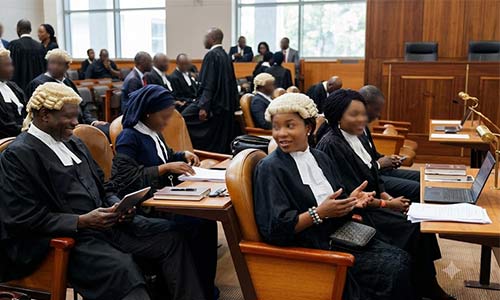
The Federal High Court sitting in Abuja has declared as null and void Section 83(6)(b) of the Electoral Act 2026, which prescribes a minimum cost of ₦10,000,000.00 each on counsel and litigants who file suits bordering on the internal affairs of political parties, holding that the provision unlawfully fetters the discretionary powers of a Judge of the Federal High Court and constitutes an unconstitutional intrusion into judicial proceedings.
His Lordship, Hon. Justice J.K. Omotosho, delivered the judgment on Thursday, 23rd July, 2026, in Suit No. FHC/ABJ/CS/721/2026 between Christian Egbuchinem Nduka (carrying on business in the name and style of Chris & Lawticus) as Claimant, and the Independent National Electoral Commission (INEC), the National Assembly, and the Attorney General of the Federation as 1st to 3rd Defendants respectively.
The Claimant, a legal practitioner, filed an Originating Summons dated and filed 9th April, 2026, in the interest of the public, seeking the determination of six questions, including whether Section 83(6)(b) of the Electoral Act 2026, by imposing mandatory costs on counsel filing suits concerning the internal affairs of a political party, derogates from the constitutionally guaranteed right of audience of a legal practitioner under Sections 6(6)(a) and 36(1) of the Constitution and Section 8(1) of the Legal Practitioners’ Act; whether the provision is inconsistent with the separation of powers and the inherent powers of the judiciary to regulate proceedings, including the award of costs; and whether the legislative powers of the National Assembly extend to fixing or limiting the discretionary powers of a Judge of the Federal High Court pursuant to Sections 6(6)(b), 253, and 254 of the Constitution.
The Claimant also sought a determination whether INEC, being a statutory body funded entirely through public funds and the INEC Fund established under Sections 3(1)-(4) of the Electoral Act 2026, is entitled to claim costs against any party or legal practitioner in Federal High Court proceedings, except in accordance with the discretion of the Court.
According to the Claimant, Section 83(5) and (6) of the Electoral Act, 2026 provides that matters based on internal affairs of political parties cannot be entertained by any Court, and that where such internal affairs suits are filed, the counsel and the claimant in such matters would be made to pay costs of not less than ₦10,000,000.00 each, in addition to the payment to INEC of any costs and solicitor’s fees. He stated that at no time was there information in the public space stating the intention of the National Assembly to impose costs for filing suits, and that he only got to know after the Act was passed.
The Claimant further contended that the imposition of cost is fixed and mandatory without taking into consideration the circumstances of each case, that the determination of costs was not left to the discretion of the judge, and that it is capable of discouraging lawyers from filing suits on behalf of their clients. He also argued that INEC, the beneficiary of the costs, is a government body funded from public resources and taxpayers’ money which does not personally bear the cost of litigation like individual litigants.
The 1st Defendant, INEC, filed a Notice of Preliminary Objection seeking orders striking out the suit for disclosing no reasonable cause of action, for lack of locus standi, and for lack of jurisdiction. INEC argued that the Claimant had not shown that he suffered or is likely to suffer any injury arising from the provisions of the Act, and that the National Assembly conducted public hearings on the amendment of the Electoral Act, 2022 prior to the enactment of the Electoral Act, 2026.
Counsel to INEC submitted that Section 83(5) was enacted to cure a mischief of persons filing frivolous suits bordering on internal affairs of political parties, and that the provision is simply a codification of the pronouncements of the Supreme Court on the issue of internal affairs not being justiciable. He also submitted that the Act does not fetter the discretion of the Court in awarding costs but simply provides a platform upon which discretion in assessing costs can be made.
The 2nd Defendant, the National Assembly, stated that it has powers to impose costs as penalty for wrongdoing and that there is no law which prevents a government agency funded by public funds from receiving cost or fees for penalized acts. It also contended that the Claimant failed to serve a three-month pre-action notice on it before instituting the action, as required by Section 21 of the Legislative Houses (Powers and Privileges) Act, 2017.
The 3rd Defendant, the Attorney General of the Federation, stated that it is not saddled with the responsibility of law making, that the Electoral Act, 2026 does not bar access to Court, and that the imposition of costs is not excessive as same is made to stem the tide of frivolous suits.
Resolving the issue of locus standi, Justice Omotosho held that even though the Claimant being a legal practitioner alone does not confer him with locus standi, he had shown sufficient interest in the subject matter of the suit as the constitutional right to access the Courts by litigants is in danger of being eroded if there is threat of sanctions.
According to His Lordship, “The Claimant does not have to wait to suffer injury from the enactment of the Electoral Act 2026. A threatened injury is sufficient ground to institute action.”
The Court noted that legal practitioners are the only ones with the right to file election related cases on behalf of litigants and that these cases have become significant revenue generators for legal practitioners. “It is therefore reasonable to expect legal practitioners to protect their right and access to approach the Court when such issues arise. I therefore hold that the Claimant have shown sufficient interest to be vested with locus standi to bring this action,” the Court held.
The Court, however, struck out the National Assembly from the suit for failure of the Claimant to serve the mandatory three-month pre-action notice required by Section 21 of the Legislative Houses (Powers and Privileges) Act, 2017.
Relying on the decisions in MOBIL PRODUCING (NIG) UNLTD V. LASEPA & ORS and PUBLIC & PRIVATE DEVELOPMENT CENTRE LTD/GTE (PPDC) v. NNPC & ANOR, His Lordship held that failure to serve the written notice is a breach of condition precedent to the assumption of jurisdiction, and that an action commenced without pre-action notice where one is statutorily required is a nullity.
“Upon this failure to fulfill condition-precedent, this Court is handicapped from assuming jurisdiction over the 2nd Defendant. Consequently, the 2nd Defendant is hereby struck out of this suit,” the Court held.
On the substantive issue, the Court upheld the validity of Section 83(5) of the Electoral Act 2026, which provides that no Court in Nigeria shall entertain jurisdiction over any suit or matter pertaining to the internal affairs of a political party.
Justice Omotosho held that the National Assembly has simply codified the settled principle of law that internal affairs of political parties are non-litigable, relying on a long line of Supreme Court authorities including UFOMBA V. INEC & ORS, ONI & ANOR v. OYEBANJI & ORS, ANYANWU v. EMMANUEL & ORS, OSAGIE & ORS v. ENOGHAMA & ORS, and TUMBIDO v. INEC & ORS, where the apex Court consistently held that leadership, membership, party congresses, and administration of political parties are “NO GO AREA” for Courts.
The Court clarified that this is not to say that political parties cannot be sued or that decisions of political parties cannot be challenged, but that apart from pre-election suits circumscribed by Section 285(14) of the Constitution and Sections 29(5) and 88(2) of the Electoral Act 2026, all other matters cannot be entertained by the Court. Aspirants who participated in a primary election retain the constitutional right to challenge the primary, and a political party can challenge the decisions of INEC where the Electoral Act or other laws are not complied with by the Commission.
“I hold that this provision is not a bar to access the Court but a filter to whittle out frivolous suits. This Court takes judicial notice of the high volume of political matters filed by various persons and due to the time constraints in these matters, the Court usually give such matters priority. Unfortunately, most of these matters which clog the Court’s docket end up being frivolous internal affairs disputes,” His Lordship held, adding that Section 83(5) is therefore valid and does not conflict with any provisions of the Constitution.
Turning to Section 83(6)(b), which mandates the Court to impose costs of not less than ₦10,000,000.00 on the counsel who filed the action and not less than ₦10,000,000.00 on the Claimant/Applicant, the Court held that the award of costs is an inherent and discretionary power of the Court which must be exercised judicially and judiciously, relying on EZENNAKA v. COP, CROSS RIVER STATE & ANOR, NNPC v. CLIFCO NIG. LTD, and NIGERIAN BANK FOR COMMERCE & INDUSTRY & ANOR v. ALFIJIR (MINING) (NIG) LTD, where the Supreme Court held that a court has an absolute and unfettered discretion to award or refuse costs.
The Court reasoned that the National Assembly, in inserting Section 83(6)(b), intended to cure the mischief of parties filing frivolous suits, noting that the inclusion of a minimum fine is meant to discourage recalcitrant lawyers and litigants from clogging the Court with frivolous suits. His Lordship referenced a recent decision of the Supreme Court in Appeal No. SC.266/2017 per Nwosu Iheme JSC, where costs of ₦50,000,000.00 was ordered to be paid personally by a counsel for filing a vexatious application, with the counsel ceasing to have right of audience in any Court in Nigeria until compliance.
Nonetheless, the Court held that the fixing of a minimum fine interferes with judicial discretion. His Lordship held:
“The fixing of a minimum fine of N10,000,000.00 on Counsel and Claimant to the mind of this Court interferes with the discretion of the Court. The Court cannot be limited or constrained regarding the costs to be imposed on erring parties. In determining or assessing the quantum of costs, the Court must consider each case individually to determine which is the appropriate costs to impose. After all, it is the Court itself that would determine if the case is frivolous or not. The Legislature therefore lacks the powers to fetter the discretion of the Court in the award of costs on erring litigants.”
Delivering the kernel of the judgment, His Lordship held:
“Consequently, I hold that section 83 (6) (b) of the Electoral Act, 2026 with respect to fixing a minimum cost of N10,000,000.00 each on Counsel and Claimant in matters bordering on internal affairs of political parties is invalid as it infringes on the discretion of the Court to award costs. The National Assembly overstepped its bounds by prescribing a minimum amount for costs to be imposed by the Court. At best that duty is that of the Chief Judge of the Federal High Court to make Rules outlining how costs is to be imposed as sanctions and not for the National Assembly to arrogate to itself the powers it lacked.
“The award of costs after judgment is delivered is part of the proceedings of the Court. This can only be regulated by the Rules of the Court or Practice Directions which are within the powers of the Chief Judge of the Federal High Court to issue by virtue of section 254 of the Constitution of the Federal Republic of Nigeria, 1999 (as amended). The Court is therefore not bound by that provision and it will assess Costs on a case-by-case basis and will assess costs to whatever amount it deems acceptable or prescribed by the Rules of Court if any.”
The Court further distinguished costs, penalties and default fees in civil proceedings from fines resulting from criminal convictions, holding that while the National Assembly is well empowered to prescribe fines as punishment for an offence, costs in civil proceedings are regulated by the Heads of Court under the enabling provisions of the Constitution.
On whether INEC is entitled to be paid costs seeing that it is funded from the national budget, the Court held that the argument of the Claimant’s counsel on the point was misconceived, as Section 83(6)(b) does not command that costs imposed by the Court be paid to INEC.
“A look at the above provision shows that costs is not to be paid to the Independent National Electoral Commission except where it is joined as a party and the Court assesses costs based on expenses incurred especially where it asks for costs. In all other cases the cost to be paid will be paid to the Court,” His Lordship held, noting that it is not in all cases that INEC will be a party, as some cases are between members of the same party or a political party and a member.