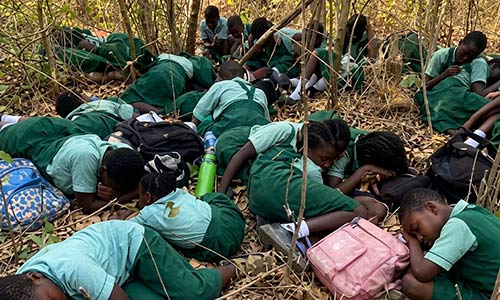
Security agencies have reportedly recorded a major intelligence breakthrough in the ongoing rescue operation for the 39 schoolchildren and seven teachers abducted from communities in Oriire Local Government Area of Oyo State on May 15, 2026, with operatives successfully identifying members of the kidnapping gang and tracing their associates across different parts of the country, placing the abductors under mounting psychological pressure and forcing them to abandon some of their earlier demands.
The development comes as the Chief of Army Staff, Lt. Gen. Waidi Shaibu, confirmed that troops are making “tremendous progress” in the rescue operation, describing the South-West as one of the most peaceful regions in the country and the Oyo school abduction as an isolated incident.
Security sources disclosed that weeks of painstaking intelligence gathering by the Department of State Services (DSS) led to the identification of key members of the gang, after which coordinated operations were launched to locate their associates in different parts of the country.
According to the sources, operatives acting on credible DSS intelligence successfully located associates of several members of the gang. The discovery has reportedly unsettled the abductors, who are said to be under intense psychological pressure after realising that security agencies know the whereabouts of their key associates.
“The kidnappers are becoming increasingly apprehensive. Their confidence has been shaken, and they are now showing greater willingness to release the children,” a security source familiar with the operation stated.
The development follows earlier reports that security forces had blocked the abductors’ escape routes and intensified surveillance around their suspected hideout in the National Park forest, where the victims are believed to be held. A combined team of DSS operatives and military personnel is said to be steadily closing in on the kidnappers’ location, with operatives expressing optimism that the standoff will soon end with the safe rescue of the hostages.
Armed terrorists abducted 39 pupils and seven teachers on May 15, 2026, during coordinated attacks on Baptist Nursery and Primary School in Yawota and two other schools in Ahoro-Esinle and Alawusa communities.
The kidnappers initially issued a set of demands that combined criminal ransom with ideological objectives: the release of detained terrorist commanders, payment of a ransom, the provision of two Hilux vehicles, and the implementation of Sharia-related laws as conditions for freeing the victims.
They specifically demanded the release of Mahmud Usman, also known as Abu Bara’a or Abbas Mukhtar, and his deputy, Abubakar Abba, alias Isah Adam or Mahmud Al-Nigeri. Both men were arrested by DSS operatives last year and have been identified by security agencies as senior members of Jama’atu Ansarul Muslimeena Fi Biladis Sudan (Ansaru), a breakaway faction of Boko Haram.
However, security sources said the recent operational gains by the rescue team have forced the abductors to abandon some of their earlier demands and shift their focus to finding a way to escape while releasing the captives.
The shift from ideological and ransom demands to a focus on escape represents a significant tactical change that security analysts attribute to the combined pressure of blocked escape routes, intelligence-led identification of the gang’s support network, and the steady advance of military and DSS operatives toward the kidnappers’ position.
Speaking during an interactive session with media executives as part of activities marking the 2026 Nigerian Army Day Celebration in Port Harcourt, Rivers State, the Chief of Army Staff confirmed the progress.
“Operations are currently ongoing to rescue those children abducted in Oyo State, and we are making tremendous progress,” Lt. Gen. Shaibu stated.
He expressed confidence that the operation would end with the safe rescue of the victims, adding that the Nigerian Army remained fully engaged in combating security threats across the country’s six geopolitical zones.
The Army Chief highlighted recent operational successes beyond the Oyo rescue mission. Troops under Operation Hadin Kai in the North-East had neutralised more than 1,872 insurgents, while many others had surrendered. Troops, working with United States partners, recently eliminated high-profile Islamic State commander Abu-Bilal al-Minuki.
Operations Enduring Freedom, Whirlwind, and the newly established Savannah Shield had continued to record successes across the North-Central, improving security in Plateau, Benue, Nasarawa, Kwara, Niger, and parts of Kogi states.
Security had also improved considerably in the South-East, while sustained operations against crude oil theft, illegal bunkering, and pipeline vandalism had boosted Nigeria’s oil production in the South-South.
Lt. Gen. Shaibu disclosed that President Bola Ahmed Tinubu had approved the establishment of a new Nigerian Army Depot in Amasiri-Edda, Ebonyi State, which, alongside the existing depots in Zaria, Kaduna State, and Osogbo, Osun State, is expected to increase the Army’s annual recruitment and training capacity to approximately 28,000 personnel.
The Army had also acquired additional armoured personnel carriers, mine-resistant vehicles, and unmanned aerial vehicles to strengthen ongoing operations, while troops continue to receive specialised training both within Nigeria and abroad.
Retired senior military officers offered contrasting assessments of the reported breakthrough.
Maj. Gen. Eniola Gbadamosi (retd) said the identification and tracing of the kidnappers’ associates had placed the criminal network on the defensive.
“If security agencies have indeed identified and located members of the kidnappers’ support network, that is a major operational advantage. Criminal groups rely heavily on logistics, communication and local collaborators. Once those networks are disrupted, they become vulnerable, make mistakes and are more likely to release their captives,” Gbadamosi stated.
He cautioned against premature celebration, stressing that the priority must remain the safe return of the children and their teachers, and said intelligence-led operations are usually more effective than direct confrontation in cases involving hostages.
A retired Brigadier General, who spoke on condition of anonymity, said the reported progress demonstrated growing synergy among the military, DSS, and other security agencies.
“Modern counter-kidnapping operations are driven by intelligence rather than brute force. The fact that security agencies have reportedly identified the kidnappers’ associates suggests they are gradually dismantling the network behind the crime,” he stated.
However, another retired Brigadier General from the northern part of the country issued a pointed warning against publicising operational breakthroughs while the rescue mission was still ongoing.
“While the reported intelligence breakthrough is encouraging, operational details should be handled with extreme caution. Such disclosures could signal to the kidnappers that they have been compromised, prompting them to relocate the hostages, alter their plans or frustrate the operation,” he stated.
The retired officer emphasised that surprise remains a critical element in counter-kidnapping operations, especially where the lives of children are involved.
“The cardinal principle in operations of this nature is surprise. You take the criminals by surprise, conclude the operation successfully and only afterwards disclose the strategy that led to the breakthrough,” he stated.
“Operational secrecy remains one of the most potent weapons in counter-kidnapping missions, particularly when the lives of innocent children are at stake,” the retired general concluded.