SINGAPORE – The US architect of Pax Silica has pushed back on perceptions that the initiative aims to ringfence a US-led AI supply chain of trusted partners against China, saying that signatories, including Singapore, are not being forced to choose between the two powers.
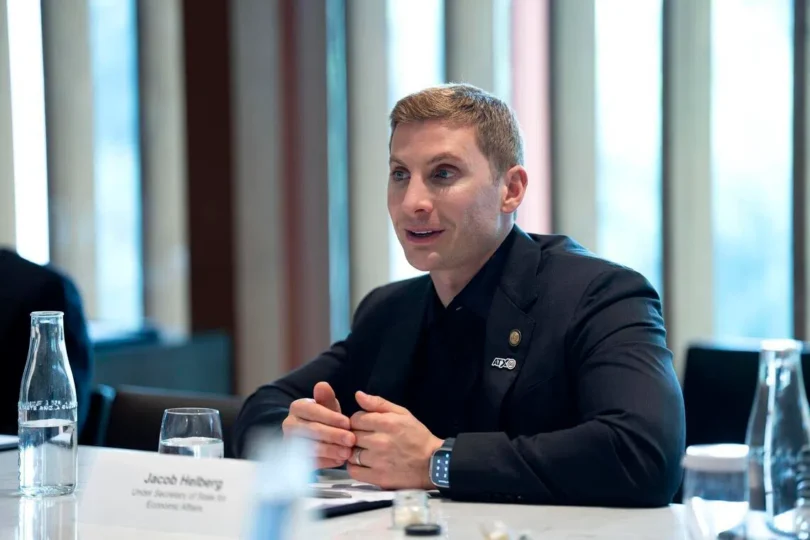
Instead, those who joined are doing so because they see real benefits in riding the AI growth story with the US, said Mr Jacob Helberg, US Under Secretary of State for Economic Affairs, in an interview with The Straits Times.
“That means more investment, more high-value activity, more talent and a bigger seat at the table as the AI economy scales over the next decade. We’re not asking partners to participate out of obligation – we’re inviting them in because the upside is real, and because countries like Singapore compound that upside for everyone in the framework.”
Noting that many Pax Silica members are also part of the China-led Belt and Road Initiative, such as the United Arab Emirates and Qatar, Mr Helberg reiterated that it “isn’t about countries choosing”.
“A lot of them are already part of the Belt and Road Initiative, so why would they be worried about being part of Pax Silica? You know, if they were worried about being part of one camp or the other, they would have never joined the Belt and Road Initiative, but they did.
“I think countries really will make decisions based on what’s in their best interest, and if they see growth in jobs as a potential outcome of joining a partnership, I actually think they’ll be very excited to pursue that.”
While Mr Helberg was emphatic that Pax Silica is not an exclusive grouping, he said the US is being strategic in who it is partnering with in what is shaping to be a grouping of technologically advanced economies embedded in value-added tech supply chains.
“Ultimately, we’re going to keep running through the list and countries that we think have high potential in ASEAN, and identify opportunities to partner with them, but we do see a path to add more members, so long as it’s anchored on tangible deliverables,” Mr Helberg told ST.
The Philippines, which formally joined Pax Silica in April, is planning to develop a joint industrial hub with the US to shore up supply chains for critical industries.
The Trump administration launched Pax Silica in December 2025 to secure a resilient critical mineral, semiconductor and artificial intelligence supply chain in its burgeoning rivalry with China. The Chinese still retain a dominant chokehold on some critical minerals, which Beijing wields as leverage, making it a source of geopolitical tensions.
Mr Helberg believes that Singapore, with its reliable, neutral and trusted hub status, can play a crucial role in an expanding global tech supply chain ecosystem.
“When I talk about Pax Silica needing Singapore, I mean it at the wafer level, the packaging level, the materials level, the capital level, and the talent level,” he added, noting that Singapore accounts for roughly 10 per cent of global wafer production.
“Singapore can actually play a really outsized role at multiple layers of the supply chain,” he said. “It’s a critical hub for advanced packaging, a meaningful node in memory (chips), and home to the equipment makers and speciality chemicals suppliers the entire industry depends on.”
“Very few countries can credibly say that – Singapore can,” he added. “Pound for pound, Singapore is one of the most consequential players in the global semiconductor economy.”
Mr Helberg was in Singapore and the Philippines from May 17 to 21, the only two ASEAN countries currently in the Pax Silica partnership.
In Singapore, Mr Helberg convened an inaugural AI ministerial roundtable with ministerial and senior government leaders from ASEAN countries to discuss opportunities in AI adoption on the sidelines of the annual Asia Tech x Singapore conference.
A few ASEAN members have shown keen interest in adopting AI in recent years, with the region showing signs of a data centre boom. Global consulting firm Kearney estimated in 2020 that the technology could potentially add nearly a trillion US dollars to the region’s gross domestic product by 2030.
Asean is seen as a crucial region for the US as it seeks to counter China’s growing influence, and where recent public sentiments towards the US have soured.
An annual survey conducted by the Asean Studies Centre at ISEAS – Yusof Ishak Institute in early 2026 showed that respondents picked China over the US as the preferred superpower for the region, and named President Donald Trump as a source of the region’s geopolitical tensions.
Mr Trump’s tariffs and the Iran war, both having significant impact on South-east Asian economies, have elicited concerns from regional leaders.
“The strategy is to really look at our supply chains in a vertically integrated way, and make sure that every node of the supply chain is either in the US or in a trusted partner nation that we deliberately want to partner with,” Mr Helberg said.
Australia, Japan, Israel, South Korea, Sweden, Qatar, Norway, the United Kingdom, Finland, the United Arab Emirates, India and Greece have also signed the Pax Silica declaration. Taiwan is a non-signatory participant.
“The growth story of the next 10 years runs through the AI supply chain. Pax Silica is how our partners ride that wave with us,” Mr Helberg said.