
EBERE UZOUKWA, PhD
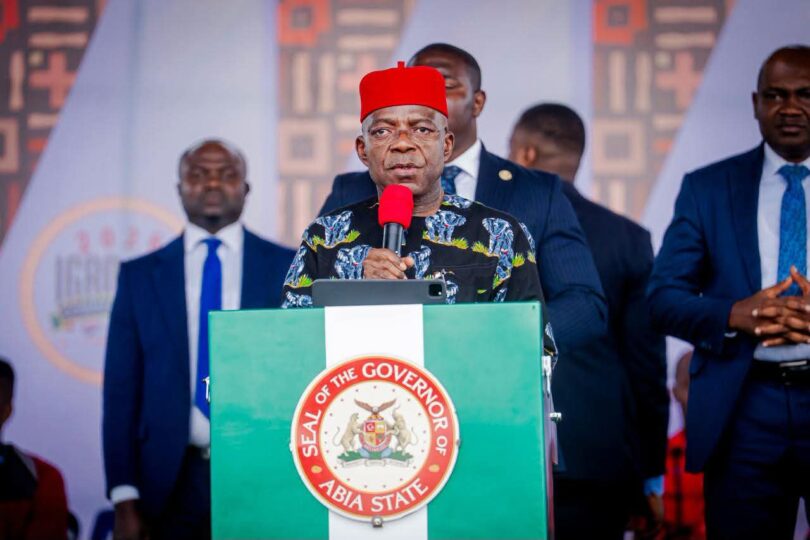
The 2026 World Igbo Day celebration in Umuahia may have been designed as an occasion to honour the history, heritage and accomplishments of Ndigbo, but Governor Alex Chioma Otti, OFR, used the gathering to deliver a strong message that reached beyond remembrance. At the heart of his address was a simple but profound proposition. The future of Ndigbo will depend not only on the remarkable achievements of the past, but on the ability of the people to unite around common interests, transfer knowledge to the next generation and adapt their traditional enterprise to the realities of a rapidly changing global economy.
Speaking on the theme “Ohaneze, History and the Dreams of Tomorrow,” Governor Otti drew a connection between the values inherited from Igbo ancestors and the responsibilities confronting the present generation. He recalled the courage, resilience, enterprise, intellectual curiosity and communal spirit that helped shape the Igbo identity, noting that these values remain relevant to the pursuit of a better future.
But perhaps the most important part of his message was his interpretation of unity. For Otti, unity does not mean that Ndigbo must think alike, belong to the same political party or agree on every question. Rather, it means recognising that individual interests cannot permanently take precedence over the aspirations of the wider community. His words were direct. “Unity does not mean unanimity of opinion on every issue but a consciousness that our individual desires cannot be superior to the aspirations of the majority.”
That distinction is important because the Igbo tradition has historically accommodated debate, argument and independent thought. The Governor reminded Ndigbo that the republican character of traditional Igbo society gave individuals the freedom to express themselves while providing communal platforms for dialogue, consensus building and collective decision making. In other words, disagreement is not necessarily the enemy of unity. The greater danger is allowing disagreement to become hostility, division and a deliberate effort to undermine one another.
That was the essence of the “Njiko ka” message at this year’s celebration. Governor Otti argued that Ndigbo must move away from an era of discord and acrimony and embrace greater peace, understanding, sincerity and cooperation. He called for sacrifices, humility, patience and discipline, particularly among leaders and stakeholders whose decisions have consequences beyond their immediate political or personal interests.
His argument was also firmly rooted in posterity. The Governor repeatedly returned to the responsibility of the present generation to think about those coming after them. For him, the question is not simply what Ndigbo can gain today, but what kind of society they will leave behind for their children and grandchildren.
This explains why he placed such emphasis on three traditional institutions and practices, namely omugwo, apprenticeship and education. Omugwo represents the transmission of affection, family values and cultural bonds across generations. Apprenticeship represents the transfer of practical knowledge, skills and commercial experience. Education represents the deliberate preparation of young people for opportunities beyond the limitations of their present circumstances.
Together, they offer a framework for understanding the Governor’s broader message about the future. Ndigbo have always been associated with enterprise and commerce. But the character of global commerce is changing rapidly. Traditional trading models are increasingly being transformed by technology, digital platforms, modern manufacturing, logistics, artificial intelligence and increasingly sophisticated global supply chains.
Consequently, the challenge before Ndigbo is not merely to continue trading, but to move further up the economic value chain. The future cannot be secured by remaining predominantly consumers, distributors or importers of goods manufactured elsewhere. The emerging global economy requires a stronger emphasis on manufacturing, innovation, technology and the development of indigenous production capacity.
This is where Governor Otti’s message on enterprise acquires particular significance. The Igbo entrepreneurial spirit that once enabled individuals to travel across Nigeria and beyond in search of opportunities must now be matched with the capacity to create products, build industries, develop technologies and compete in global markets. The transition from buying and selling to producing and innovating is therefore not a rejection of the traditional Igbo commercial spirit. It is its logical evolution.
The same apprenticeship culture that trained generations of successful traders can become a foundation for training young people in modern manufacturing, technology, engineering, digital commerce and other knowledge based industries. The same appetite for education that has historically driven Igbo families to make enormous sacrifices for their children’s schooling must now be directed towards science, technology, engineering, mathematics, entrepreneurship and other fields capable of positioning young people for the opportunities of the new global economy.
And the same determination that has taken Ndigbo to virtually every corner of the world must be harnessed to build enterprises that can compete from home with businesses anywhere in the world. This is why Governor Otti’s message should not be reduced to another call for political unity. It is fundamentally a call for economic and generational solidarity.
Unity of purpose should translate into collaboration among entrepreneurs, professionals, investors, academics, political leaders and young people. It should encourage partnerships rather than destructive rivalry, knowledge sharing rather than knowledge hoarding, and investment in productive capacity rather than an excessive concentration on consumption.
The Governor’s reference to the metallurgical achievements of ancient Igbo societies at Opi, Lejja and Igbo Ukwu was also instructive. It served as a reminder that technological ingenuity is not alien to Igbo history. The challenge before the present generation is to ensure that the ingenuity of the ancestors is not merely celebrated as history but reproduced in contemporary forms.
The future belongs to societies capable of converting knowledge into products, ideas into enterprises and innovation into economic value. This is also where the message of Ohanaeze President General, Senator John Azuta Mbata, complemented the Governor’s position.
Senator Azuta Mbata challenged Ndigbo to interrogate the future they want for themselves and for Nigeria, pointing to the Igbo Charter for Strategic Engagement for National Development as a framework for thinking about how Igbo potential can be maximised. His message of “Njiko ka” was equally unequivocal. Ndigbo may disagree over politics, religion, strategy or even interpretations of history, but beneath those differences lies a shared identity and responsibility.
That is perhaps the most significant lesson from the 2026 Igbo Day celebration. Ndigbo do not need to eliminate their differences to pursue common objectives. They need to learn how to manage those differences without allowing them to destroy the collective interest.
The challenge is particularly urgent for a people whose population, commercial networks and professional presence extend far beyond the five South East states. The question is how to transform that widespread presence into greater economic influence, technological capacity and productive power.
Governor Otti’s message provides a clear direction. Preserve the values that made Ndigbo resilient, but adapt them to the demands of a new age. The world that produced yesterday’s commercial opportunities is not the world of tomorrow. Global competition will increasingly reward those who manufacture, innovate, create intellectual property, deploy technology and build efficient production systems.
Ndigbo therefore have an opportunity to decide how they deploy their considerable human and economic resources. The task is not to abandon commerce, but to modernise it. Not to abandon apprenticeship, but to expand its scope. Not to abandon enterprise, but to move enterprise from trading alone into manufacturing, technology, innovation and global production.
Ultimately, the message from Umuahia was about responsibility. The generation that inherited the courage, enterprise, resilience and communal values of its ancestors has a duty to pass on something more valuable to the next generation. A more united people, a stronger productive economy, better institutions, greater technological capacity and a renewed confidence in the ability of Ndigbo to compete anywhere in the world.
The 2026 Igbo Day celebration therefore, offered more than an opportunity to remember where Ndigbo came from. It presented a challenge to decide where they are going. And perhaps the most enduring message from Governor Otti is that the journey to that future must be undertaken together.
– Dr Ebere Uzoukwa is the Senior Special Assistant to the Governor of Abia State on Public Affairs.