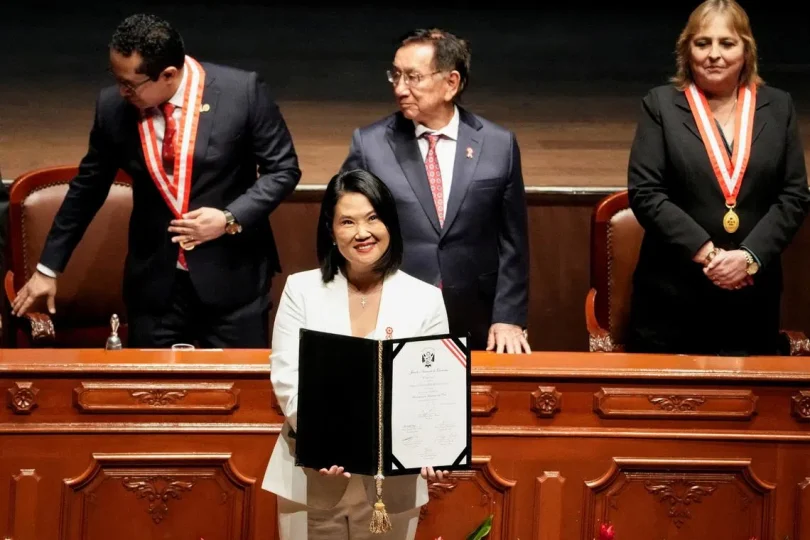
LIMA, July 28 – Keiko Fujimori will be sworn in as Peru’s president on Tuesday, becoming the latest in a string of conservative leaders elected across Latin America by voters frustrated by crime, weak economic growth and political instability.
The 51-year-old daughter of former President Alberto Fujimori will become Peru’s first-ever elected female head of state.
Her victory in June’s presidential runoff marked the return of one of Peru’s most influential and polarizing political dynasties and capped a political comeback after years of failed bids.
Fujimori will be Peru’s 10th president since 2016 following a tumultuous decade in which no leader completed a full five-year term.
Her election extends a broader rightward shift across Latin America, with a string of recently elected leaders advocating closer ties with the United States and tougher policies on crime.
Fujimori has said there is “very significant space” for cooperation with the administration of U.S. President Donald Trump and expressed interest in Peru joining the “Shield of the Americas,” a regional initiative proposed by Trump to combat transnational crime.
Washington has made one of its strongest efforts in years to deepen ties with Peru, a major copper and critical minerals producer, with strategic Pacific ports, in an effort to counter China’s influence in the region.
On Monday, Fujimori named former central bank board member Elmer Cuba as economy minister and Carlos Espa, a former presidential candidate who also worked for the U.S. Embassy in Lima, as foreign minister.
“We are going to build the consensus needed to turn decisions into results for citizens,” Fujimori said.
CONGRESS, ECONOMIC CHALLENGES
Fujimori narrowly defeated leftist congressman Roberto Sanchez in one of Peru’s closest elections in modern history. Sanchez has alleged electoral fraud without providing evidence and has pledged to lead a left-wing opposition bloc in Congress.
Protests against her candidacy drew hundreds of left-wing activists and civil society groups in Lima ahead of the runoff. Demonstrations are planned to coincide with Tuesday’s inauguration.
Fujimori’s Popular Force party is expected to hold the largest minority bloc in a fragmented Congress, which has returned to a bicameral structure for the first time in three decades.
In a vote to elect the head of Congress on July 26, the incoming coalition secured the presidency of the Senate, while the opposition won leadership of the body’s lower house, the Chamber of Deputies.
Maintaining legislative support could prove challenging.
“There won’t be much room for a honeymoon period,” said Peruvian political analyst and independent business consultant Jeffrey Radzinsky. “She has to build confidence among a broad segment of the population that distrusts her, while also meeting high expectations.”
Peru has remained one of Latin America’s more resilient economies despite years of political upheaval, largely driven by copper exports. The central bank recently raised its 2026 growth forecast to 3.4%, citing stronger domestic demand and investment.
Growth slowed sharply in May as fishing output plunged and agricultural exports weakened, exposing the country’s vulnerability to climate-related shocks.
Several regional leaders, including Argentina’s Javier Milei, Chile’s Jose Antonio Kast and Daniel Noboa of Ecuador, are expected to attend Tuesday’s inauguration. REUTERS