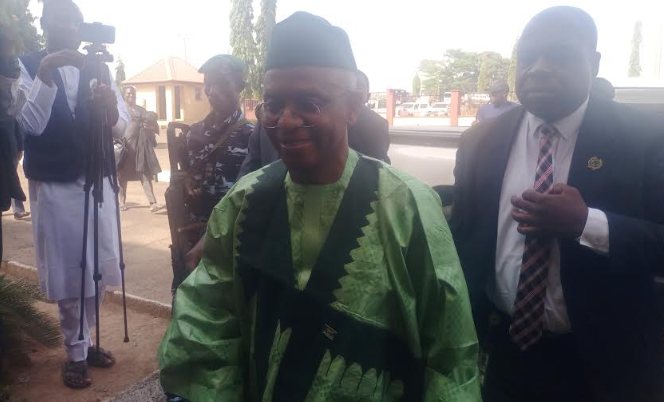
The Federal High Court in Abuja on Monday ruled that the detained former Kaduna State Governor, Nasir El-Rufai, has a case to answer over allegations that he unlawfully intercepted the telephone communications of the National Security Adviser (NSA), Nuhu Ribadu.
In a ruling delivered by Justice Joyce Abdulmalik, the court dismissed as lacking in merit a no-case submission filed by El-Rufai, seeking to be discharged and acquitted of the charges against him.
The former governor, who served between 2015 and 2023 and was also Minister of the Federal Capital Territory (FCT) under former President Olusegun Obasanjo, is standing trial over comments he made during an appearance on Arise Television on February 13.
He is facing a five-count amended charge instituted by the Federal Government through the Department of State Services (DSS).
The prosecution alleged that during his appearance on Arise TV’s Prime Time programme in Abuja, El-Rufai admitted knowing and associating with an individual who had illegally intercepted Ribadu’s telephone communications.
In addition to allegations that his actions breached national security and public safety, an offence punishable under Section 12(1) of the Cybercrimes (Prohibition, Prevention, etc.) (Amendment) Act, 2024, the former governor was also accused of failing to report the alleged crime to the appropriate security agencies.
During the television interview, El-Rufai had reacted to what he described as an attempt by DSS operatives to “abduct” him at the Nnamdi Azikiwe International Airport in Abuja on February 12, 2026, following his return from Cairo.
He alleged that the security agency was acting on the instigation of the Independent Corrupt Practices and Other Related Offences Commission (ICPC), which he claimed had received a directive from Ribadu to detain him.
The former governor said he obtained the information from an individual who had listened to the NSA’s telephone conversations.
Prosecution insists El-Rufai has a case to answer
Following the prosecution’s closure of its case after presenting two witnesses, El-Rufai applied to be discharged and acquitted.
His legal team, led by Senior Advocate of Nigeria (SAN), Paul Erokoro, argued that the prosecution had failed to establish a prima facie case requiring him to enter a defence.
The defence also described the charge as incompetent.
However, prosecution counsel, Oluwole Aladedoye, SAN, urged the court to dismiss the application and direct the defendant to open his defence.
Aladedoye maintained that the oral and documentary evidence presented before the court was sufficient to link El-Rufai to the allegations.
In her ruling, Justice Abdulmalik held that the evidence presented by the prosecution was strong enough to warrant an explanation from the defendant.
Although the court had yet to determine whether El-Rufai was guilty or otherwise, it dismissed the no-case submission and ordered him to open his defence.
El-Rufai had sought to quash charges
The latest ruling follows an earlier application by the former governor seeking to stop his trial after he was accused of admitting that he used “technical equipment” to illegally intercept the NSA’s telephone communications.
In the application, El-Rufai advanced 17 grounds for urging the court to quash the charge, marked FHC/ABJ/CR/99/2026.
He argued that the charge was legally defective, maintaining that the DSS had no legal basis to interpret a “casual remark” made during a television interview as “a confession” that he had tapped the NSA’s telephone line.
The former governor further contended that his remarks on Arise TV did not qualify as a confessional statement under the law.
According to him, for a statement to be admissible as a confession, it must be made under caution, voluntarily and in circumstances that satisfy the Judges’ Rules.
El-Rufai maintained that his comments were made during a voluntary public discussion without any caution or warning and without the protections afforded to suspects in custody.
“A casual remark on a television programme cannot be elevated to a judicial confession,” he argued.
The court, however, declined to quash the charge and ordered an accelerated hearing of the case.
El-Rufai, who has been in detention since February, is also facing trial before courts in Abuja and Kaduna State.
Court earlier rejected bail variation request
In a related development, Justice Abdulmalik had, on July 23, dismissed as lacking in merit an application by the former governor seeking a variation of his bail conditions, which he described as stringent and difficult to fulfil.
According to his lawyer, the conditions El-Rufai sought to vary included a requirement to produce Grade Level 17 civil servants who own properties in Maitama or Asokoro, Abuja, as well as verification and attestation letters from the Kaduna State traditional council.
The prosecution opposed the application, arguing that qualified public officers capable of meeting the conditions were available and could be secured by the defendant.
The court subsequently rejected the request to vary the bail conditions.