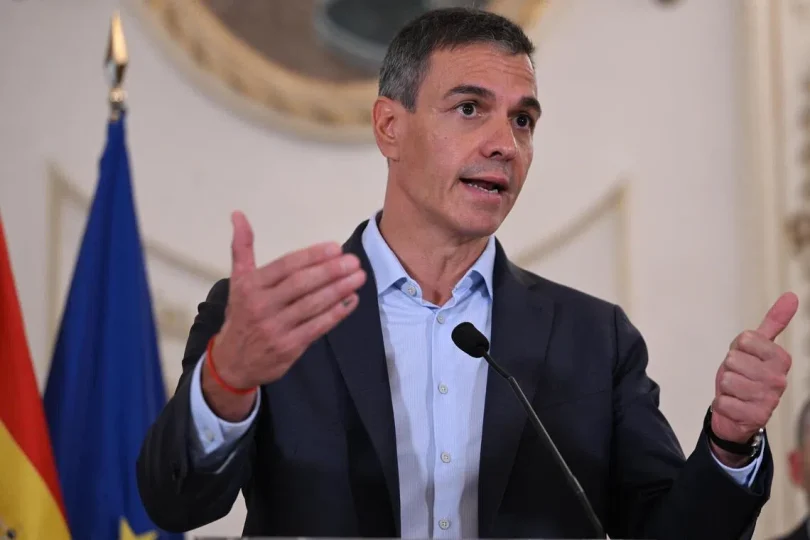
MADRID – Spanish Prime Minister Pedro Sanchez has been the most progressive European leader on migration, bucking his colleagues’ rightward shift.
That stance has now left him politically exposed after thousands of migrants overran a Spanish enclave in Northern Africa.
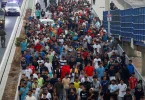
As Sanchez grappled with 50,000 undocumented migrants arriving illegally in Ceuta, the Spanish leader found himself the target of swift condemnations and warnings, as leaders vowed to impose border checks if needed and even suspend Spain’s participation in Europe’s free-travel zone, known as the Schengen area.
“It goes without saying that the EU must immediately take all necessary steps and consider all options, including a suspension of Schengen cooperation,” Danish Prime Minister Mette Frederiksen, a centre-left socialist like Sanchez, told broadcaster DR.
“Uncontrolled immigration is a threat to Europe and Denmark.”
Some even directly linked the migration surge to Spain’s more welcoming migration laws, including pathways to residency not available elsewhere.
“Poland has tightened asylum laws, border procedures, and has built effective barriers on its border with Belarus, which is the eastern border of the EU,” Polish Prime Minister Donald Tusk. “Spain must follow our example if Schengen is to survive.”
The pile-on reflected how out of step Sanchez’s has become on some of Europe’s most hot-button issues – and how keen most leaders are to pounce on a tough-on-migration narrative.
While many, including those on the left, have pushed tougher migration laws and funneled billions into new defence spending, Sanchez has held the line in Spain.
The pressure on Sanchez came even though it’s highly unlikely the newly arrived migrants can move anywhere else in Europe.
Already, about half are back across the border in Morocco and the rest will likely to be sent back soon, according to the Spanish government.
Sanchez himself noted on the afternoon of July 31 that more unauthorised entries occur through Italy, Greece and the Western Balkans than through Spain.
“Solidarity and empathy are optional,” he wrote in a post on X. “Respect for European treaties and the data is not.”
Sill, the crisis served as catnip for right-wing leaders focused on migration.
Italian Prime Minister Giorgia Meloni was quick to jump on the issue – an easy way to please her voters.
On the night of July 31, the country said it would impose entry controls for non-EU citizens arriving from Spain.
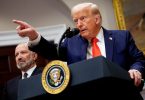
Even US President Donald Trump, who has sparred with Sanchez over NATO spending and threatened to cut off trade with Spain, got in on the action.
“It looks like an invasion of a country by hundreds of thousands of people, and that same thing is going to happen to us if the Republicans don’t get elected, except worse, much bigger, much easier to get into,” he said on July 31 during a Cabinet meeting.
But the issue also sparked concern among more centrist leaders, including European Commission President Ursula von der Leyen, the European Union’s top executive, and German Chancellor Friedrich Merz, who called for a quick solution.
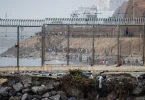
The crisis saw thousands of migrants jump over fences that mark the border between Ceuta and Morocco, or swim in the Mediterranean to evade a breakwater that marks the frontier.
Ceuta and Melilla, another Spanish enclave in Northern Africa, are Spanish territory and once people enter either city they are officially on EU soil.
The reasons behind the wave of entries – the biggest ever – are unclear.
According to Teneo, a political consultancy, Morocco may have instigated “the crisis by relaxing controls at the border” in retaliation for a recent visit by Sanchez to Algeria.
The two North African countries have a long-standing diplomatic spat.
Within Europe, however, Sanchez is now facing pressure for his migration policy.
Most recently, Sanchez ruffled feathers with a plan to grant residency permits to more than 1 million undocumented migrants.
Madrid had to go out of its way to explain that the permits would only allow people to work in Spain and not elsewhere in the EU, so they would be unlikely to leave the country.
The discomfort with Sanchez can go beyond migration, as well.
The Spanish leader also refused to meet NATO’s 5 per cent of GDP defence spending target, making Spain the only country among 32 allies to hold out.
Madrid argues that while it won’t pledge to hit the 5 per cent mark, it has recently increased spending in nominal terms more than others.
Sanchez’s courting of China has similarly created friction within the EU, as the bloc pushes to end certain economic dependencies on the Asian nation.
For Sanchez, the crisis presents a new problem on the domestic political front, where he already governs a weak minority coalition and is trailing in polls ahead of an election in 2027.
On July 31, he referred to the mass entries as an “attack” and a “violation” of Spain’s territorial integrity – rare words for the Socialist, who usually portrays himself as a defender of immigration. BLOOMBERG