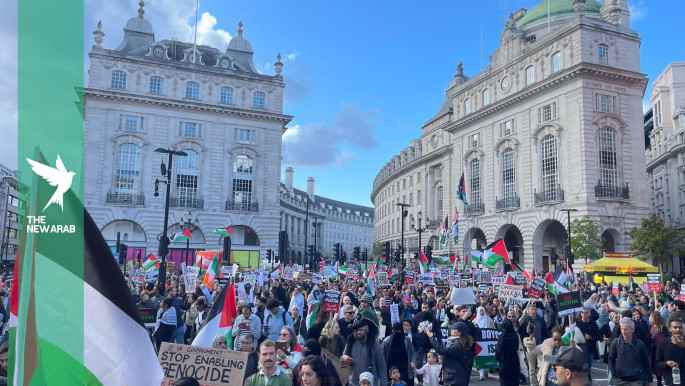
The pro-Palestine protest to mark the 78th anniversary of the Nakba will take place on 16 May [Getty]
Pro-Palestine groups and anti-racism organisations in Britain have intensified their mobilisation efforts for a major march to mark Nakba Day set to take place in London on 16 May after reaching an agreement with police over the route of the demonstration.
The Palestine Coalition confirmed it had reached an agreement with the Metropolitan Police for demonstrators to march around four kilometres from South Kensington, where the Israeli embassy is located, to Pall Mall near the UK government and parliament district in central London.
The march will mark the 78th anniversary of the Palestinian Nakba and is set to take place on the same day as a separate far-right demonstration organised by anti-Islam activist Tommy Robinson, which police have also approved.
Robinson’s march is expected to travel nearly three kilometres from Euston to Parliament Square via Downing Street under the slogan “Unite the Kingdom, Unite the West”.
Under arrangements agreed with police, Trafalgar Square – which has been a traditional gathering point for protests in London – will remain closed to both demonstrations throughout the day.
Current plans place the starting points of the two marches more than 5.5 kilometres apart, while their end points will remain more than 1.5 kilometres apart.
Peter Leary, deputy director of the Palestine Solidarity Campaign, told The New Arab that the agreement with police, finalised last Thursday, had strengthened cooperation between the Palestine Coalition and the anti-racism group Stand Up To Racism to ensure the largest possible turnout for the Nakba anniversary march.
The Metropolitan Police also confirmed the agreement with organisers to The New Arab.
Coordinators of the pro-Palestine demonstration said the march would carry two main slogans: “Justice for Palestine” and “United against Tommy Robinson and the far right”.
The Palestine Coalition has stepped up campaigning efforts ahead of the protest, announcing that buses will travel from 21 cities across England to bring participants to London.
In a statement, the Palestine Solidarity Campaign urged people to protest against “the far right in Britain that glorifies Israel’s racism and brutality”.
“Our unity and solidarity are stronger than their hatred and division”, the group said.
Meanwhile, the Stop the War Coalition said the march would bring together Palestinians and supporters of “freedom and justice from all ages and backgrounds”.
“We will stand shoulder to shoulder in London and show that unity and solidarity will prevail”, the group added.
Stand Up To Racism also called on supporters across Britain to join the march, which it said would demand “an end to Britain’s complicity in Israel’s crimes” and reaffirm support for the “inalienable rights of the Palestinian people, including the right of refugees to return to their homes”.
It also called on “everyone opposed to racism and fascism and all people of conscience” to join the protest against “racism, the far right and all forms of hatred, including Islamophobia and antisemitism”.
Palestine emerges as a central issue ahead of local elections
Opposition to Israel’s war on Gaza has emerged as a central issue in the 2026 local elections in Britain set to take place on Thursday.
Campaigners have pushed for candidates to sign a “Palestine Pledge” as part of their “Vote Palestine 2026” campaign which is aimed at putting the issue of Palestine at the top of the political agenda in the country.
The pledge commits candidates to taking all appropriate steps to “protect the rights of the Palestinian people”, “hold Israel accountable for crimes including genocide and apartheid”, and ensure local councils are not complicit in such actions.
Among the measures proposed are demands for councils to divest pension funds from companies linked to Israel or operating in illegal settlements in the occupied Palestinian territories.
The campaigners published a nationwide list on Wednesday of the 2,148 candidates that have signed the pledge – representing around nine percent of all candidates standing in the election – urging voters to review it before casting their ballots.
Around 25,046 candidates are contesting 5,066 seats across 136 councils in England, including 32 councils in London.
Opinion polls and political forecasts suggest the ruling Labour Party could suffer major losses, particularly in London, amid dissatisfaction with Prime Minister Keir Starmer’s administration over unfulfilled election promises.
Forecasts also indicate the Conservative Party could lose support to the right-wing Reform UK and the Green Party of England and Wales.