
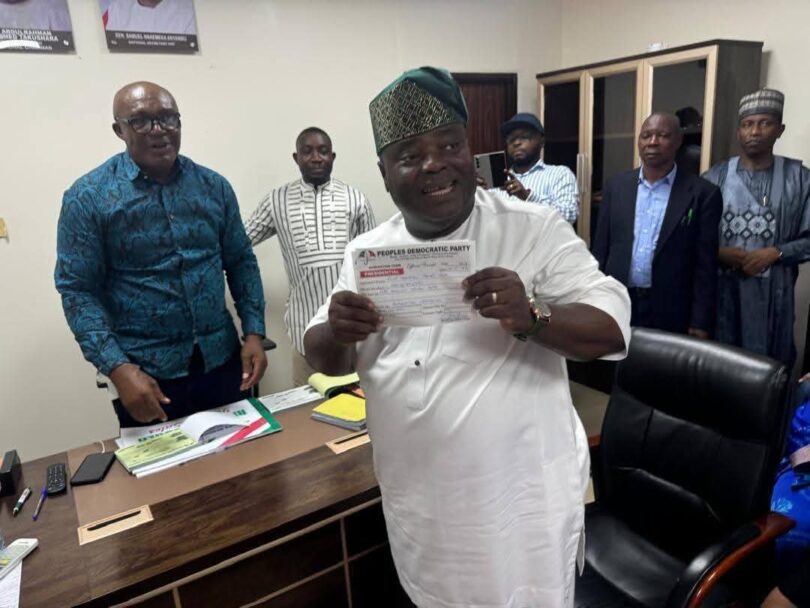
“Senator Sandy Onor’s political journey has been subject to various interpretations. Over time, some analyses suggest a reliance on external political relationships rather than an exclusive focus on grassroots support.”
Cross River State politics has historically been characterised by a strong emphasis on identity, equity, and political equilibrium.
For many observers, the recent efforts to position Senator Onor as a potential presidential aspirant within the Peoples Democratic Party (PDP) are viewed as more than just an ambitious proposal.
Some analysts suggest these maneuvers reflect a strategic recalibration, potentially aimed at re-establishing political relevance in anticipation of future governorship considerations in Cross River State, particularly for the 2031 election cycle.
The political landscape in Cross River State is often described as discerning. Many residents and commentators are familiar with the patterns of political discourse and the key figures involved, often identifying what they perceive as underlying motivations behind political narratives within the state.
A central element in this evolving political discussion is the notable association between Senator Onor and the former Rivers State Governor, now Minister of FCT, Nyesom Wike. This political connection has become a frequent topic of conversation in Nigerian political circles. Some interpret the current presidential speculation as a carefully crafted strategy to reintroduce Senator Onor into Cross River’s political discourse following his performance in the 2023 elections.
A point of discussion for many is the perceived incongruity between local electoral outcomes and national political aspirations. Questions are being raised by some Cross Riverians regarding how a political figure’s performance in local elections aligns with a potential bid for national office, particularly given the extensive mandate required to lead the Federal Republic of Nigeria.
Senator Sandy Onor’s political journey has been subject to various interpretations. Over time, some analyses suggest a reliance on external political relationships rather than an exclusive focus on grassroots support. His governorship campaign in 2023, while presented as a broad movement, ultimately highlighted a perceived disconnect with a segment of the Cross River electorate.
In 2023, the electorate of Cross River State made choices that, for many, reflected a preference for stability and continuity in leadership. The outcome indicated a rejection of what some perceived as divisive politics, favoring a leadership direction aligned with the state’s broader aspirations.
However, rather than a complete withdrawal from active political engagement, current signals from Senator Onor and his associates suggest a continued pursuit of political influence through various avenues. The presidential discussions are interpreted by some as less about immediate national service and more about maintaining visibility and leverage for future political negotiations within the state.
Cross Riverians are often seen as astute observers of political dynamics, and many believe they can discern underlying political objectives. The broader aim, as some interpret it, is to position Senator Onor for a potential governorship attempt in 2031, with strategic alliances forged outside the state. However, a significant consideration in this approach is the distinct political culture of Cross River State, which many believe is not easily amenable to external political directives, particularly when compared to other states.
Regardless of the influence a figure like Nyesom Wike may hold in national political circles, many Cross Riverians assert that the state’s political direction is ultimately determined by its own populace and their collective will. The state possesses a unique political identity, distinct leadership dynamics, and a strong sense of autonomy.
Attempts to utilise Cross River as a platform for external political strategies are often met with skepticism and are widely believed to be unlikely to succeed without strong local endorsement.
Furthermore, a point of concern for some political stakeholders revolves around the perception that Senator Onor has at times prioritized individual ambition over collective political harmony. His challenge to the state’s established zoning understanding during the 2023 governorship race generated considerable discussion and was seen by some as potentially undermining the long-standing rotational arrangement that has historically contributed to stability among the senatorial districts.
Rather than fostering broad consensus, some analyses suggest his political approach has at times been associated with a sense of entitlement and a confrontational style.
Even during his tenure in the Senate, some critics have argued that the Central Senatorial District did not witness the kind of transformative constituency projects that were widely anticipated. For many constituents, this period was perceived by some as being more characterized by continuous political ambition than by tangible developmental impact.
Consequently, the most recent presidential speculation has, for many, struggled to generate widespread enthusiasm beyond a specific political circle.
To many Cross Riverians, this endeavor is viewed as a familiar political strategy, potentially lacking broad organic support. It is perceived by some as a carefully constructed media narrative designed to project an image of national relevance where local legitimacy remains a subject of ongoing debate.
The electorate is often described as increasingly sophisticated. There is a strong understanding that political popularity cannot be simply generated externally. True political leadership, many believe, emanates from the people themselves, and the people of Cross River have articulated their preferences through electoral processes.
Significantly, the current political sentiment in the state appears largely aligned with the broader national direction under President Bola Ahmed Tinubu and the leadership of Governor Bassey Otu. There is a perceived consolidation around themes of continuity, stability, and strategic alignment with the federal government. In this climate, efforts to re-energize past political structures through external sponsorship are often viewed as increasingly detached from present realities.
Indeed, a growing sentiment within the Central Senatorial District, according to some reports, is that Cross River’s future leadership transitions, following Governor Otu’s tenure, should emerge from internal consensus rather than from externally influenced arrangements.
This perspective is gaining increasing traction. Ultimately, Senator Sandy Onor’s presidential considerations may inadvertently achieve an outcome contrary to its intended purpose. Rather than rebuilding political momentum, it has, for some, reignited public discussion about his electoral history, his political affiliations, and a perceived disconnect from the grassroots realities within Cross River State.
Politics, at its core, relies on trust and acceptance. In democratic societies, the prevailing view is that extensive external political engineering cannot successfully impose a political figure who, in the eyes of a significant portion of the electorate, is considered to have struggled to gain widespread political acceptance.
Cross Riverians are widely regarded as having matured politically. They are often described as increasingly vigilant, discerning, and resistant to external manipulation. The era where external political actors could significantly dictate the state’s political destiny is, for many, perceived as diminishing.
This is why many believe this latest political initiative will likely conclude similarly to previous attempts of its kind: without achieving its broader objectives.
*Agim Ojong Agim is the Convener, Dignity in Cross River State Central District Politics