
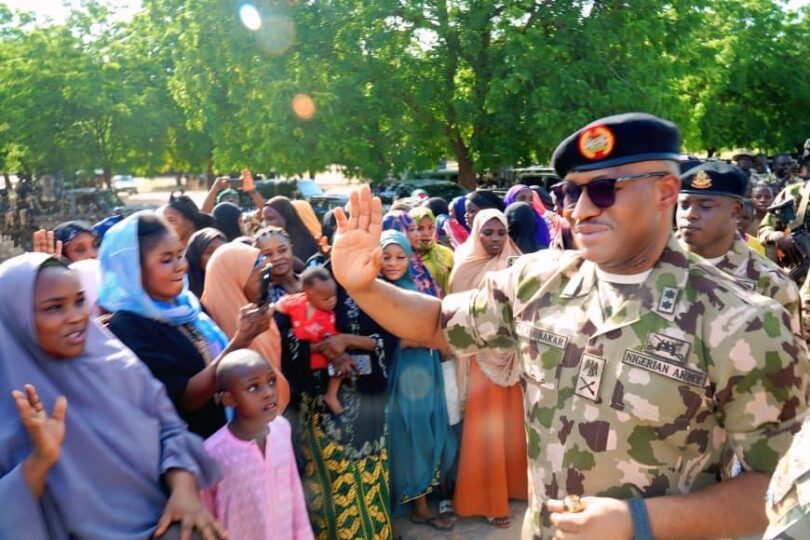
The end of a military command is rarely marked by celebration alone. Behind the ceremonial handshakes, salutes, photographs and carefully chosen words are memories that cannot be fully captured in official statements. There are battles won, communities reclaimed, captives rescued and families reunited. There are also empty seats in officers’ messes, soldiers who did not return from operations and families whose loved ones paid the supreme price.
It was against this mixture of accomplishment, sacrifice and remembrance that Major General Abdulsalam Enesi Abubakar handed over the leadership of the Joint Task Force North-East, Operation Hadin Kai, to Major General I.A. Ajose on 15 September 2026. The handover brought to an end nearly 17 demanding months of service as the 15th Theatre Commander.
Abubakar assumed command from Major General Waidi Shaibu, now the Chief of Army Staff, on 29 April 2025 amid the familiar challenges of the counterinsurgency campaign. Although the terrorists had been considerably weakened over the years, they remained capable of launching attacks and inflicting casualties. They continued to take advantage of the region’s vast territory, the difficult terrain of the Lake Chad Basin and instability along Nigeria’s international borders within Operation Hadin Kai’s area of responsibility.
The increasing use of improvised explosive devices and armed drones, alongside attacks by small and highly mobile groups, presented fresh dangers to troops and vulnerable communities. The mandate before the new Theatre Commander was clear but enormously demanding: to degrade the terrorists, protect civilians, recover threatened areas and help create the conditions for normal life to return to the North-East.
Normalcy in such an environment could not be measured by military victories alone. It had to be seen in reopened markets, schools and farmlands; in the return of displaced families; and in the ability of citizens to travel, trade, worship and sleep without waiting for the sound of gunfire.
According to the official account presented at the end of Abubakar’s tenure, more than 7,000 displaced families returned to their ancestral communities, with returned or resettled communities in every local government area of Borno State. Behind those figures were families carrying what remained of disrupted lives back home: elderly people returning to compounds built by their fathers, women reopening rooms that had stood empty for years and children seeing villages they had known only through the stories of their parents.
The Theatre also recorded the voluntary, safe and dignified repatriation of more than 3,000 Nigerians from the Republic of Cameroon. The exercise was undertaken by the Borno State Government in collaboration with the Federal Ministry of Humanitarian Affairs and Poverty Reduction and the United Nations High Commissioner for Refugees.
Other signs of returning life became visible. The National Youth Service Corps orientation exercise returned to Maiduguri after an absence of more than 13 years. West African Examinations Council and National Examinations Council examinations were conducted in Banki and Gwoza. Trade routes reopened, markets came back to life and farmers returned to lands that had been inaccessible.
These were not the accomplishments of the military alone. They resulted from cooperation among the Armed Forces, the Borno State Government, federal institutions, humanitarian organisations, traditional institutions and the communities themselves. The military’s role was to create and protect the environment in which civil life could resume.
Every reopened school, cultivated farm, restored market and returning family represented a rejection of the future the terrorists sought to impose upon the region. Terrorist organisations may occupy territory with weapons, but they sustain their influence by frightening people away from their homes and livelihoods.
The operational account presented at the handover stated that more than 1,106 Jama’atu Ahlis Sunna Lidda’awati wal-Jihad and Islamic State West Africa Province terrorists were neutralised during Abubakar’s tenure, including some commanders and other important figures within their structures.
The Theatre also reported the recovery of more than 475 assorted weapons and 24,409 rounds of ammunition. From April 2025, at least 295 improvised explosive devices were discovered and safely detonated. More than ₦300 million linked to terrorist financing was intercepted, while no fewer than 758 suspected logistics collaborators were arrested.
These aspects of the campaign were important because insurgencies do not survive on ideology alone. They require money, fuel, food, medicine, weapons, intelligence and networks capable of moving supplies. Targeting those networks weakened both the fighters and the concealed system that enabled them to survive, recruit and attack.
Sustained military pressure, combined with non-kinetic initiatives, contributed to further surrenders. According to the Theatre, 969 terrorists and members of their families surrendered within the final year of Abubakar’s command. The Theatre also recorded the rescue of 638 civilians from terrorist enclaves and all 46 students endangered during the attempted abduction at the Federal Government Girls College, Monguno.
For the families involved, these were not abstract operational successes. They represented the difference between a lifetime of grief and the indescribable relief of seeing a missing child or relative return alive.
One of the most consequential campaigns of the period was Operation Desert Sanity V in the Timbuktu Triangle. Beginning on 21 January 2026, the operation combined sustained ground action with coordinated air support against terrorist positions in an area that had long served as a sanctuary, detention centre and logistics base.
Military accounts stated that troops uncovered and demolished three ISWAP detention facilities with an estimated combined capacity of about 300 captives. At least 32 terrorists, including two Qaids and three Munzirs, were reported neutralised. The pressure exerted by the advancing troops also enabled more than 70 captives to escape and emerge in Goniri, Buratai and Mandaragirau.
Among the escapees was Malam Jidda Ba Jidda, a farmer from Kufi village reportedly abducted in December 2025. His experience placed a human face on the importance of the operation. For those held in such facilities, escape meant release from hunger, coercion, forced labour, violence and the constant fear of execution.
The destruction of the detention facilities denied the terrorists places they had used to imprison, punish and terrorise civilians. It also challenged the aura of invincibility that terrorist organisations seek to create around their enclaves.
At Mallam Fatori on 18 March 2026, troops repelled a coordinated ground and drone attack on a military position. The military reported that at least 80 terrorists, including three senior commanders, were killed. Four soldiers were wounded, while weapons, ammunition, explosives and armed-drone components were recovered.