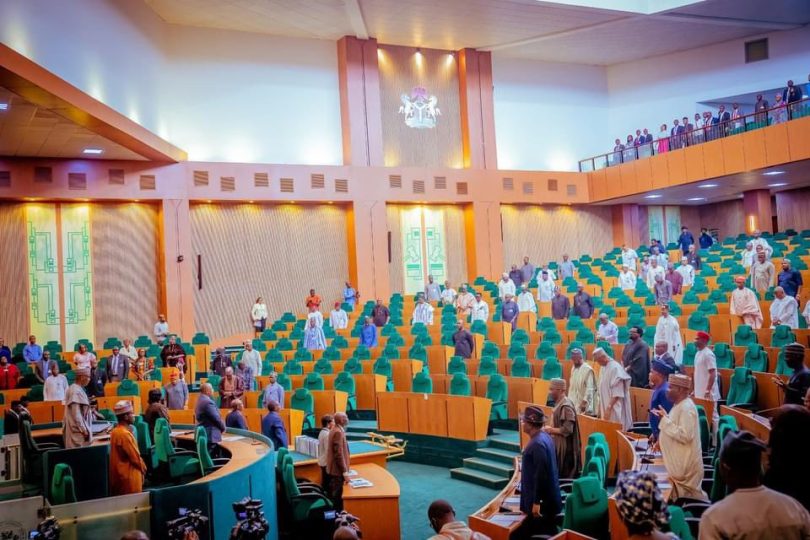
The committee demanded explanations over deductions from the accounts of UBEC and other agencies, even as the Accountant General defended the practice as temporary borrowing to meet critical government obligations.
The House of Representatives Public Accounts Committee (PAC) has directed the Office of the Accountant-General of the Federation (OAGF) to submit comprehensive records of outstanding revenues allegedly owed to the federal government by the Central Bank of Nigeria (CBN), the Nigerian National Petroleum Company Limited (NNPCL) and other revenue-generating agencies.
The committee also demanded explanations over allegations that the OAGF withdrew billions of naira from the accounts of several government agencies, including the Universal Basic Education Commission (UBEC), without promptly refunding the funds.
The directives were issued on Monday during an investigative hearing attended by the Accountant-General of the Federation, Shamseldeen Ogunjimi.
During the session, committee member Gboyega Isiaka (APC, Ogun) raised concerns over what he described as persistent failures by government-owned enterprises to remit their statutory operating surpluses to the federal government.
He said, “Considering our GDP, ours is one of the lowest in the continent, at about 16 per cent. Now, I know that business entities are meant to return about 80 per cent of their taxes, and others are between 20 per cent and 50 per cent.
“From the totality of what we are seeing, there appears to be some backlog of remittances still. Can you give some examples or figures on this? That is one. Two, even those business entities that are returning, as a member of the economic team, how comfortable are you with the performance of some of those entities, given their assets and all of that?” he asked.
He said weak revenue remittances continue to undermine Nigeria’s fiscal position despite the enormous assets controlled by many public institutions.
Mr Isiaka questioned the level of compliance by major agencies, including the CBN, the Nigerian Maritime Administration and Safety Agency (NIMASA), the Securities and Exchange Commission (SEC) and others, insisting that Parliament must know not only the percentage of operating surplus remitted but also the actual surplus generated by each agency.
Responding, the Director of Revenue and Investment at the OAGF, Makinde Mogaji, disclosed that the Central Bank allegedly has an outstanding obligation of about ₦5.3 trillion in unremitted operating surplus.
According to him, despite repeated interventions by the Public Accounts Committee and efforts to recover the funds, the apex bank has yet to remit the money.
He explained that under existing financial regulations, about 70 per cent of the eligible operating surplus is expected to be paid into the federal government’s account, adding that other agencies, including the Federal Airports Authority of Nigeria (FAAN), have made substantial remittances.
He said, “Early last year, they owed the federal government ₦5.3 trillion for their operating surplus, and despite all the effort of the PAC, ₦5.3 trillion CBN, and despite the effort of the PAC to recover the money, they refused to pay…70 per cent of that money should be paid and behold, CBN refused to pay. That is CBN. And that is just one of our huge sources of revenue. An agency like FAAN, we have a record of ₦473 billion paid.”
The hearing also examined the controversial policy of automatic deductions from the accounts of ministries, departments and agencies (MDAs), introduced as part of efforts to improve government revenue collection.
Mr Ogunjimi defended the policy, describing it as an advanced recovery mechanism designed to collect revenues due to the government before agencies submit their final operating surplus calculations.
He said the initiative significantly boosted government revenue in the previous fiscal year but faced resistance from some agencies, many of which sought presidential intervention to reverse or reduce the deductions.
According to the Accountant-General, some agencies secured partial or complete reversals after appealing to President Bola Tinubu, while others continued to challenge the deductions.
He also accused the Nigerian National Petroleum Company Limited (NNPCL) of failing to cooperate with the recovery process, noting that disagreements over outstanding liabilities remain unresolved and are now being reviewed by a post-assessment committee.
“So we have been battling with that, and that’s why we were not able to return to what we had last year to that level. And you also have instances where agencies like NNPC refused to cooperate entirely… to the extent that they had to be walked out for non-compliance. NNPC has agreed to some of those abilities; some, they said, no, they do not agree. So, all of that is still being handled by a post-mortem committee,” he stated.
Supporting this view, Mr Mogaji added that the automatic deduction mechanism remains operational, explaining that final reconciliations are carried out after agencies compute their actual operating surpluses to determine whether additional payments or refunds are necessary.
Attention later shifted to allegations that the OAGF withdrew statutory allocations from several agencies’ accounts to finance government obligations.
Committee Chairman Bamidele Salam cited complaints received from UBEC, the National Agency for Science and Engineering Infrastructure (NASENI), the Nigerian Broadcasting Commission (NBC) and other agencies currently under investigation by the committee.
According to Mr Salam, UBEC alleged that approximately N16 billion approved for expenditure in November 2025 was not released, while another N15 billion was withdrawn from its account and has yet to be refunded.
He said similar complaints had been received from NASENI and other government institutions, raising concerns over the legality of using funds appropriated for statutory functions to finance unrelated government expenditures.
The committee chair questioned the justification for such deductions, particularly from agencies responsible for critical national development programmes.
Responding to the allegations, Mr Ogunjimi acknowledged that funds had occasionally been taken from agency accounts to enable the government to meet urgent financial obligations.
He, however, insisted the transactions were temporary borrowing arrangements rather than permanent withdrawals.
According to him, the OAGF only considers funds that have remained unused for extended periods and acts on directives issued by the Minister of Finance before accessing such balances.
He maintained that the government refunds the money whenever the affected agencies require it, citing the Tertiary Education Trust Fund (TETFund) as an example of an institution whose funds were fully repaid after being utilised temporarily.
The Accountant-General stressed that his office does not arbitrarily access agency accounts and that each transaction follows an internal assessment process.
The committee was, however, unconvinced by the explanation.