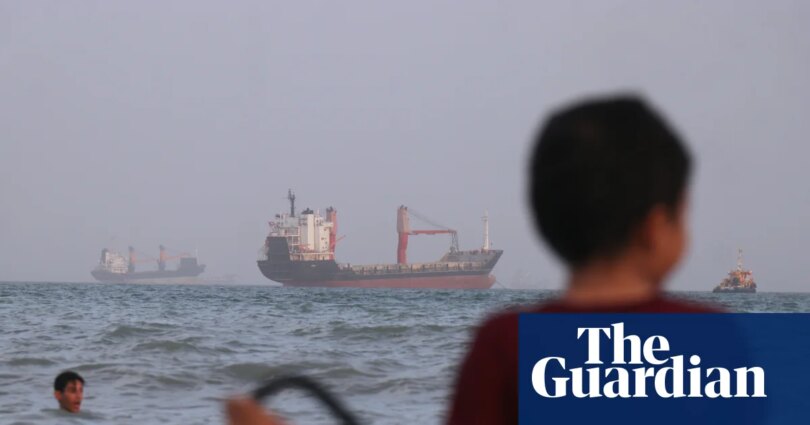
The US has launched an operation to “guide” ships trapped in the Gulf by the Iran war through a southern route of the Strait of Hormuz, even as Tehran insisted that any such transits would have to be coordinated with its armed forces.
The scheme was announced as “Project Freedom” on Sunday night by Donald Trump on his social media page, where he portrayed it as a humanitarian gesture to help crews on hundreds of ships which have been unable to leave the Gulf since the war began.
Shipping executives have responded cautiously to the move, amid uncertainty over how or if it would work in practice.
US officials were quoted in press reports as saying the operation would not involve naval escorts. US Central Command said it would “support” the project with its considerable military resources in the region, including guided-missile destroyers, more than 100 land and sea-based aircraft, drones and 15,000 troops. But it said the emphasis of the mission was to “combine diplomatic action with military coordination”.
On Monday morning, a US-led military organisation, the Joint Maritime Information Center (JMIC), said the US had established an “enhanced security area” south of the established prewar shipping lanes running through the strait. The new route would take ships through Omani territorial waters, the JMIC said, and due to high anticipated traffic, ship operators were told to coordinate with Omani authorities by radio.
Transiting ships were also advised to avoid navigating in or close to the usual shipping lanes which “should be considered extremely hazardous due the presence of mines that have not been fully surveyed and mitigated”.
Iran’s military command insisted that ships passing must coordinate with them.
“We will manage the security of the Strait of Hormuz with all might, and inform all commercial ships and tankers to refrain from any attempt to transit without the coordination of the Iranian Armed Forces stationed in the Strait of Hormuz in order not to jeopardize their security,” Maj Gen Ali Abdollahi said, according to Mehr news agency.
Earlier, Abdollahi had warned Iran would attack “any foreign armed force” which tried to approach or enter the strait, “especially, the aggressive US army”.
It was unclear on Monday morning how many ships had chosen to exit through the strait along the US-recommended route. Richard Hext, the chair of Vanmar Shipping and the Hong Kong Shipowners Association, pointed out that Iran had previously declared that unapproved transit of the strait would be considered a “violation of the ceasefire” agreed last month.
“Under these circumstances we should be cautious,” Hext told CNN.
The French president, Emmanuel Macron, said on Monday that the only way to reopen the strait of Hormuz was “a coordinated reopening by the United States and Iran”.
Macron, speaking at a meeting of European leaders in Armenia, added: “We are not going to take part in any military operation in a framework that to me seems unclear.”
More than 850 ships are estimated to have been trapped in the Gulf since the US and Israel launched their attack on Iran on 28 February. Iran imposed a blockade on foreign shipping using the Hormuz strait soon after the war began and Trump imposed a counter-blockade of ships using Iranian ports on 13 April. A Pakistani-brokered ceasefire, announced by Trump in early April, stopped hostilities but failed to open the strait.
An estimated 20,000 sailors are stuck on the tankers, bulk carriers, container ships and other vessels marooned in the Gulf, and there are growing concerns for their welfare. Trump said the US had been approached by countries around the world for help.
Announcing the project on on his Truth Social site Trump said the US would use its “best efforts to get their Ships and Crews safely out of the Strait”. Giving no details on how it was to be achieved, the president presented to as a humanitarian gesture “on behalf of the United States, Middle Eastern Countries but, in particular, the Country of Iran”.
“I have told my Representatives to inform them that we will use best efforts to get their Ships and Crews safely out of the Strait. In all cases, they said they will not be returning until the area becomes safe for navigation, and everything else,” Trump said.
He added: “If, in any way, this humanitarian process is interfered with, that interference will, unfortunately, have to be dealt with forcefully.”
His post was also notable for its claim that there were “very positive discussions between US representatives and Iran … and that these discussions could lead to something very positive for all”, in a dramatic change of tone.
Trump has a record of delivering surprisingly upbeat messages in the hours before global markets open. He had initially reacted negatively over the weekend to Iran’s latest 14-point peace proposal, saying Iran had not yet “paid a big enough price” for its past wrongs. The Israeli state broadcaster, Kan News, reported on Sunday night it had interviewed Trump and quoted him as saying he had “studied the new Iranian proposal and it is unacceptable to me”.
Trump’s rhetoric over the weekend, prior to his announcement on Sunday, had been particularly bellicose. After telling Congress in a formal letter that the US was not at war, he told a meeting of supporters at a retirement community in Florida: “You know we’re in a war, because I think you would agree we cannot let lunatics have a nuclear weapon.”
The war talk boosted speculation over the possibility of another round of US strikes against Iran aimed at forcing concessions, including a halt to the country’s nuclear programme.
Israeli press reports quoted senior military officials as saying they were preparing for possible US strikes on Iran, and the likelihood that Tehran would hit back at Israel.
A senior Israeli officer who briefed reporters on Friday said any peace agreement without a cessation of Iran’s uranium enrichment programme and the surrender of its stockpile of highly enriched uranium would be considered a failure.
Iran’s military-backed Fars news agency had quoted a senior official as saying a return to all-out conflict was “likely”, weeks after the ceasefire was brokered. Pakistani efforts to rekindle peace talks in Islamabad, after a first round ended without agreement, have so far failed as each side set preconditions that the other refused to fulfil.