
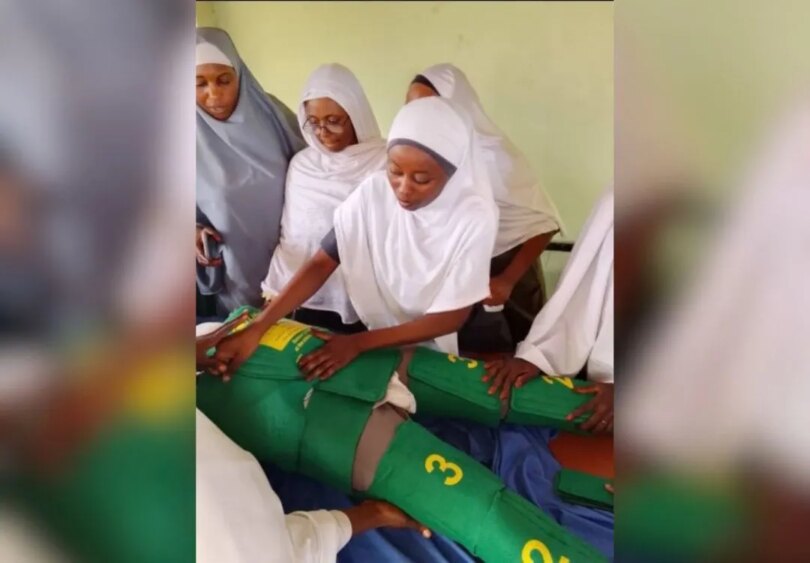
PPH, or excessive bleeding after childbirth, is one of the leading causes of maternal deaths worldwide, including in Kaduna and other parts of Nigeria.
At a primary healthcare centre in Kaduna State, Zainab Garba remembers what health workers used to do when a woman began bleeding heavily after childbirth.
For Ms Garba, an antenatal care provider at PHC Abdukwari in Sabon Gari LGA, who also assists with deliveries, there were limits to what health workers at her level could do.
But she said that began to change after she was trained to use the E-MOTIVE approach to detect and manage postpartum haemorrhage (PPH).
“With the presence of E-MOTIVE and the training given to us, we now do better,” she said. “The majority stop bleeding without even being referred.”
Ms Garba is one of the frontline health workers PREMIUM TIMES met during visits to primary healthcare facilities in Kaduna, where an intervention is attempting to address a longstanding challenge in maternal healthcare: shortages of skilled health workers to manage potentially life-threatening complications at the primary healthcare level.
The intervention, known as the Task Shifting Task Sharing (TSTS) project, is implemented by Pathfinder International in partnership with Impact Catalysts, with support from the Gates Foundation. It is designed to strengthen the capacity of Community Health Extension Workers (CHEWs) to take on specific maternal healthcare responsibilities at the primary healthcare level.
Under the project, 77 CHEWs have been trained across 77 primary healthcare facilities in nine LGAs: Kaduna North, Kaduna South, Igabi, Soba, Sabon Gari, Makarfi, Kaura, Jema’a and Zangon Kataf.
They are supported by nine clinical mentors, one in each LGA, and nine Reproductive Health Coordinators.
Programme records reviewed by PREMIUM TIMES show that the CHEWs received competency-based training in PPH prevention and management, basic emergency obstetric and newborn care and other maternal and newborn health services.
A key component of the training focuses on preventing, detecting, and managing PPH using the E-MOTIVE approach.
PPH, or excessive bleeding after childbirth, is one of the leading causes of maternal deaths worldwide.
It can occur within the first 24 hours after childbirth, known as primary PPH, or between 24 hours and six weeks after delivery, known as secondary PPH.
A 2026 Lancet Series highlighted by the World Health Organisation estimates that PPH affects about 27 million women and kills nearly 43,000 women globally each year. It also indicates that PPH costs countries, health systems and families globally over $10 billion each year.
The burden is particularly high in poorer regions, with the WHO estimating that more than 85 per cent of deaths from PPH occur in sub-Saharan Africa and South Asia.
In Nigeria, PPH remains a major contributor to maternal mortality, accounting for an estimated 23 to 30 per cent of maternal deaths, according to WHO.
Recent surveillance data from Kaduna also show the continuing toll of PPH. A Kaduna State Primary Health Care Board review for the first quarter of 2026 identified PPH as the leading cause of maternal death among cases for which causes were detailed, with PPH-related deaths reported in Kudan, Birnin Gwari and Lere LGAs.
The finding followed a similar pattern in the last quarter of 2025, when the state’s community maternal and perinatal death surveillance report linked maternal deaths in several LGAs to PPH, often following deliveries outside health facilities.
In many cases, according to the WHO, there are no identifiable risk factors, making early detection and rapid treatment particularly important.
Lewis Aituma, a senior resident doctor in Obstetrics and Gynaecology, described PPH as “the obstetrician’s nightmare,” particularly in countries such as Nigeria, where access to emergency obstetric care remains inadequate.
He said women with multiple pregnancies, prolonged labour, fibroids, anaemia or previous Caesarean deliveries may face a higher risk.
If severe bleeding is not controlled quickly, he added, a woman can develop shock, organ failure and die.
Recognising excessive blood loss early and starting treatment quickly is therefore critical to preventing severe complications.
Under its latest guidance, WHO recommends objective measurement of blood loss after childbirth. Although PPH has traditionally been diagnosed when a woman loses at least 500 millilitres of blood after delivery, the latest guidance recommends earlier intervention when blood loss reaches 300 millilitres and is accompanied by abnormal vital signs.
One tool for doing this is a calibrated drape placed beneath the woman after delivery. It collects and measures blood, reducing reliance on visual estimation.
Once PPH is diagnosed, WHO recommends rapid use of the MOTIVE treatment bundle: massage of the uterus, oxytocic medicines to stimulate contractions, tranexamic acid to reduce bleeding, intravenous fluids, examination of the vaginal and genital tract, and escalation of care where necessary.
Together with early detection, the approach is commonly referred to as E-MOTIVE.
Evidence suggests it can make a substantial difference.
A large randomised trial involving more than 200,000 women in hospitals in Nigeria, Kenya, South Africa and Tanzania found that early detection and bundled treatment reduced, by about 60 per cent, the risk of a combined outcome of severe PPH, surgery for bleeding or death from bleeding compared with usual care.
But in Kaduna, having an effective approach is only part of the equation.