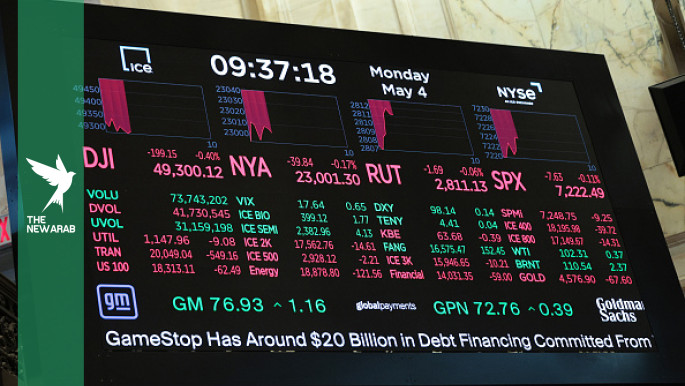
Stocks sank on Tuesday with a fresh spike in Middle East tensions fanning fears over the fragile US-Iran ceasefire, as the two sides appeared no closer to a deal to reopen the Strait of Hormuz.
And while oil prices fell, they held most of the huge gains seen on Monday after the two countries traded fire over the key waterway and the United Arab Emirates reported a strike on an installation.
The exchanges came after Donald Trump announced a mission called “Project Freedom” to guide ships from neutral countries out of the Gulf, saying it was a humanitarian effort to help stranded crews.
The US president was later quoted by Fox News as warning that Iran would be “blown off the face of the Earth” if it attacked US ships.
Crude prices surged on Monday – with Brent up almost six percent – after a US admiral said US forces sank six small Iranian boats. Iran denied any had been sunk and earlier fired warning shots at US warships.
That came after the UAE said an energy installation in the emirate of Fujairah had been hit, while the UAE defence ministry announced four cruise missiles were launched from Iran, with three successfully shot down and another falling into the sea.
A senior Iranian military official did not deny the strikes but said: “What happened was the product of the US military’s adventurism to create a passage for ships to illegally pass through” the Strait of Hormuz, according to state television.
Still, Iranian Foreign Minister Abbas Araghchi said the clashes showed there was “no military solution to a political crisis” and pointed to Pakistan’s efforts to keep mediating.
Both main oil contracts slipped on Tuesday, with West Texas Intermediate shedding more than one percent. However, it was hovering just below $105, and Brent was slightly lower at a little more than $113.
“The US has already demonstrated its willingness to secure passage, successfully guiding vessels through contested waters,” said Stephen Innes at SPI Asset Management.
“But the response from Tehran has been equally clear, signalling that any proximity to its strategic perimeter will be met with force, raising the stakes into something that feels less like brinkmanship and more like an asymmetric pressure campaign.”
Fears that the ceasefire, which has been in place since early April, could fall apart weighed on Asian equities, with Hong Kong, Singapore, Mumbai, Bangkok, Manila, Wellington, and Taipei all down.
Sydney also retreated as the Australian central bank hiked interest rates for the third straight meeting, citing rising energy prices.
London and Paris were down while Frankfurt opened higher.
Tokyo, Seoul and Shanghai were closed for holidays.
The losses followed a drop on Wall Street – where the S&P 500 and Nasdaq came off record highs — and came after a healthy rally fuelled by fresh interest in all things linked to artificial intelligence.
“Whether Operation Project Freedom actually proceeds, or proves to be the latest in a long line of initiatives and threats that fail to gain traction or are later walked back, remains to be seen,” said IG’s Tony Sycamore.
“If it does proceed, whether Iran will allow safe passage or instead chooses to fire on escorted vessels is another open question.”
Meanwhile, Wells Fargo Investment Institute’s Darrell Cronk warned that even if the crisis is brought under control, energy markets and factory activity would likely take some time to get back to normal.