PORT SUDAN, Sudan – Sudanese 13-year-old Afrah wants to become a surgeon, and nothing will stop her, not even the war that has ravaged her country and forced millions of children out of school.
Quiet and determined, she kept learning on her own for months, uprooted by the now three-year conflict between Sudan’s army and the paramilitary Rapid Support Forces.
“I would study my lessons again and again,” she told AFP at a displacement camp in Port Sudan, where she is again receiving an education thanks to UNICEF and local organisation SCEFA.
Afrah is one of more than 25 million minors in Sudan, or half the total population, of whom eight million are currently out of school, according to the UN children’s agency.
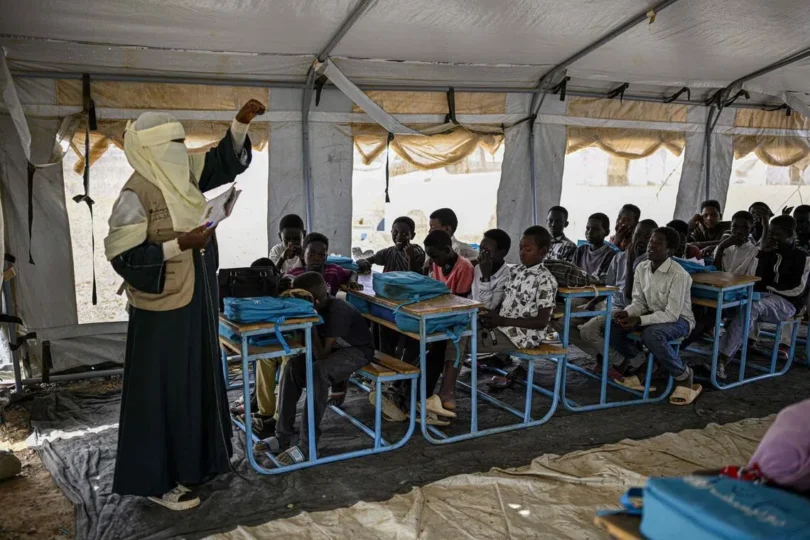
At the Al-Hishan camp, tents arranged in a square function as an elementary school for more than 1,000 children – nearly a third of whom required an accelerated curriculum to make up for lost time.
Laughter fills the camp now, but most of the children arrived traumatised by horrors, including starvation and rocket fire.
Their drawings, educators said, were at first dominated by war: depictions of the tanks, weapons and death they saw as their families fled.
“They come here scared, exhausted, isolated, but over time you see their drawings change,” UNICEF spokeswoman Mira Nasser told AFP.
“They start to adapt and process.”
In one tent, children repeated handwashing instructions after a social worker, while in another, they recited a poem in choral unison.
Elsewhere, a teacher – herself displaced and living at the camp – explained chemical and physical reactions to her class, as her three-year-old son pulled at her skirt.
“These children’s future is at stake, and education is itself a form of protection,” Ms Nasser said.
“Here they can at least get a sense of normalcy, even in a displacement site. They can resume their education, they can play, they can make friends.”
Displaced Sudanese students attending a class at an elementary school run by the Sudanese Coalition for Education in partnership with the United Nations International Children’s Emergency Fund.
PHOTO: AFP
Ms Awatef al-Ghaly, a 48-year-old Arabic teacher who was displaced from North Darfur, remembered her first days at the site, when thousands of families were left listless with their kids in tow.
“There were 60 teachers here. We just got to work,” she told AFP, at the same empty plot where they started, in the shadow of the Red Sea mountains.
They lined the students up by grade, threw together a schedule and started going through old lessons.
Ms Soad Awadallah, 52, taught English for four decades in South Darfur before arriving in Port Sudan.
“It took a lot of patience, we had the kids all sat on the ground at first,” she said, gesturing towards the rows of desks that now fill the tents, a welcome addition even if students have to squeeze in four to a bench.
According to Ms Nasser, because of the time that students lost, ranging from months to years, “some even forgot how to read and write”.
But their determination was indomitable, and the makeshift school recently graduated its first class from elementary to middle school, Ms Ghaly said with pride.
“Even when things were difficult, in the heat of summer with bugs everywhere, the kids wanted to learn,” she said.
Before the final exam, “some of them would follow us teachers home begging for more review sessions”.

Across Sudan, five million children are internally displaced, according to UNICEF. Millions are going hungry, including more than 825,000 children under five suffering severe acute malnutrition.
PHOTO: AFP
Fatma, 16, wants to become a psychiatrist to help those hurt by the fighting in Sudan.
“This war has destroyed people emotionally… My father was in the main market in Khartoum when the RSF went through killing people. He ran away, and he still feels that pain,” she told AFP.
“When I sit with the social worker, I feel better. I want to help people like that.”
One little girl, who came up to an AFP journalist’s hip, was missing her right arm, amputated after she was wounded in the capital Khartoum.
She high-fived with her left hand.
Across Sudan, five million children are internally displaced, according to UNICEF. Millions are going hungry, including more than 825,000 children under five suffering severe acute malnutrition.
The use of child soldiers has been reported across the country, and rampant sexual violence against minors has prevented many from returning to school even in areas now safe from the fighting.
Many just want to go home.
“I miss my friends and my family, I miss my school in Khartoum – it was full of trees,” 14-year-old Ibrahim said.
But he has a goal. “I want to become a petroleum engineer,” he told AFP, as the sound of children playing outside filled the tent.
During recess, dozens of pupils dashed around their teachers, laughing, playing and making hearts at AFP’s cameras.
One boy named Rizeq, clad in a red Manchester United jersey, steeled himself and walked up to the adults.
His voice a little shaky but his chest puffed out, he said: “I want more English classes in the evening.” AFP