Mr Nwabueze said the OTO aims to promote voluntary tax compliance while rebuilding confidence in taxpayers and revenue institutions.
The Office of the Tax Ombud (OTO) has advocated for fairer tax administration, robust taxpayer protection, and greater accountability from revenue authorities, emphasising that public confidence is essential to improving voluntary tax compliance in Nigeria.
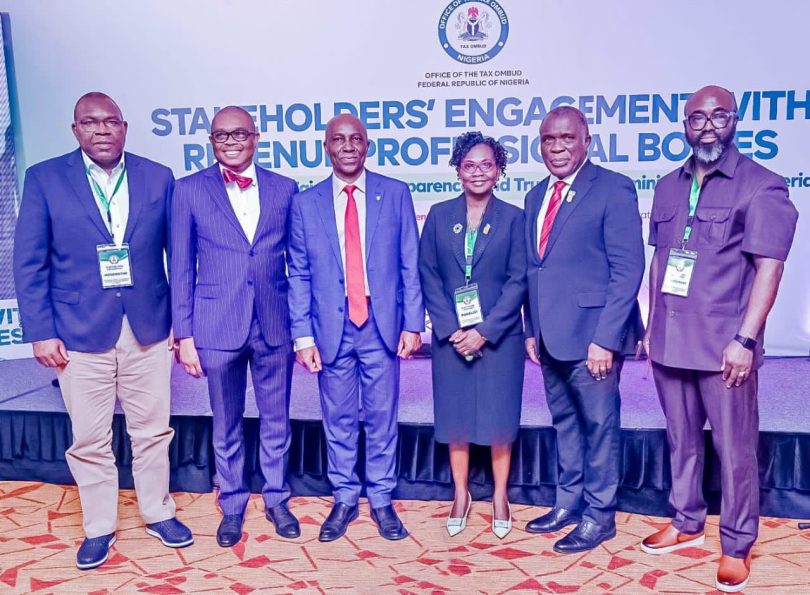
Speaking at a stakeholders’ engagement with revenue professional bodies in Lagos on Thursday, the Chief Executive of the Tax Ombud, John Nwabueze, stated that effective tax administration relies not only on legislation and enforcement but equally on public trust.
The event, themed “Promoting Fairness, Transparency and Trust in Nigeria,” centred on strengthening the relationship between taxpayers and the government. Mr Nwabueze noted that citizens are more inclined to comply voluntarily when they perceive the tax system as fair, transparent, impartial, predictable, and accountable.
He explained that the creation of the OTO reflects global best practices and demonstrates Nigeria’s commitment to establishing an independent, impartial, and credible institution dedicated to protecting taxpayers’ rights. Since its inception, the office has structured its governance and operational frameworks, developed institutional policies and complaint-handling procedures, and initiated stakeholder engagements across the public and private sectors to address taxpayer grievances.
Furthermore, the office has developed a technology-driven complaint management framework to improve public access to its services. It has also launched taxpayer education and awareness programmes, a toll-free call centre, a website, and a case management system (CMS).
“The OTO aims to promote voluntary tax compliance while rebuilding confidence in taxpayers and revenue institutions,” Mr Nwabueze said. “It is about rebuilding confidence in our tax and revenue institutions and ensuring that every taxpayer—whether an individual, a small business, or a multinational enterprise—is treated fairly, respectfully, and in accordance with the law.”
He added that the office has begun international benchmarking and peer-learning with tax ombud institutions in South Africa, Canada, Australia, Pakistan, Kenya, and the United Kingdom to adopt global best practices.
Mr Nwabueze called for a sustained, coordinated national taxpayer education campaign involving federal and state revenue authorities, educational institutions, professional bodies, and traditional and community institutions. He argued that tax education should be continuous rather than occasional, delivered in local languages, and provided in accessible formats through digital platforms, radio, television, community outreach, and social media.
“A confident taxpayer is more likely to comply voluntarily and contribute to national development,” he added, reiterating that the strength of a country’s tax system depends on public confidence in its administering institutions. “Fairness encourages compliance. Transparency inspires confidence. Trust strengthens legitimacy. These three values are inseparable.”
Also speaking, the Minister of Finance and Coordinating Minister of the Economy, Taiwo Oyedele—represented by his Special Adviser on Revenue, Olufemi Olarinde—stated that Nigeria must build a tax system anchored on clarity, consistency, and predictability. He suggested that the system should be digitised and harmonised to reduce human discretion, curb corruption and inefficiency, and provide taxpayers and the government with real-time clarity on obligations and compliance.
“If we get fairness, digitisation, and harmonisation right, we will earn the trust of our citizens, and trust is the true currency of any tax system,” Mr Olarinde explained. He added that the OTO was created to assure citizens that the tax system is fair and that taxpayers deserve a fair hearing when disputes arise. “Just as we ask taxpayers to meet their obligations, we must also hold revenue authorities accountable for how they exercise their powers.”
Lagos State Governor’s Special Adviser on Taxation and Revenue, Abdul-Kabir Ogungbo, described the establishment of the tax ombud as timely. He noted that Lagos State has introduced digital tools to simplify the taxpayer experience, harmonise revenue processes, and reduce leakages. He cited the Lagos Revenue Portal and other reforms—including the adoption of the Joint Revenue Board’s approved list of taxes and levies—as measures to improve transparency and fairness under the Nigeria Tax Act.
Addressing concerns regarding multiple taxation, the Executive Secretary of the Joint Revenue Board, Olusegun Adesokan, stated that the Taxes and Levies Act eliminates and criminalises illegal and multiple tax collection by associations, and mandates that states adopt technology in tax administration. Mr Adesokan emphasised that greater public awareness and compliance would reduce multiple taxation and improve transparency, which he noted relies on the collective efforts of all stakeholders.
During the panel session, the President of the Nigerian Bar Association (NBA), Afam Osigwe, argued that tax laws should be simple enough for taxpayers to understand without falling prey to extortion or corruption. He warned that taxes should not consume the bulk of a taxpayer’s disposable income and that disputes must be resolved quickly and at minimal cost.
“We need a digitised tax system that makes compliance easy. If tax laws are complicated, compliance will be difficult,” the NBA president stated. Mr Osigwe identified multiple taxation, illegal collection, and extortion as key issues for the Tax Ombud to address, noting that “some so-called taxes end up in private pockets.”
The Chairman of the Committee of Finance Experts at the Nigeria Employers’ Consultative Association (NECA), Olumuyiwa Adebayo, urged the tax ombud and other authorities to address repeated audits by different units within the Nigeria Revenue Service (NRS). “Within the same service, different departments sometimes audit the same issue simultaneously, discouraging businesses from complying,” he said.
The Vice President of the Institute of Chartered Accountants of Nigeria (ICAN), Etofolam Osuji, added that accountants must ensure compliance by presenting financial statements that accurately reflect reality. “It’s not every inflow that is profit. Expenses must also be recognised,” he said.
Echoing these sentiments, the Deputy Vice President of the Chartered Institute of Taxation of Nigeria (CITN), Titilayo Fowokan, stated that the tax ombud provides an independent channel for taxpayers to lodge complaints, which helps build trust. She called for stronger taxpayer advocacy, noting that many businesses remain unaware of their tax obligations and rights. “If taxpayers understand their responsibilities and are treated fairly, compliance costs will fall for both taxpayers and tax authorities,” she said, urging the office to continue promoting taxpayers’ rights so citizens can raise complaints without fear of intimidation.