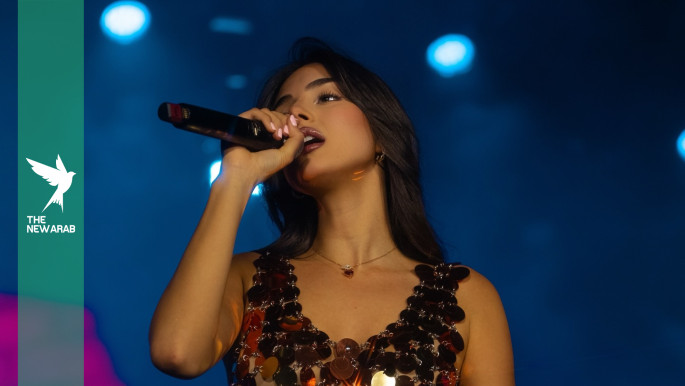
Earlier this year, 24-year-old Lebanese artist Tiara Wehbe was preparing to release a new single titled Shatara. But as Israel’s recent war on Lebanon unfolded — followed by a fragile ceasefire after a devastating period of violence that has killed more than 2,000 people — she decided to hold it back.
“I kept delaying the release of this next song because of everything happening in my country,” she shares with The New Arab. “When Lebanon is hurting, its ache lives in all of us Lebanese people.”
She adds that her father, half-sister, and much of her extended family are still living in Lebanon, explaining that what is happening there is not something she can observe from a distance or emotionally distance herself from.
Against this backdrop, her approach to music is naturally shaped by current realities. For Tiara, continuing to create is not about ignoring what is happening, but about finding a way to exist alongside it — using music to process difficult emotions while also offering moments of relief.
“I feel like we’re all deeply connected, and there’s a shared love that unites us no matter where we are,” she says, before explaining how music fits into that idea. “It’s one of the only ways we can escape — a way to feel good within ourselves, to disconnect from the heaviness, and reconnect with something lighter inside us.”
From this perspective, the themes in her music become more defined, with much of her work centring on confidence and self-assurance, particularly in how women perceive themselves.
“Women should feel really good about themselves — confident, a little sexy, and completely comfortable in who they are,” she says, describing a sense of ease in one’s own body and the freedom to enjoy oneself without overthinking it.
This idea sits at the centre of her more upbeat tracks; however, her music is not confined to a single emotional space, and it is here that her range becomes most evident.
For example, on Weili, heartbreak is reframed as something controlled and self-assured rather than purely vulnerable. Ana Beirut, released in 2021, shifts the focus towards her home city, serving as a tribute to its resilience. In contrast, Ahla Fatra takes a softer approach, focusing on intimacy and the experience of being deeply immersed in a relationship.
This variety in subject matter is also reflected in her sound. Tiara moves between Arabic pop, R&B, and darker pop influences, adapting her style to suit the mood of each track rather than adhering to a single genre, with these shifts feeling closely tied to the emotions she is expressing rather than separate from them.
Taken together, this versatility reflects how her approach to music has been shaped by an early and long-standing interest in performing.
“I’ve been singing for as long as I can remember,” she says, recalling how she and her friends would recreate shows like The Voice and The X Factor at home.
She also points to repeatedly watching Burlesque as an important influence, particularly the performances of Christina Aguilera and Cher, which helped shape her understanding of stage presence and commitment to performance.
The road to creative freedom
With her mother’s support, that early passion gradually developed into a more structured pursuit as she travelled between Orlando, New York, and Los Angeles, taking part in competitions and workshops that exposed her to different facets of the entertainment industry, from singing to acting and modelling.
Alongside this, she was already performing live shows across Lebanon while still at university.
However, despite this promising start, her entry into the industry was later hindered by obstacles that disrupted her creative momentum at a crucial stage.
“I just wasn’t around the right people… I had a really bad deal or person I was working with,” she shares. “So I wasn’t able to properly get into the studio and make the music I love.”
For an artist who identifies first and foremost as a creator, losing that sense of control was particularly difficult, as she explains: “I’m a creator, right? I create my own music… so the fact that I wasn’t able to do that was very frustrating.”
That period of restriction, however, ultimately led to a reset.
After moving on and finding the right collaborators, she began to reclaim her creative independence, stepping fully into the role of an artist who writes, shapes, and directs her own work.
“I’ve been making my own music for about a year and a half to two years,” she says, adding that she officially started releasing her work last summer.
As Tiara began to define her sound, her influences became more apparent — not just in genre, but in tone, mood, and visual identity.
“A very big influence for me would be The Weeknd and Lana Del Rey,” she says.
Her connection to Lana, in particular, reflects a deeper emotional alignment rather than simple admiration, as she explains: “I was so obsessed with her… I had an Instagram fan page for her when I was younger, and I would record covers and post them anonymously.”
What draws her to these artists, she explains, is their ability to build entire worlds around their music, adding, “I love their artistic vision, visually and sonically… Lana has a very cinematic quality.”
The duality behind the sound
This cinematic and atmospheric influence feeds directly into her own work, where sensuality and mood are central but never one-dimensional.
“My music is very sexy. I have very sensual flows and melodies,” she says. “But I also have a very emotional side.”
It is within that emotional dimension that her music begins to deepen. Moving beyond surface-level confidence into something more personal, her current releases lean into a playful, flirtatious energy, while she becomes increasingly interested in exploring the experiences that have shaped her identity over the years.
“I’ve never said this in any interview, but I think coming from a broken home makes you realise a lot of things about your character, about life,” she shares. “I want to have more of my emotions in my music.”
That duality — between outward confidence and inner complexity — is embedded even in her more upbeat tracks, with songs like Nawi Aaleih presenting themselves as light and flirtatious, built around teasing romantic exchanges.
“It’s about going back and forth with a guy… telling him, like, tell me what you want. It’s a very loving, funny, playful song,” she explains.
Yet even here, there is a deeper layer beneath the surface.
“Sometimes, I don’t really know what I want… or I just want what is not easy to have,” she says. “These are things where we realise we’re attached to external validation.”
From Pinterest to reality
This contrast becomes even more apparent in her track Shatara, where moments of vulnerability cut through an otherwise confident, assertive sound.
As she explains, “I sing in Spanish, and although some people may not understand the lyrics or look up the translation, if they do, they will see that I’m actually very soft on the inside — I’m just scared of getting hurt.”
For Tiara, language becomes a deliberate means of expressing vulnerability, allowing her to move between tongues to reveal different sides of herself and convey emotional depth beyond what is immediately apparent.
That same sense of personal expression extends naturally into her visual world, where her aesthetic choices mirror the emotions at the core of her music.
Speaking about her track Ahla Fatra, she says, “The music video is very me. I love the ocean, and I’m drawn to dreamy, euphoric colours like purple, lilac, and baby blue — those soft, atmospheric visuals have always inspired me. I was in a relationship at the time, so that feeling of love, affection, and the honeymoon phase comes through in both the song and the visuals.
“We even added a large moon in the background during the French bridge, which I loved. Most of the scenes are set by the beach, featuring sailing, boats, nature, and picnics surrounded by flowers,” she adds.
“It all comes from my Pinterest boards — ocean imagery, siren aesthetics, nature, beautiful dresses, the moon, and stargazing. It feels very true to who I am.”
The next chapter
Looking ahead, Tiara’s focus is on expanding both her sound and her storytelling, allowing more of her personal experiences to shape her music while continuing to experiment with language and genre.
“Touching on more personal topics… having more French- and English-dominated tracks,” she says. “I’m exploring and finding my sound.”
Among her upcoming releases is a personal track dedicated to her mother, rooted in a childhood memory, titled Je te regarde, je t’admire, which translates to “I look at you and admire you.”
“It was actually a lullaby that she used to sing to me… now I’m singing these words back to her,” she shares.
Despite the evolution in sound and subject matter, the core message behind Tiara’s music remains unchanged — one centred on self-worth, confidence, and emotional freedom.
“Being unapologetically and authentically yourself… not wanting to change or compare,” she concludes.
Zainab Mehdi is The New Arab’s Associate Editor and researcher specialising in governance, development, and conflict in the Middle East and North Africa region
Follow her on Instagram: @zaiamehdi_/@zainabmehdiwrites_