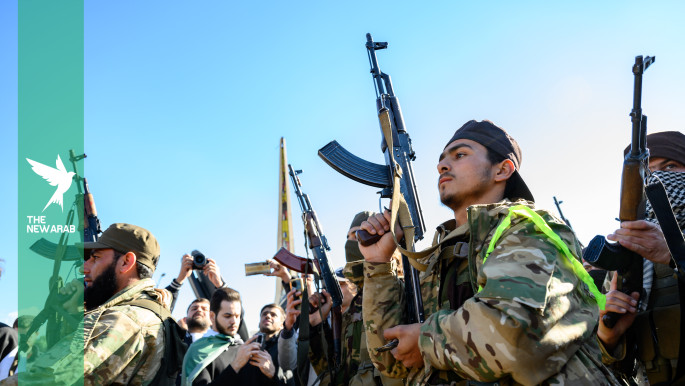
The arrest of an Uzbek foreign fighter by the Syrian government in Idlib last week, and the subsequent tensions, demonstrate the government’s precarious approach to one of Syria’s most sensitive topics.
The fighter’s detention, after allegedly firing his weapon in Idlib city, prompted crowds of Uzbek fighters to protest outside the city’s criminal investigations office, demanding his release.
According to local media, President Ahmed Al-Sharaa personally intervened, dispatching a senior military commander to meet with elders from the community in order to defuse tensions and negotiate an end to the standoff.
In the days after the incident, Syrian security services arrested 16 Uzbeks during security sweeps in the towns of Kafiriya and Al-Foua.
These tensions are not the first of their kind between foreign fighters in Idlib and the Syrian government.
In October 2025, following the alleged kidnapping of a girl, clashes broke out in Idlib’s Harem camp between the government and a contingent of mostly French fighters belonging to Firqat al-Ghuraba (Foreigners Brigade) – a group of foreign jihadists led by the French jihadi, Omar Omsen.
These events underpin the volatile nature of relations between the Syrian state and its community of foreign fighters amid latent tensions and a degree of mutual suspicion.
Syria’s foreign fighters
As the Syrian revolution descended into a bitter civil war, tens of thousands of foreigners – who are referred to as muhajirin (migrants) in Arabic – flocked to the country from across the world to take up arms against the Assad regime.
These muhajirin joined a number of largely Islamist groups, including the Islamic States (IS), as well as a number of other factions, some of which aligned themselves with Hayat Tahrir Al-Sham (HTS) – the armed faction led by Ahmed Al-Sharaa, which has now become the government.
The largest contingent of foreign jihadis – at around 3,500 people – remaining in Syria belongs to the Uyghur-majority Turkistan Islamic Party (TIP) – a key HTS ally which has now largely been integrated into the Syrian military’s 84th Division.
However, there are other factions, like those who follow Omar Omsen, who have resisted integration into the security architecture. Omsen’s Firqat Al-Ghuraba still operate their own police and court system within their camp in Harem.
The Uzbeks represent the second largest national grouping present in north-west Syria, however, unlike the Uyghurs, they are not centralised around a particular outfit and instead can be found among the ranks of a number of different armed groups, some of which are HTS-loyalists, whilst others have elected to keep the government at arm’s length.
Muhajirin frustration
The muhajirin represent some of the new government’s most hardened and effective fighters. They were integral to HTS’s ability to hold out against the Assad regime through many long years of relative international isolation and now act as a “vital pillar of support as the new government consolidates control over the country,” Issam Al-Reis, a military researcher with ETANA, a Syrian research group, told The New Arab.
Yet, there is some unease within these groups about the trajectory of Syria’s new government.
“There is a degree of disconnect between some of these foreigners and the new government, due to differing visions for Syria,” Aymenn al-Tamimi, an independent analyst and researcher, explained to TNA.
“HTS have been taking a nationalistic turn for several years and [the foreign fighters] generally support the application of Islamic law, rather than building a nationalistic project.”
This has created friction, with some prominent foreigners, such as the American Bilal Abdul Kareem, and the Uzbek, Abu Dujana Al-Turkistani, openly criticising the current government and its former manifestation as HTS.
“The government has taken a hard line on critics within these camps,” says Tamimi, with both Abdul Kareem and Al-Turkistani being arrested without explanation in 2025.
There are fears in some corners that Damascus may seek to sideline foreign elements under pressure at home and abroad. Such fears may be contributing to recent tensions, with this latest mobilisation not organised by a particular faction, but rather, a more spontaneous action by the community.
“There is a general sense of solidarity across the muhajirin,” explains Tamimi. “That they all have to look out for each other as they don’t necessarily have the same networks that Syrians might have tapped into to navigate the complexities of the civil war.”
During the clashes in October between the government and Omar Omsen’s ‘Foreigners Brigade’, groups of Uzbek fighters mobilised in defence of the French jihadists, and an eventual ceasefire was partly mediated via senior Uzbek commanders.
Despite that, there are “many foreigners who are outright loyalists and continue to stand by [Al-Sharaa],” says Tamimi. “They have also undergone a political transformation away from transnational jihad that mirrors Al-Sharaa’s own journey.”
Political sensitivities
The foreign fighters file is highly sensitive for the Syrian government, both at home and abroad. Foreign governments have raised concerns about the future of their respective foreign nationals – many of whom are wanted for terror offences – in the new Syria.
The presence of a large component of Uyghurs has complicated Damascus’ relations with Beijing. China’s ambassador to the UN has warned Damascus that it must prevent “terrorist forces” from using its territory to attack other countries – a thinly veiled reference to the TIP’s desire to secure independence from China.
Equally, the closure of Al-Hol camp – the notorious ISIS prison camp – in April, and the release of thousands of IS-linked families, have only raised further concerns in foreign capitals about the security risk posed by foreigners in Syria.
At home, many Syrians, especially members of Syria’s many ethnic minorities, fear the continued presence of these figures in Syria, who they see as the vanguard of the new regime’s most Islamist elements, and whom many blame for the ‘Islamisation’ of the Syrian revolution.
The purported role of foreign elements during the massacres targeting the Alawite community in March 2025 only served to deepen this fear.
Al-Sharaa, clearly aware of these sensitivities, ordered the foreign contingents, who were very visible in the streets of Syria’s cities at the time, to return to their bases in Idlib and northern Aleppo, in the days after the fall of Assad’s regime in 2024.
“Such decisions have been a bit shameful for these foreign fighters,” explains Al-Reis. “[They] fought to overthrow the regime, but they now feel like something that the government would prefer not to talk about,” he added.
“Ultimately, their concern is that they are vulnerable without citizenship, and they believe they are eligible for Syrian citizenship since most of them have been in Syria for over a decade.”
As a result, incidents like those that occurred in Idlib last week, which only serve to bring greater attention and scrutiny to the foreign fighter file, are likely frustrating for the government and its strategy of marginalising the issue.
Integration
The government is also working to legitimise the continued presence of the muhajirin by integrating them into Syria’s security architecture whilst extending legal recognition of their status through the provision of citizenship.
“The government wants them to be formally folded into the Ministry of Defence, which will place a proper command and control above them,” explains Aaron Zelin, a fellow at the Washington Institute for Near East Policy. “This will give the government a degree of administrative control over these armed groups.”
The Ministry of Defence’s 84th Division has become the designated unit for the government’s non-Syrian servicemen. Several muhajirin commanders have even been given senior positions within the army.
To Beijing’s chagrin, Abdul Aziz Dawoud Khodabardi, a Uyghur and head of the Turkistan Islamic Party, which seeks the independence of Xinjiang from China, was appointed as a Brigadier-General in 2025 – a position only a step below the Chief of Staff of the Armed Forces.
Despite some concerns, Washington reportedly gave the green light for the integration of these foreign fighters into the Syrian military, judging that it was safer to keep these elements inside the tent, rather than marginalising them.
“Some foreign fighters are reluctant to integrate into the military due to ideological reasons,” explains Zelin, “but this is a relatively small contingent of foreigners, and whilst it is sensitive, it is unlikely to directly threaten the government itself.”
Alongside this, the government may seek to normalise the legal position of foreign fighters in Syria. Al-Reis suggests that perhaps President Al-Sharaa “feels a personal debt” to many of these fighters for their role in supporting the toppling of the Assad regime. It remains unclear whether Syria’s government intends to extend citizenship to these muhajirin. If it indeed does, the last eighteen months have shown few signs of progress on the issue.
“Some foreigners may be looking at the relatively quick extension of citizenship to previously stateless Kurdish populations over the last few months and wonder why they are yet to receive it,” suggests Al-Reis.
Ultimately, the presence of these foreign groups is not something new for northwest Syria, “in many respects they are very well integrated,” explains Tam Hussein, an award-winning journalist who has reported extensively on transnational jihadist networks. “They own businesses, are known in the community and are integral to this part of Syria,” he said.
“Syria’s history is characterised by different waves of migrations,” he adds. “This is just part of that historical process, and so I don’t see these tensions as disrupting that at the end of the day.”
Cian Ward is a journalist based in Damascus, covering conflict, migration, and humanitarian issues
Follow him on X: @CP__Ward
Edited by Charlie Hoyle