
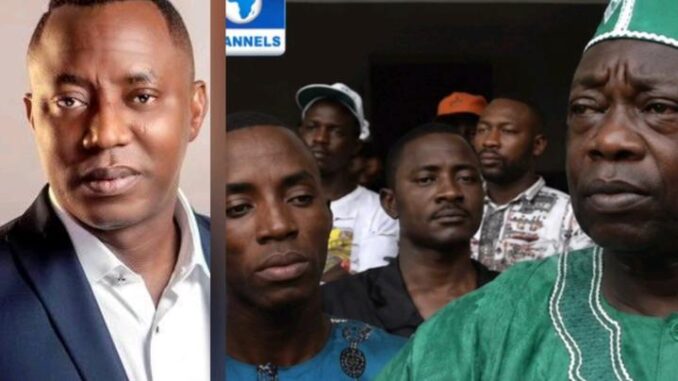
Human rights activist and former presidential candidate, Omoyele Sowore, has recalled an encounter involving the late Chief MKO Abiola and Channels Television founder, John Momoh, during the political crisis that followed the annulment of the June 12, 1993 presidential election.
According to a report by Arise News, Sowore shared the account while reflecting on his involvement in the pro-democracy movement as a student activist during the military era.
Speaking during the interview, Sowore recounted how he and other student activists visited Abiola’s residence in 1993 to discuss the struggle over the annulled presidential election, which had been widely regarded as one of the freest and fairest elections in Nigeria’s history.
Describing the events of that day, he said, “The owner of Channels TV wanted to interview Abiola, and I stood behind him to assure him that I support his mandate.”
“John Momoh came with a cameraman. He was the only journalist there at the time, and he introduced himself before asking to interview Chief Abiola,” Sowore recalled.
According to him, Momoh’s visit came at a tense moment in the country’s political history when pro-democracy activists were mobilising against the annulment of the June 12 election by the military government.
Sowore said he deliberately positioned himself behind Abiola throughout the interview as a visible demonstration of solidarity with the late politician and the democratic mandate many Nigerians believed had been denied.
“I stood behind him deliberately because I wanted him to know that we, as student activists, were solidly behind his mandate,” he said.
He noted that student activists played a significant role in the nationwide campaign for the restoration of Abiola’s mandate, despite the risks associated with confronting the military authorities.
Reflecting on the atmosphere at the time, Sowore said, “Those were very difficult times. Many of us believed that the mandate given to Abiola by Nigerians had to be defended.”
According to him, many young Nigerians considered the struggle a fight to preserve democracy rather than support for a single individual.
“We were prepared to stand with him because we believed that the will of the Nigerian people should be respected,” he added.
Sowore stressed that the June 12 movement united people from different backgrounds who shared a common commitment to democratic governance and constitutional rule.
He argued that the sacrifices made by activists, journalists, civil society groups, and ordinary citizens contributed significantly to Nigeria’s eventual return to civilian rule in 1999.