
Beirut, Lebanon – A large, white scar stretches up Yousef Atwi’s left calf. His vision in his left eye is permanently damaged, the pupil clouded with a thin, milky film – injuries Atwi attributes to white phosphorus.
The 73-year-old sat at the edge of his bed, his voice low as he recounted the incident to The New Arab.
It was the summer of 2024, and like most summers before, Atwi was harvesting watermelons on his family’s land in Khiam, a mountaintop village on Lebanon’s eastern border with Israel.
Then, without warning, a jet flew overhead, showering a white chemical over the rows of ripe watermelons.
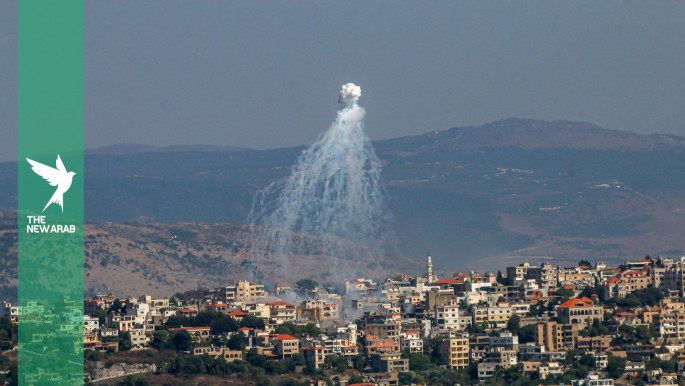
White phosphorus is a highly reactive chemical used in military operations, which Israel has repeatedly and unlawfully deployed in Lebanon.
Upon contact with the air, the chemical ignites spontaneously. When it comes into contact with skin, it burns the tissue to the bones, consuming the flesh as long as it is exposed to oxygen.
A scalding pain engulfed Atwi, and he looked down to see his left leg aflame, his trousers melting into his charred flesh.
“It burned, it burned, it burned,” Atwi emphasised. His eyes stung, and his vision blurred, and he choked as he inhaled the smoke. With his last strength, he hobbled to a nearby pond and dropped into the cool water.
Atwi’s wife, who asked to remain anonymous, was in their home that day, in the city centre. She smelled a sulfate-like odour and saw a tail of white smoke drifting toward the village, rushing to close the windows before it could seep into her home, she recounted to The New Arab.
Atwi’s friends rushed him in the back of their pickup to a hospital in Saida, where he said the doctor confirmed he had been injured by white phosphorus.
Israel’s ‘unlawful’ use of white phosphorus
Ahmad Baydoun, an architect and PhD researcher in the Netherlands, has documented and mapped almost 250 white phosphorus strikes by Israeli forces between October 2023, when Israel and Hezbollah began launching frequent cross-border attacks, and November 2024, when a ceasefire agreement was signed.
These attacks stretched across 372 hectares of land – equivalent to about 530 soccer fields.
Baydoun recorded four strikes in Khiam in June and July 2024, but The New Arab was unable to match any of them to the strike described by Atwi and his wife.
However, he told TNA his count reflects only strikes with visual confirmation of the distinctive white phosphorus burst at the moment of impact, a verified minimum, not a complete record.
The absence of a matching strike does not mean white phosphorus was not used in the incident Atwi described, but that there was no footage to meet his confirmation method, he added.
Nearly 40% of the strikes Beydoun documented struck residential areas – a pattern that human rights groups say raises serious questions about the legality of Israel’s use of white phosphorus.
Ramzi Kaiss, the Lebanon researcher for Human Rights Watch (HRW), told The New Arab that under international law, white phosphorus can be used on the battlefield for a number of tactics, including to create a smoke screen, hide the movement of troops, or to mark a certain area, but that “it becomes unlawful when used over populated areas”.
The toxic airbursts can spread over 125 to 250 meters, which makes it “unlawfully indiscriminate”, or unable to distinguish between a military target or civilian object, he said.
Between October 2023 and June 2024, HRW verified Israel’s deployment of white phosphorus in at least 17 municipalities in south Lebanon, including five where the munitions were unlawfully used over populated residential areas.
More recently, HRW documented Israel’s unlawful use of white phosphorus over homes in the southern Lebanese town of Yohmor on 3 March, 2026.
A New York Times investigation also verified Israel’s unlawful use of white phosphorus over populated areas in Lebanon, including on 30 May in Nabatieh, as well as near the coastal city of Tyre, and in three southern villages, including in Atwi’s village, Khiam.
Israel, on multiple occasions, has denied using the weapon illegally.
Burns tissues from the inside
In her office at the AUB Medical Centre’s emergency ward, Dr Tharwat Zahran – a medical toxicologist and co-director of the hospital’s toxicology service – flipped through photos showing the hospital’s preparations to treat white phosphorus injuries: a decontamination tent pitched outside the hospital, a row of showers, and a blue, full-body chemically resistant suit.
White phosphorus is not new to the hospital. In 1982, it admitted patients with phosphorus burns after Israel showered West Beirut with the chemical, according to The Washington Post.
Lebanon’s health ministry said exposure to white phosphorus had injured at least 173 people between October 2023 and May 2024. HRW’s Kaiss noted that most injuries were a result of asphyxiation.
Dr Zahran noted that patients in south Lebanon have suffered respiratory issues from secondary exposure to white phosphorus – inhaling the lingering smoke when they returned to check on their homes after an attack.
White phosphorus typically causes two types of burns – thermal and chemical – which make them particularly severe, Dr Zahran explained. When the chemical ignites, it can cause a deep, second- or third-degree thermal burn.
And when white phosphorus interacts with water, or any humid substance – including the mucous membranes lining the nose, mouth, and lungs – it releases phosphoric acid, a corrosive substance that can chemically burn tissues from the inside, she explained.
This reaction means that a person exposed to white phosphorus fumes can develop chemical pneumonitis, Dr Zahran said, which often requires long-term hospitalisation and intensive care, just due to inhalation.
If a patient is seen for white phosphorus, the first step is decontamination, she said, which involves washing the patient with soap and water before they enter the hospital. Then, doctors must remove any fluid-filled sacs, or bullae, covering the burn, as these remain toxic, filled with the chemical.
Doctors will attempt to remove all white phosphorus particles, placing them immediately into water, so they do not reignite, she continued.
Lingering fragments of white phosphorus can exacerbate wounds even after treatment, enter the bloodstream and cause multiple organ failures, and can reignite when dressings are removed and wounds exposed to oxygen.
After the initial treatment, a silver sulfadiazine cream is prescribed, standard for thermal and most chemical burn treatments, Dr Zahran added. Other long-term treatments for white phosphorus burns may also be required, such as the removal of thick scab tissue or plastic surgery for deep burns.
Atwi’s wife pulled out her phone to show a photo she took of Atwi’s injury weeks after the attack. A thick, crusted, white scab still covered his raw skin.
Looking at the photo, Dr Zahran said it was possible that Atwi was injured by white phosphorus, but could not confirm, given the late stage of Atwi’s injury in the photo and the fact that she could not examine him in person.
‘Everything was gone’
White phosphorus can also contaminate land for decades, leaving behind toxic chemicals that erode its fertility. Atwi’s land has been passed down through his family for generations, and was the source of his livelihood, but may now be unusable for generations to come.
He described his land as fertile and green, where he planted “all types of vegetables” and tended to around 70 olive trees. When Atwi was able to return to his land after the attack, the entire harvest was lost. “Everything was gone. There was nothing left,” he said.
Hassane Makhlouf, a professor of soil science and microbiology at Lebanese University, told The New Arab that from October 2023 until the November 2024 ceasefire, white phosphorus strikes had damaged around 2,000 to 2,500 hectares of land.
Since the recent escalation on 3 March, Makhlouf estimates that an additional 1,000 hectares of land have been impacted, but noted that the ongoing conflict has prevented extensive testing from taking place.
Lebanon’s National Council for Scientific Research in June told the Lebanese daily, L’Orient Le Jour, that “no fewer” than 173 hectares of land were set ablaze by white phosphorus strikes in 2026.
Makhlouf said that when white phosphorus interacts with moisture in the soil, it transforms into phosphoric acid, which lowers the soil’s pH and depletes it of minerals – a reaction similar to what occurs when white phosphorus comes into contact with human mucous membranes.
He expressed concern about the long-term accumulation of white phosphorus in the soil, with Israel having deployed it in south Lebanon “for over 30 years” – and especially since 2023.
“If there is a significant accumulation [of white phosphorus], we will lose the biological activity, and the soil may become unsuitable for agriculture,” he said. He added that white phosphorus could also seep through the soil into groundwater, impacting irrigation and drinking water and posing health risks to the population.
Other experts interviewed by L’Orient Le Jour, however, said the long-term environmental impacts of white phosphorus may be overstated.
Makhlouf added that other toxins from Israeli strikes, such as heavy metals and herbicides, which Lebanon accused Israel of spraying over southern villages in February 2026, may have equally harmful effects to white phosphorus.
Hence, Makhlouf has developed a treatment which would reintroduce beneficial bacteria into the soil, working to counter the effects of the toxic chemicals. Yet restoring the soil will require government support and an end to the conflict – and neither appears imminent, he stated.
‘Israel wants to take this land’
As for Atwi, he hopes to return and regrow his land. But life won’t be easy, he said. A bulldozer overturned many of his olive trees, and the jars of olive oil he had planned on selling likely now lie shattered under the rubble of his home.
His wife pulls up another photo, one that shows their house, before it was destroyed this April: a large, white, two-story home. She said it was a close-knit neighbourhood, where she was surrounded by family. They would visit each other often.
“We’d all sit outside, under the house, and gather to cook together,” she said. “We’d go down to the field to pick our crops, then eat and share with the neighbours.”
Now, she says, all of that is gone. “My children, my grandchildren, and I are all living through the same suffering,” she said. “[Israel] wants to take the land. It’s fertile, and there’s water. They don’t have water there, but South Lebanon is a paradise.”
Atwi, still with high hopes to return to Khiam, stood up and walked to a small corner of the room, where he pulled out a key – the key to his home. A broad smile spread across his face as he held the keys up, dangling them in the air.
Hanna Davis is a freelance journalist reporting on politics, foreign policy, and humanitarian affairs
Follow her on Twitter: @hannadavis341
Edited by Charlie Hoyle