In a deeply embarrassing development for Baghdad, Israel established two forward-operating bases (FOBs) for supporting air campaigns against Iran on federal Iraqi territory in a flagrant violation of Iraq’s already fragile sovereignty.
The Wall Street Journal reported the first base’s existence, in the barren Nukhaib desert southwest of the Shia shrine cities of Najaf and Karbala, on 9 May. The New York Times further revealed Sunday that Israel also set up a second base somewhere else in the country’s western desert regions that it operated for over a year and even used during the June 2025 12-day war.
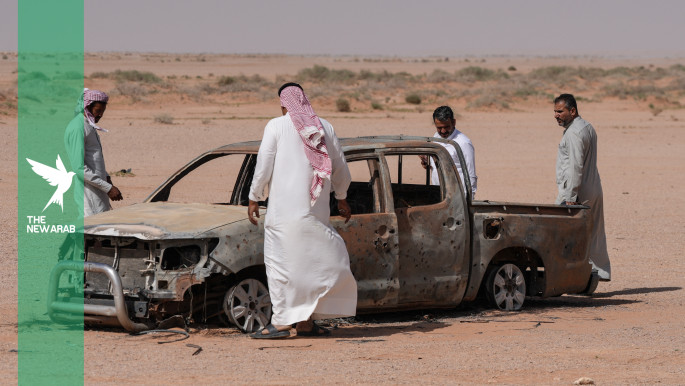
A Bedouin shepherd accidentally stumbled upon one of the bases on 3 March and alerted the Iraqi military, a move his family believes resulted in his subsequent death. An Iraqi reconnaissance mission dispatched the following day was bombed, killing a soldier and injuring two others.
In Baghdad, some pinned the blame on former Prime Minister Mohammed Shia’ al-Sudani, and Iraqi officials accused the US of helping conceal the first base.
Raised stakes
Caroline Rose, a Senior Director at The Soufan Center, noted that the desert region near Najaf and Karbala was always perceived as “a strategic site to conduct covert, special operations,” adding that the Israeli presence was of great significance.
“While the base appears to be small in scale, only accommodating special forces and emergency rescue responders, it’s the ability for Israel to establish a physical presence that ultimately raises the stakes for both Iran and Iraq,” Rose told The New Arab on Wednesday, preceding the revelation of a second base.
“For Iran, this represents increased vulnerability as Israel demonstrated a capacity to establish a foothold in a neighbouring country – without a secured agreement with the Iraqi government-and dodge detection of its presence for months,” she said.
“For the Iraqi government, this ultimately creates greater pressure from both Iran and Iran-backed groups operating in the country, forces that had long called for American withdrawal and more aggressive positioning against Israel.”
Ceng Sagnic, US Director of the Jerusalem Center for Security and Foreign Affairs and chief of analysis at the geopolitical consultancy firm TAM-C Solutions, outlined the various reasons Israel required FOBs in Iraq.
Israel’s large-scale air campaign with the US, which saw a staggering 250 Israeli jets surging into Iranian airspace on the war’s first day, necessitated an “immense level of support operations”.
And Israel, unlike the US, doesn’t have any known access to regional bases, including American ones.
Also speaking before the NYT report on Sunday, Sagnic told TNA that it was unlikely Israel established only one makeshift FOB for the Iran war, adding that it might’ve been the only one subsequently dismantled, “which is why we know about it”.
Kristin Ronzi, a Middle East and North Africa analyst at the risk intelligence company RANE, outlined how the location of these bases “provided significant secrecy and facilitated covert operations” due to their “remoteness and distance” from cities. Furthermore, “Israeli airstrikes provided cover and helped conceal” them, she told TNA.
Nothing to see here
After the WSJ report, Baghdad scrambled to save face, launching a publicised operation in the area with the unsubtle codename ‘Imposing Sovereignty’. On 12 May, Iraqi Army Chief of Staff General Abdul Amir Rashid Yarallah visited the area of the first base with a senior military delegation.
“Iraqi officials have tried to downplay the reports because the situation puts Baghdad in a diplomatic predicament as it balances ties between the US and Iran,” Ronzi told TNA.
“Furthermore, the establishment of an Israeli military base within Iraqi territory is a significant embarrassment for Iraqi security forces and exposes their vulnerabilities,” he added.
“Yarallah’s military delegation is likely a way to demonstrate the military’s presence in the area, further downplay these reports and try to move past this.”
Rose similarly assessed that Yarallah’s delegation was a way to “reassert Iraqi control and insight into local security conditions”.
“This represented a key blind spot for the Iraqi federal government and a key point of contention both with Iran and Iran-aligned groups within the Popular Mobilisation Forces (PMF) – a network that the US is putting pressure on Baghdad to disempower and disassemble,” she said.
“By sending a security detail to investigate local developments, Baghdad is seeking to reassert the image that it is in the driver’s seat.”
Ronzi expects that US knowledge of the Israeli presence could “further entrench pro-Iranian factions’ political positions” in Iraq, shifting them further towards Iran. Additionally, it simultaneously “risks emboldening” Iraqi nationalists to push for reduced US-Iraq relations.
“Even so, there will likely still be pragmatic Shiite factions and other minority groups that do not want to risk a diplomatic confrontation with the US, especially since the US holds significant economic and security leverage over Iraq,” she said.
“Even though the incident will likely anger Iraqi factions across the political spectrum, many will still want a more pragmatic approach to dealing with it, likely through more rhetorical and symbolic means, if publicly addressed.”
The US troop presence in Iraq, now confined to the autonomous Kurdistan Region, has been authorised by Baghdad since the US returned to Iraq in 2014 to help combat the Islamic State (IS). Conversely, Iraq never had diplomatic relations with Israel and would never authorise any Israeli military presence.
“With no Status of Forces Agreement or any sort of arrangement for an Israeli military installation – whether permanent or temporary – in Iraq, this does represent a breach of Iraqi sovereignty, though it is not the first time that Iraq has been used for operations against Iran,” Caroline Rose said.
Sagnic views this as part of the central Iraqi government’s general inability to control “vast patches of its territory” and lack of capacity to establish such control anytime soon.
Israel wouldn’t have serious difficulty exploiting this vacuum, secure in the knowledge that the Iraqi government was unlikely to “have even gathered information about the existence” of FOBs on its soil.
Furthermore, the revelations indicate that Iran was unable to detect either base, which Sagnic assesses further cements “suspicions that, contrary to its propaganda, the Iranian regime is incapable of geospatial intelligence collection beyond internet-based navigation data and maps”.
Historically unprecedented
Ronzi noted that while Israel has conducted operations in Iraq before, this incident was truly unprecedented. Establishing military bases within federal Iraqi territory and “seemingly without the Iraqi government’s knowledge” represents a “brazen breach” of Iraqi sovereignty.
“Previous incidents of Israeli violations of Iraqi sovereignty, in addition to this latest one, indicate Israel’s capability to operate within Iraqi territory,” Ronzi said.
Sagnic argued that it’s fair to say that “technically” the incident represents the “only documented operational Israeli military presence” on Iraqi soil.
“Other than limited-scale and advisory roles played by different Israeli agencies and the military in support of the Kurds in the 1970s, and of course the airstrikes since the 1960s, no other documented operational military presence or activity of Israel was reported from Iraq,” he said.
Israel was long known to have destroyed Iraq’s Osirak nuclear reactor in Baghdad in a historic June 1981 airstrike. Much more recently, it’s widely believed to have carried out strikes against Iraqi militia-related targets in 2019.
Scapegoating Sudani
“The accusations against Sudani are likely in part because he was the caretaker prime minister at the time of the incident and amid speculation that the Iraqi government was complicit in US efforts to conceal the base,” Ronzi said.
“But there is also a degree of Sudani’s political rivals capitalising on the speculation and ongoing accusations to place the blame for the incident not just on him but also on his allies in the national security and intelligence communities.”
Sagnic reiterated that the Iraqi state system is “far from any position” to “weigh itself” against regional rivals, with its strength instead assessed through internal power rifts with the Kurdistan Regional Government and little else.
Consequently, no one in the central government “reasonably expects intact sovereignty,” with the flagrant Israeli breaches treated as “yet another political tool” mainly for domestic consumption.
“The revealed Israeli operation inside Iraq is also likely to be used in that same local power struggle, with accusations traded among rival figures as if anyone could have detected that base, let alone stopped it,” Sagnic said. Yarallah’s visit and accusations against Sudani should be “read in that context” as well.
“The revelation is therefore unlikely to have a broader impact on Iraq-US relations, or even Iran-US relations, because both Tehran and Baghdad have no choice but to downplay it,” Sagnic added.
“Inside Iraq, it will simply add another line item to the long list of political disputes among rival factions.”
RANE’s Ronzi anticipates that Iraqi security forces will “increase their presence” in more remote parts of the country and conduct “internal investigations into Iraq’s national security and intelligence services,” although the Iraqi government will “likely continue to downplay” the whole affair.
She concluded by predicting that while political rivals will likely capitalise on these revelations to some extent, “over time, it will likely largely blow over”.
Paul Iddon is a freelance journalist based in the Middle East who writes extensively about the region’s affairs, conflicts, and politics
Follow him on Twitter: @pauliddon
Edited by Charlie Hoyle