WASHINGTON, April 25 – The first indications that something had gone wrong at the 2026 White House Correspondents’ Association dinner came around 8:35 p.m. on Saturday from a series of audible but mysterious thuds.
Dinner chatter paused.
The silence was broken when the doors crashed open to the giant ballroom at the Washington Hilton, where some 2,600 journalists and their guests – dressed with rare pomp in tuxedos and gowns – had just sat down for the salad courses and glasses of wine. President Donald Trump was seated with first lady Melania Trump, Vice President JD Vance and other dignitaries at a long head table.
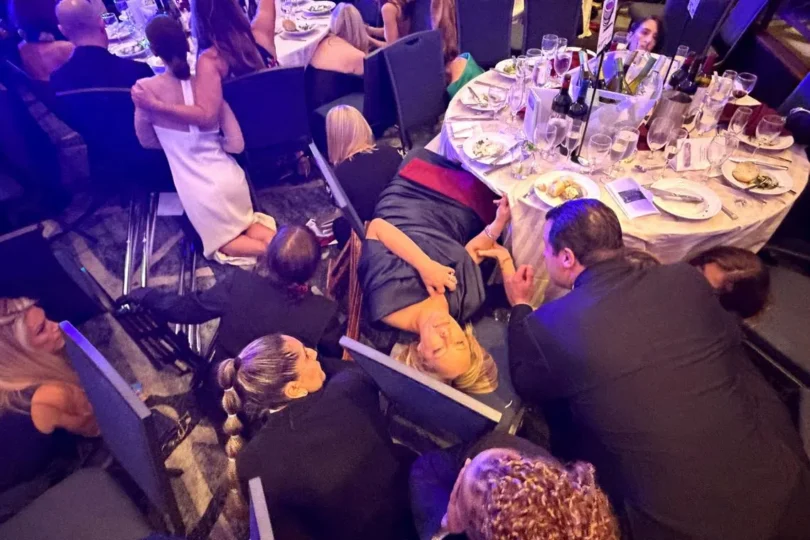
Elegantly uniformed waiters soon charged down the middle aisle. Agents hustled Vance and several others off the stage. Plainclothes officers sprang from their seats and pushed to the ground several cabinet members, who had been seated moments earlier at tables among the journalists, then rolled the administration officials beneath tables.
Other officers drew handguns. Still others materialized seemingly from nowhere in full tactical gear, long guns trained on the astonished, alarmed attendees, most of whom were diving to the floor, crawling under tables and chairs for safety.
Trump and the first lady barely moved at first as chaos erupted around them.
“I thought it was a tray going down,” Trump told reporters in a White House press conference hours later.
But it was no service mishap. Authorities later said a gunman with multiple weapons had charged through a security checkpoint the floor above the ballroom, in the same hotel where another lone gunman, John Hinckley Jr., had shot President Reagan as he left an event in 1981.
The suspect in Saturday night’s shooting, identified by a law enforcement official as Cole Allen, a California teacher who was staying at the hotel, allegedly fired rounds from a shotgun that struck a Secret Service agent before he was tackled by police.
Within the ballroom, Secret Service agents soon descended on Trump. The president crouched as they got him out of his chair and stole glances toward the center of the room, where other agents stepped across chairs and tables to reach remaining dignitaries.
Personnel in combat dress swarmed the ballroom stage. Secretary of State Marco Rubio was quickly shuttled away. Agents shoved Homeland Security Secretary Markwayne Mullin into a side room and led House Speaker Mike Johnson away while tugging on his tuxedo jacket.
Several ball attendees began chanting, “USA! USA! USA!”
Then a roomful of journalists, rising uneasily from the ground where they had spent several unnerving minutes, began to work. Smartphones slid from pockets. Cameras clicked on. Some 2,600 people tried to figure out what exactly had happened. Rumors swirled. Reporters struggled for WiFi access. The password for the event’s network, many suddenly learned, was “MOREWINE.”
Backstage, Trump insisted the show must go on, telling leaders of the White House Correspondents’ Association that he still wished to deliver remarks. Instead, the Secret Service convinced Trump to return to the White House. The dinner was off. The president pledged to resume the event within the next 30 days.
Meanwhile, agents sealed the doors to the ballroom, which grew increasingly warm. Nearly an hour after the shooting, Education Secretary Linda McMahon left the hotel with her security detail.
Gentlemen undid their bow ties. Ladies slid off their high heels. Weijia Jiang, a White House correspondent from CBS News and president of the White House Correspondents’ Association, asked guests moments later to depart the Hilton.
As they did, onlookers at the hotel bar stood by the exits. Their phones were out, recording. REUTERS