President Bola Ahmed Tinubu has directed the Minister of the Federal Capital Territory (FCT), Nyesom Wike, to allocate a suitable parcel of land in Abuja for the development of the Abdulsalami Abubakar Africa Resource Centre (AAARC), in recognition of the former Head of State’s contributions to peace, democracy and national……
President Bola Ahmed Tinubu has directed the Minister of the Federal Capital Territory (FCT), Nyesom Wike, to allocate a suitable parcel of land in Abuja for the development of the Abdulsalami Abubakar Africa Resource Centre (AAARC), in recognition of the former Head of State’s contributions to peace, democracy and national development.
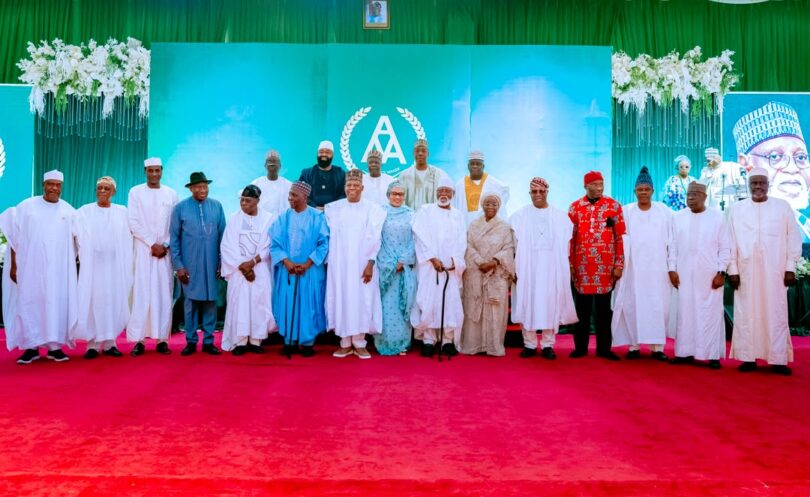
Tinubu gave the directive on Saturday in Abuja during the public presentation of three books — Call of Duty, Nigeria’s Grand Patriot and Mediating for Peace in Africa — organised in honour of former Head of State, General Abdulsalami Abubakar (retd), as part of activities marking his 84th birthday anniversary.
Represented by Vice President Kashim Shettima, the President described Abdulsalami as a statesman whose life has been defined by duty, moderation, courage and unwavering commitment to public service.
According to a statement by Stanley Nkwocha, Senior Special Assistant to the President on Media and Communications in the Office of the Vice President, Tinubu said the former military leader continues to play a vital role in promoting peace, national unity, democratic stability and responsible political engagement through the National Peace Committee.
READ ALSO: Abdulsalami, Bago Join Worshippers for Eid Prayers in Niger
The President said the establishment of the Abdulsalami Abubakar Africa Resource Centre aligns with the values the elder statesman has championed throughout his life.
“The establishment of the Abdulsalami Abubakar Africa Resource Centre is a worthy initiative that aligns with the values General Abubakar has championed throughout his life.
“In recognition of its importance, I hereby direct the Honourable Minister of the Federal Capital Territory to allocate a suitable parcel of land within the Federal Capital Territory for the development of the Centre and the advancement of its mission,” Tinubu said.
The President noted that Abdulsalami occupies a unique place in Nigeria’s history, particularly for overseeing the transition from military rule to democracy in 1999.
“At a moment of profound uncertainty, when Nigeria stood at a crossroads, providence entrusted him with the responsibility of leadership. He understood both the weight of that responsibility and the demands of the moment. He pledged to return the country to democratic rule, and he fulfilled that pledge faithfully and honourably,” he said.
Tinubu described the transition programme supervised by Abdulsalami as one of the greatest services rendered to Nigeria by any leader, noting that it gave birth to the Fourth Republic, the country’s longest uninterrupted democratic era.
He also recalled that his own return to active political participation was influenced by Abdulsalami’s sincerity and commitment to restoring constitutional rule.
“Like many pro-democracy activists of that era, I returned to participate in the democratic process because I was convinced of General Abdulsalami Abubakar’s sincerity and determination to restore constitutional rule.
“He kept his word and, as a result, helped steady the ship of state, preserved national cohesion, and guided our country safely towards democracy,” the President said.
Tinubu added that millions of Nigerians, including those currently serving in public office, remain beneficiaries of the democratic foundation laid during Abdulsalami’s stewardship.
Delivering the keynote address, former South African President, Thabo Mbeki, said Abdulsalami’s sacrifices and commitment to democratic governance and peacebuilding had contributed significantly to stability across Africa.
Mbeki commended the former Nigerian leader for resisting pressures to cling to power and instead choosing to entrench democracy and peacebuilding.
Chairman of the occasion and former Head of State, Yakubu Gowon, said Abdulsalami’s leadership during Nigeria’s transition to civilian rule remains one of the continent’s most remarkable democratic achievements.
He described the elder statesman’s mediation efforts across Africa as legendary and urged younger generations to emulate his patriotism and selfless service.
Former President Olusegun Obasanjo said Abdulsalami had continued to play a stabilising role in Nigeria through his peacebuilding initiatives, while former President Goodluck Jonathan described him as a remarkable statesman devoted to national and regional peace.
Also speaking, Julius Maada Bio, who is Chairman of the ECOWAS Authority of Heads of State and Government, said the three books launched in honour of Abdulsalami reflected a life dedicated to service, patriotism and leadership.
According to him, history remembers leaders not for the power they wield but for their willingness to relinquish power in pursuit of a greater national cause.
In her remarks, Fatima Lami Abubakar, wife of the former Head of State, expressed gratitude for the recognition accorded her husband and described him as a peace-loving man committed to both family and national service.
Responding, Abdulsalami thanked President Tinubu and Vice President Shettima for supporting the commemorative event.
He recalled assuming office in 1998 when Nigeria faced significant political uncertainty and noted that the successful transition to civilian rule was achieved within 11 months.
The former Head of State urged Nigerians to continue promoting peace, justice and national unity in the interest of national development.
The event also featured goodwill messages from Senate President Godswill Akpabio, United Nations Deputy Secretary-General Amina Mohammed and representatives of former Ghanaian President Nana Akufo-Addo.
Donations announced during the book presentation included N500 million from businessman Aliko Dangote, N250 million from BUA Group Chairman Abdul Samad Rabiu, N100 million from the Senate and N50 million from the House of Representatives, alongside contributions from governors, commercial banks and other dignitaries.