

The chancellor insists that the indefinite delay of the stationing had nothing to do with his row with the US president
Chancellor Friedrich Merz has confirmed that the US will not station Tomahawk long-range cruise missiles in Germany in the foreseeable future. He insisted that the suspension had nothing to do with his row with President Donald Trump but was rather caused by inadequate stockpiles.
Merz made the remarks in an interview with ARD on Sunday, saying that the promise given by then-President Joe Biden will be left unfulfilled.
“The Americans themselves don’t currently have enough,” Merz said, adding that there was “hardly any way” for Washington to transfer the systems at present. At the same time, he noted that it is “not too late” for the deployment.
The original plan was announced in July 2024 by Biden and then-Chancellor Olaf Scholz. A joint statement said that the US would begin “episodic deployments” of long-range fires from its Multi-Domain Task Force in Germany in 2026, including SM-6 missiles, Tomahawks, and developmental hypersonic weapons, with a view to long-term stationing.
Merz insisted that the U-turn was not related to his criticism of Trump, including remarks in which he said that Washington “obviously has no strategy” in the Iran war and that the US “is being humiliated by the Iranian leadership.” At the time, Trump fired back, claiming Merz “doesn’t know what he’s talking about” and advising him to focus on “fixing his broken Country.”
As the row intensified, the Pentagon announced the withdrawal of around 5,000 US troops from Germany, with Trump suggesting the number could be even higher.
At the same time, the US is indeed struggling with depleting stockpiles. In late March, CBS News reported, citing sources, that the US had used more than 850 Tomahawks in the Iran conflict, roughly nine times the Pentagon’s average annual procurement rate.
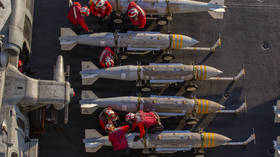
The Tomahawk is a long-range cruise missile launched mainly from ships and submarines. The US Navy says Block IV and V versions can fly about 900 nautical miles, or 1,600 kilometers, and carry a 1,000-pound-class (450kg) conventional warhead.
You can share this story on social media: