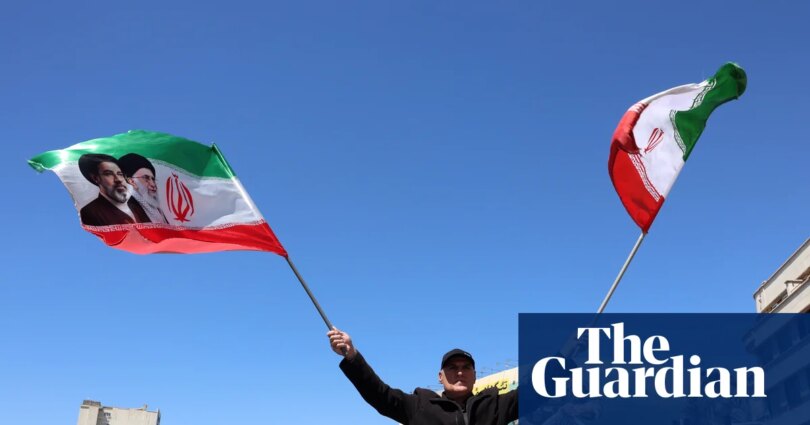
Donald Trump has claimed that the infighting between moderates and hardliners in Iran’s leadership is so intense that the country has “no idea who their leader is”, but many Iranian experts questioned his analysis, saying that – given the mass assassinations of senior commanders – the country has shown remarkable institutional cohesion.
Trump’s allegations of “CRAZY” splits in the Iranian leadership – the second outing for this argument in three days – is remarkable since he has previously said either he has little knowledge of the new Iranian leadership or that there has already been regime change.
But Trump’s team, either through Pakistani mediators or more direct contacts, may be picking up that different factions are demanding different preconditions for the talks to restart. Trump at a minimum is implying that military hardliners have taken charge from the civilian diplomatic leadership.
It is hardly a secret that Iran has been riven for decades over how to approach the US and the wisdom of negotiations, but some Iranian academics and observers are accusing Trump of cognitive warfare: attempting to create what Mohamed Amersi, a member of the Global Advisory Council at the Wilson Centre, described as “chronic systemic paralysis in which the country’s decision making machine becomes deadlocked”.
Ali Ansari, a professor of modern history at St Andrews, said Iran, if not experiencing a leadership vacuum, is at least a country in transition since the newly installed – and apparently badly injured supreme leader Mojtaba Khamenei – has not yet been able to establish his authority, a process that took his father and predecessor Ali Khamenei many years.
““We are not quite sure if he is all there and even if he is all there, whether he will be able to consolidate his position and authority in the way that his father did,” Ansari said.
Ali Alfoneh, a senior fellow at the Arab Gulf States Institute, said Iran had been moving towards a more collective leadership in the final two years of Ali Khamenei’s life. “He was getting older and unwilling to take responsibility for unpopular measures or ones that he could not justify in religious terms such as not enforcing the hijab,” said Alfoneh.
Mojtaba Khamenei has said little in detail about the talks or the ceasefire, but one indicator of his frame of mind may be his appointment as military adviser of Mohsen Rezaee, one of the most unreconstructed of the former Islamic Revolutionary Guard Corps (IRGC) commanders and an opponent of a ceasefire.
Hassan Ahmadian, an associate professor of west Asian studies at the University of Tehran, denies there are any fractures in the country’s leadership.
“The Iranian political system is very institutionalised. Name another system whose top echelon is assassinated and is capable of continuing and also waging a retaliatory war effort against two big foes. I do not see any historical parallel to this,” Ahmadian said.
He added: “For every institution in Iran there is a parallel institution and that makes it easier to withstand shocks.”
He said that Iran has united around a new strategy born of war that focuses on using the leverage provided by the strait of Hormuz to fight Trump’s pressure.
“The strait is the key … If there is a fair deal, we will get sanctions relief and reparations and in exchange Iran will bring in the IAEA [the UN nuclear inspectorate] and dilute the highly enriched uranium.
“Moreover, we are saying if you violate your commitments, we have a changed mentality. In 2018 [when Trump pulled out of the nuclear deal] Iran did not have a lot to offer. At this point we do, so we are talking Trump’s language. It is very effective. As you target our people, we will target the pockets of your people,” he said.
Ahmadian said Trump’s claims of a divided command were a form of psychological warfare and argued that senior leaders widely agreed on the refusal to negotiate until the US ends its blockade of Iran’s ports.
That policy, he said, derives its strength from being hammered out by the 13-strong supreme national security council (SNSC), the governing body that, far more than the political cabinet, brings together all the forces inside Iran: judicial, political, military and intelligence.
The Israeli decision to assassinate the SNSC secretary, Ali Larijani, may turn out to be counterproductive, since it removed the most capable, pragmatic and experienced figure in Iranian politics, who might have been able to forge a consensus negotiation strategy. Mohammad Bagher Zolghadr, his replacement as secretary, does not have the same breadth of experience, and is a veteran IRGC commander.
To the extent that anyone has taken on Larijani’s cohesive role, it is the speaker of the parliament, Mohammad Bagher Ghalibaf. Sometimes described as a “modernising autocrat”, he was appointed head of the Iranian delegation to Islamabad, overseeing the foreign minister, Abbas Araghchi, a skilled diplomat who would work inside pre-determined parameters.
In recent, widely praised TV interview, Ghalibaf laid it on thick how successful Iran has been, but also made clear the country cannot continue in the same vein. Making the case for negotiation, he argued Iran may have won the battle, but it may not be able to win the war.
He cautioned against exaggerating Iran’s leverage, stressing that US military superiority and capabilities should not be underestimated. Iran had to negotiate, a position not shared.
In all this, the elected Iranian president, Masoud Pezeshkian, has been sidelined. The reformist leader has been deputed instead to keep the home front operating, and has been kept from the details of the negotiations.
Prof Ansari argued some of the tensions on how to negotiate reflect IRGC concern to protect essential interests – including its extensive business empire. He said: “The real danger for the Islamic republic is not war but peace, for then there will be an auditing of what the hell happened – especially if the economic situation is extremely difficult as it is expected to be.”